

Army Wants Faster Movement On Deal For Hawaiʻi Live-Fire Training Lands
The Army secretary said he asked Gov. Josh Green’s office for a list within the next few weeks of things the military can do to help the community.
This story was written by AP writer Audrey McAvoy.
SCHOFIELD BARRACKS, Hawaii (AP) — The U.S. Army’s top civilian leader says he wants to move more quickly on an agreement that will allow the military to continue using the only large-scale live-fire training range for ground forces in Hawaiʻi.
Army Secretary Dan Driscoll said Tuesday that he discussed the issue during a meeting with Gov. Josh Green the previous day. The Army leases a key part of Pōhakuloa Training Area on the Big Island from the state, and its contract to do so expires in 2029.
It wants to be able to continue using the land so it can quickly send troops from Hawaiʻi to Asia and the Pacific, something that is growing in importance as China becomes more assertive particularly regarding Taiwan, the self-ruled island that Beijing claims as its own territory.
A May public hearing on whether to extend the lease generated hours of testimony against allowing the Army to stay. Many Native Hawaiians and environmental activists upset with the U.S. military’s history of damaging Hawaiian lands with target practice and fuel leaks said they wanted the Army to return the land to the state.
Driscoll told reporters the Army needs the Pōhakuloa land, which sits on a rocky plateau about 6,200 feet above sea level between the Big Island’s tallest volcanoes, Mauna Kea and Mauna Loa.
“The world is changing. We all know this. The threat in Indo-Pacom is more real than ever before,” Driscoll told reporters, referring to the U.S. Indo-Pacific Command, which overseas military operations in Asia and the Pacific.
He said he wanted a more aggressive timeline “to bake out these negotiations in the coming months, rather than waiting until 2027, 2028 and 2029.”
“This land matters to the United States Army. We have got to be able to train here.” Driscoll said.
Driscoll said he asked Green’s office for a list within the next few weeks of things the Army can do to help the community.
“What we are hoping to do is figure out ways where we, the Army, can continue to contribute to a community that has given so much to our Army and so much to our nation, while at the same time acknowledging the very real world threat that we are facing in the Indo-Pacific,” Driscoll said.
The Army says other live-fire training areas in Hawaiʻi are too small to accommodate battalions and brigades. And commanders say they wouldn’t be able to deter potential adversaries in the Indo-Pacific if they have to spend extra time transporting troops to the region from U.S. mainland training ranges.
Green said he spent significant time on Monday speaking with Driscoll and his team.
“We will be exploring possibilities on the military leases together in the coming days and weeks, and he now better understands how important it is to us to work together for the good of Hawaiʻi’s people and our land, while we all work together protect our country,” Green said in a statement.
The governor said he updated the state’s congressional delegation on the meetings. Green said he would get the community’s input “as we move forward.”
U.S. Rep. Jill Tokuda, a Democrat whose district includes rural Oahu and the Big Island, has said she wants the military to help increase Hawaiʻi’s housing supply and bolster the island state’s water and sewer infrastructure.
Healani Sonoda-Pale, a community organizer with the Native Hawaiian sovereignty group Ka Lāhui Hawaiʻi, said the state needs to look at how the Army is managing these lands. She said it would be irresponsible for negotiations to bypass that process.
“There shouldn’t be any backdoor discussions regarding these leases,” she said.
Driscoll visited Hawaiʻi during a Pacific trip that will include stops in Australia and the Philippines.
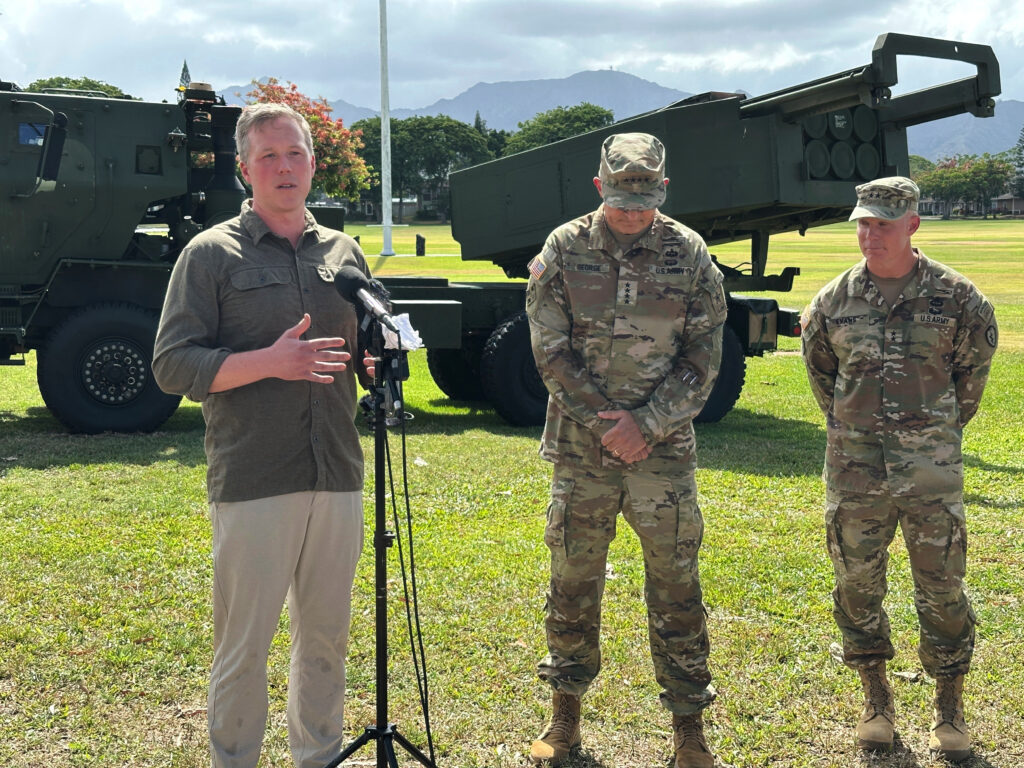
He spoke to journalists in front of two HIMARS rocket launchers, which are designed to deliver precision strikes to long-range targets. Hawaiʻi-based soldiers with the 25th Infantry Division are due to receive 16 of the launchers, which the U.S. also supplied to Ukraine to help it defend against Russia’s invasion.

