Hawaiʻi Needs New Tech To Clean Up Old Bombs
Magnetic detection can only go so far in an island chain made of volcanic rock. Experts say other methods could be a game-changer.
For decades, clearing heaps of unexploded bombs, spent ammunition and other potentially dangerous ordnance from former military training sites has relied on little more than advanced metal detectors.
In Hawaiʻi that presents a unique problem: The detectors throw off false positives because they can’t tell the difference between the targeted debris and metallic rocks that naturally appear in volcanic soil.
“It’s about 50% effective, which is not very good,” said Andrew Alling, a University of Hawaiʻi College of Engineering student.
This summer, Alling is part of a team of students and professors — joined by the university’s official drone squad — that will test methods of detecting unexploded ordnance that don’t rely on magnetic fields.
The effort comes at an opportune time, just as the U.S. Army has given notice that it intends to return to the state the vast majority of the lands it leases for training on Oʻahu. That includes more than 780 acres of the nearly 4,200-acre Mākua Military Reservation, which community members and cultural practitioners have pressed the Army to return for decades as it promised to do in the 1940s.

Organizers with the nonprofit Mālama Mākua have estimated it would take decades to clear all the bombs, bullets and chemicals that riddled the Mākua Valley during the live fire drills that continued there until 2004.
However, they’re hopeful the UH team might offer a breakthrough on detection of unexploded ordnance, also known as UXO.
“If this detection equipment is redesigned and calibrated and it works,” Mālama Mākua advocate Vince Dodge said, “and it’s going to save them (the Army) time and money.”
That would be a contrast from the current reality at the Waikoloa Maneuver Area on Hawaiʻi island where, when crews often push large carts outfitted with magnetic sensors across a rugged World War II-era training site, Alling said, “the entire map just turns red” with detections.
“It’s all a target,” Alling said of the volcanic landscape.
Getting The Team Together
Later this year, the College of Engineering, along with UH Mānoa’s Hawaiʻi Institute of Geophysics and Planetology, expects to receive a two-year, $6 million grant from the Army Engineer Research and Development Center to expand their work, according to Alling.
The money will fund professors, principal investigators, research assistants and all the field equipment. The dollars would have arrived sooner, Alling said, but it got held up in the Trump administration’s recent withholding of federal research funding.
During that delay, the UH team got a jump on its work anyway.

The UH Drone Technologies Team started flying drones equipped with infrared cameras at the Kawai Nui model airplane field on Oʻahu’s Windward side and the UH baseball field in Mānoa as part of its early tests.
“We’ve essentially just transformed that team, like as of this summer, into the UXO team,” Alling said. The group is testing whether thermal imaging might eventually do a better job than metal detectors. It’s also looking into acoustic and seismic-based imaging as possible solutions.
The team also is exploring how to make the metal detectors more accurate, he said, by calibrating them based on the iron levels in the soil at different sites.
Long-time weapons disposal technician Allan Vosburgh called the quest to find better UXO detection methods for the islands “the Holy Grail.”
Vosburgh is a Vietnam veteran and the CEO of Golden West Humanitarian Foundation, a nonprofit that works on technology to address the unexploded mines and other “remnants of war.” He called the UH endeavor “a good project, particularly given the potential for the Army turning over property here in Hawaiʻi that could be fairly contaminated,” including Mākua.
A Pervasive Problem
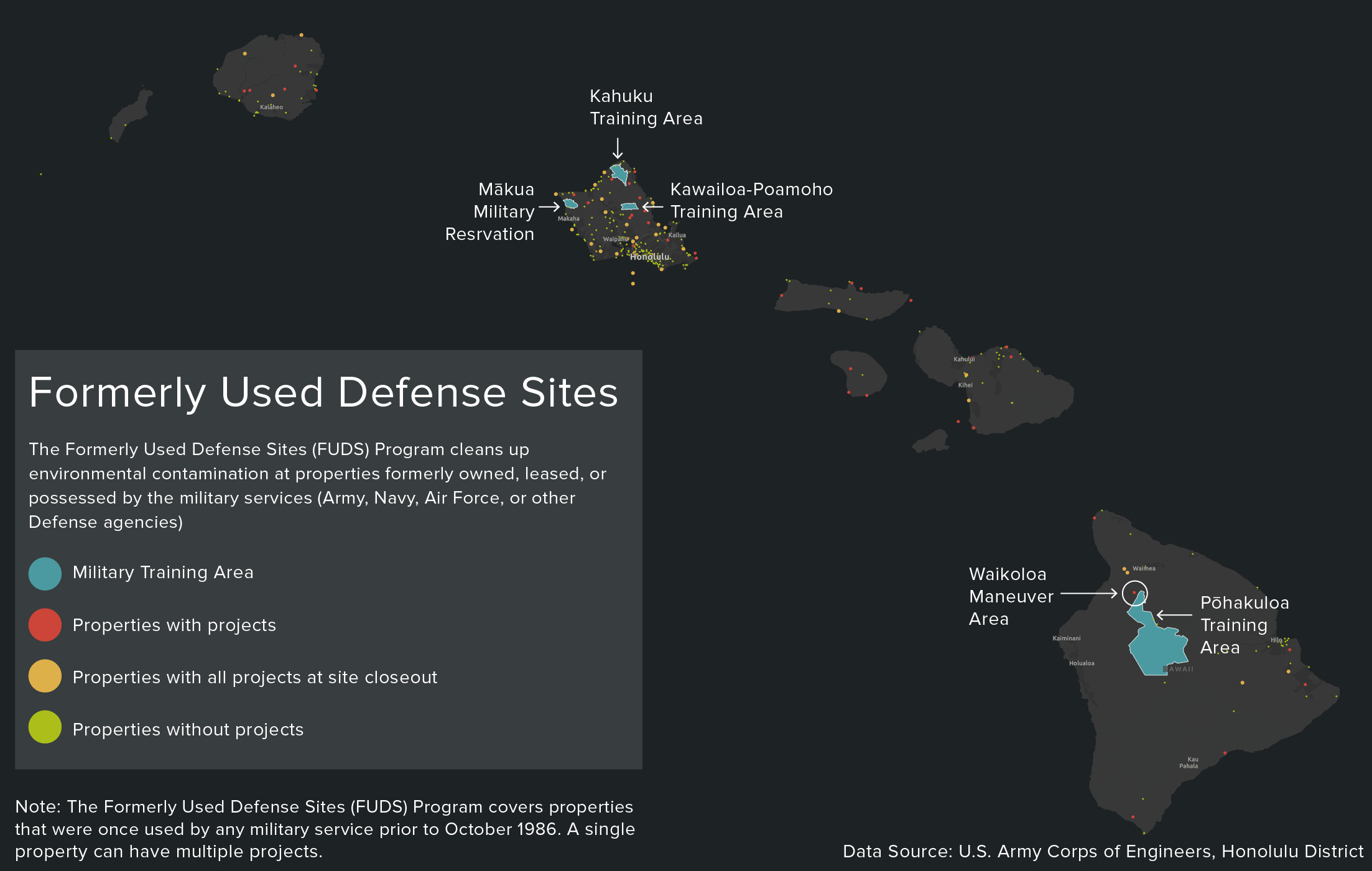
More than 300 “Formerly Used Defense Sites” are scattered across the Hawaiian Islands, according to the U.S. Army Corps of Engineers’ Honolulu District. They represent areas leased or owned by the military for training before 1986 that need environmental cleanup including, in many cases, UXO clearing.
That tally doesn’t include Hawaiʻi’s largest and most notorious military bombardment site: Kahoʻolawe. That’s because bombing on that leeward island didn’t stop until 1990. Nor does it include the Mākua Military Reservation, where live fire didn’t cease until 2004, or Pōhakuloa on the Big Island, where live-fire training continues in the shadow of Mauna Loa.
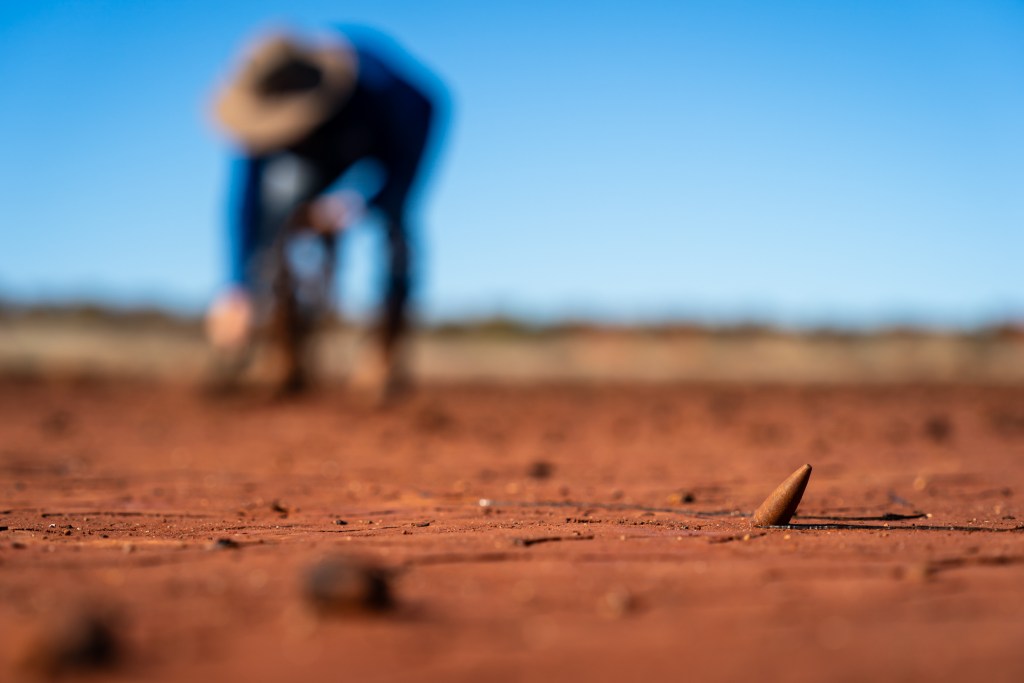
Removing all of the spent ordnance scattered across Kahoʻolawe’s rugged landscape has proven a vexing task, costing the U.S. Navy more than $340 million over two decades ago to clear 75% of the island’s surface.
During test sweeps carried out during that cleanup era, magnetic sensors only located the sample targets buried in the Kahoʻolawe volcanic soil half of the time, according to a 2005 Defense Department report.
Kahoʻolawe Island Reserve Commission Director Michael Nahoʻopiʻi met recently with the UH team and said their work has a lot of potential. He cautioned, though, that any new and improved detection methods need to make sense financially for the contractors hired to carry out the cleanups.
“There’s a lot of things to be done out there,” Nahoʻopiʻi said. For the Kahoʻolawe cleanup, “I wanted them to understand why we didn’t go down that high-tech road.”
Contractors working on the Kahoʻolawe cleanup project would have gotten around to testing new technology if it didn’t have a 10-year horizon, he said. That might have included acoustic detection and radar to enhance the magnetic images of what lay on and just below the surface.
The Navy also needed to show Congress quick results, Nahoʻopiʻi said, to keep the funding flowing.
Contractors did experiment with an overhead detection drone on Kahoʻolawe during the federally mandated nearly decade-long cleanup, he said, but it crashed in strong wind gusts there. He noted that drone technology has vastly improved since then.
Nahoʻopiʻi added that the Navy did improve its data collection using magnetic sensors during its Kahoʻolawe cleanup project, which ran from 1997 to 2004.
In Mākua, Dodge and other activists are anxious to see the valley returned to the community.
For more than 20 years, they’ve mostly had to settle for limited, bimonthly guided visits into the area, under a unique “cultural access” agreement with the Army. Military technicians accompany those groups to ensure they don’t tread over any uncleared UXO.
The hazards that remain there were made soberingly clear in 2015, when two landscapers contracted by the military were injured after one of their weed-whackers struck some of that debris on the ground, triggering an explosion.
“We want it back, you know. We need this ʻāina to feed us again, to grow food, and to have water flowing back into the ocean,” Dodge said. “The Army has kuleana (responsibility) here. They used the valley for 80 years, and so they need to see it through. They need to put up the money to ensure that whole valley, ultimately, is cleaned.”
Civil Beat’s coverage of environmental issues on Hawaiʻi island is supported in part by a grant from the Dorrance Family Foundation.