Farming Dispute On North Shore Highlights Zoning Challenges
Hawaiʻi needs more locally grown food, but plans for a vertical farm and aquaculture operation near Sunset Beach Park violate zoning rules and threaten the community character, critics say.
Philip Mislinski lives on an acre of land in Pūpūkea with a big mango tree, a papaya grove and panoramic views of Sunset Beach from his deck. It’s a quiet neighborhood of 1- to 3-acre properties and a signature North Shore country feel.
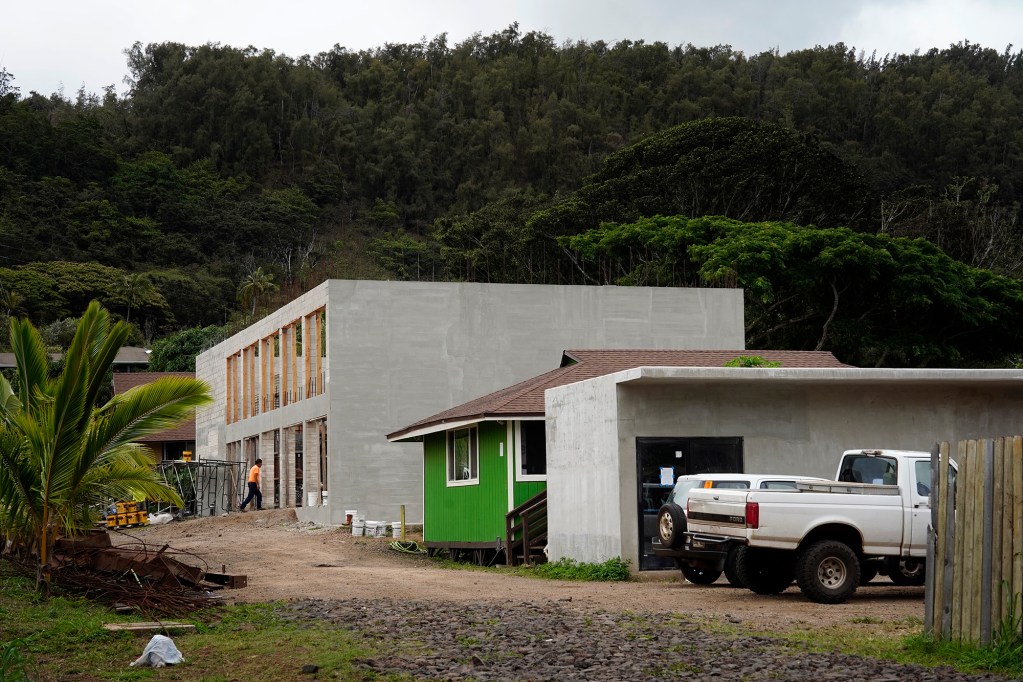
The community’s rural character is maintained by zoning regulations limiting urban density and encouraging small-scale agriculture. But Mislinski says the concrete structure rising above the banana trees next door goes well beyond what is allowed and threatens the community’s character.
In a lawsuit filed last month, Mislinski argues the Department of Planning and Permitting erroneously approved a permit for his neighbor, Ahmad Ramadan, to construct a vertical farm and processing facility with multiple aquaculture ponds, a roadside stand and an accessory dwelling unit to house up to five farmers.
Disputes over agriculture in Hawaiʻi are common, but they are usually flipped: Protests over developers seeking to turn farmland into housing or wealthy residents engaging in gentleman farming — buying land meant for ranching and growing food to build homes and enjoy large swaths of empty space.
At a time when the state is looking to increase food production on its agricultural lands, Ramadan’s project could produce local food for his local restaurants. But some, including the area’s state representative, argue country-zoned land isn’t the place for such a project.
Ramadan, who also used to operate a food truck on the property, also has a history of permit violations and residents have complained about his use of the land for years, including raw sewage flowing from the property in 2010 and 2016, city records show.
“I see how things happen on the North Shore … I don’t want a large-scale shrimp and tilapia farm right next door,” Mislinski said. “And if you let someone get up and running, it’s a 20-year battle to get them shut down.”
Ramadan declined to comment.
‘A Fine Line To Walk’
North Shore state Rep. Sean Quinlan said the issue comes down to a lack of enforcement by the planning department and raises questions about what should be allowed on country-zoned land.
Country plots make up just 5.6% of Oʻahu’s land and are concentrated on the North Shore, Waiʻanae and Kahaluʻu.
The plots, which generally range between 1 to 3 acres, aren’t large enough for any profitable production. But they could allow a family to sustain themselves. It’s a fine line to walk though, said farmer and North Shore neighborhood board member Racquel Achiu.
“You wouldn’t really be able to push the whole agro-tourism, business kind of thing. It’s really set to try to address the self-sustaining person,” she said.
The plots near Mislinski in Pūpūkea have small vegetable gardens, fruit trees and chickens. Surplus is normally traded between neighbors, Mislinski said.
Ramadan is a restaurateur who grew up eating fresh food in Hawaiʻi. He owns Da Spot, a healthy cafeteria-style eatery near the University of Hawaiʻi Mānoa with satellite locations on various UH campuses.
He also operated a free meal service during the Covid-19 pandemic, though it was shut down by the Department of Health for improper temperature controls and inadequate hand-washing stations.
Ramadan’s construction permit says he plans to build a vertical farm and processing facility, multiple aquaculture ponds, a roadside stand and an accessory dwelling unit to house up to five farmers.
It states the farm will produce vegetables and herbs, and raise shrimp and fish for Ramadan’s restaurant. The roadside stand will sell any excess food he grows as well as houseplants. Ramadan also has plans for over 20 parking stalls on the property.

Mislinski filed his first request for the planning department to launch an investigation into the current construction effort three years ago when he noticed crews laying a concrete foundation.
“They came out and inspected. They didn’t stop him. He just kept going and he built the roadside stand,” Mislinski said.
The planning department did issue a stop-work order in 2024 and required Ramadan to obtain a special management area or SMA permit — a prerequisite for developing in a coastal zone. He also has a permit to dig the aquaculture ponds. But he still needs building permits and other approvals for the rest of his project.
In his SMA permit, Ramadan states he plans to pursue after-the-fact approval for the structures he’s built, something that is legal according to the planning department’s website.
The vertical farm building, a two-story concrete structure, is nearly enclosed. An existing shed has been turned into an accessory dwelling unit and the roadside stand has all four walls and a door.
Mislinski has filed multiple requests for investigation over the construction and called the police over a dozen times in the last two years to stop crews working at night and on holidays, according to police records.
“To bring DPP up to speed on what’s going on has chewed up countless hours of my time,” Mislinski said. “But I’m having to do research and constantly bother DPP … Half the time, I don’t even hear back.”
A Lack Of Enforcement
Ramadan bought his North Shore property in 2006 and has a history of county ordinance violations.
When Mislinski purchased the home next door in 2020, Ramadan had already racked up 16 notices of violation and orders to halt construction and the operation of a food truck from the planning and permitting department. Violations ranged from operating an unpermitted shrimp truck, construction without permits, using a shed to house people and multiple instances of raw sewage flowing from the dwellings on the property.
Ramadan has received three more violation notices since Mislinski moved in. Two for the unpermitted construction of the vertical farm building and another for using the shed as a residence.
In his suit, Mislinski argues that Ramadan’s plans aren’t allowed for country-zoned properties, and that the businessman’s construction effort should be subject to a more rigorous public review required of major projects.
Some of the uses Ramadan proposes are permitted by the county’s land use ordinance. Aquaculture and crop production are allowed. Beyond size requirements, there’s nothing banning vertical farms. But his plan for animal and produce processing isn’t permitted, according to the county’s land use ordinance.
He can have a roadside stand. However, it needs to be unenclosed without running water or electricity. What’s sold in the stand must also be grown on the property, which is tricky if he intends to sell houseplants because a nursery is not allowed under the land use ordinance.
The county’s statutes allow for one dwelling per acre, but his plans call for two dwellings in a 1-acre space. The statutes also say farm worker housing isn’t allowed — something his plans call for.
The planning department’s approval letter for the SMA permit states that the project was only reviewed and approved pursuant to special management zone rules. The approval doesn’t constitute compliance with other requirements and regulations, like the land use ordinance.

SMA permits are required to avoid permanent losses of valuable natural resources in fragile coastal areas. The permit DPP approved was for minor development — a project with less than $500,000 in costs that poses no threat to the environment. Ramadan valued construction at $290,000.
But Mislinski believes his neighbor severely undervalued the project to avoid the lengthy and public process a major permit requires.
Quinlan says he’s received dozens of emails from neighbors complaining. He wrote a letter to DPP urging it to take a closer look at Ramadan’s property in June.
“So many people look at North Shore as just an opportunity to make money, where there doesn’t seem to be a lot of oversight,” Quinlan said.
When DPP does issue violations and fines to those who ignore the rules, Quinlan said, that doesn’t seem to slow them down.
Achiu of the neighborhood board agrees.
“Most of their action is based off complaints because they just don’t have the manpower or the capacity to enforce randomly,” Achiu said.
The department has improved some in recent years, Achiu said, but change never seems to happen fast enough.
The department has been plagued by slow approval times and weak enforcement for years. Some have chosen to develop without permits instead of waiting for one. Fines are issued, but don’t stop determined developers.
DPP declined to comment due to the ongoing litigation.
Mislinski has gone back and forth with the department, emailing the director and requesting investigations on DPP’s website. Since filing the lawsuit, he’s put in further requests but construction continues.
“In my perfect world, we would have a lot more enforcement with more teeth,” Quinlan said. “Because that’s a really quiet little neighborhood, and people just want to have their peace of mind.”
“Hawai‘i Grown” is funded in part by grants from the Stupski Foundation, Ulupono Fund at the Hawai‘i Community Foundation and the Frost Family Foundation.