

Fix It! Roosters Love The Waikīkī High Life But Neighbors Don’t Love Them
Responsibility for managing feral chickens on Oʻahu varies from property to property.
Marina Kamahele has noisy, messy neighbors, and even for Waikīkī, these guys take the cake.
She estimates more than a dozen are camped out next door to her place sometimes, and like clockwork, they make a racket around 5 a.m. every morning for at least an hour, she said.
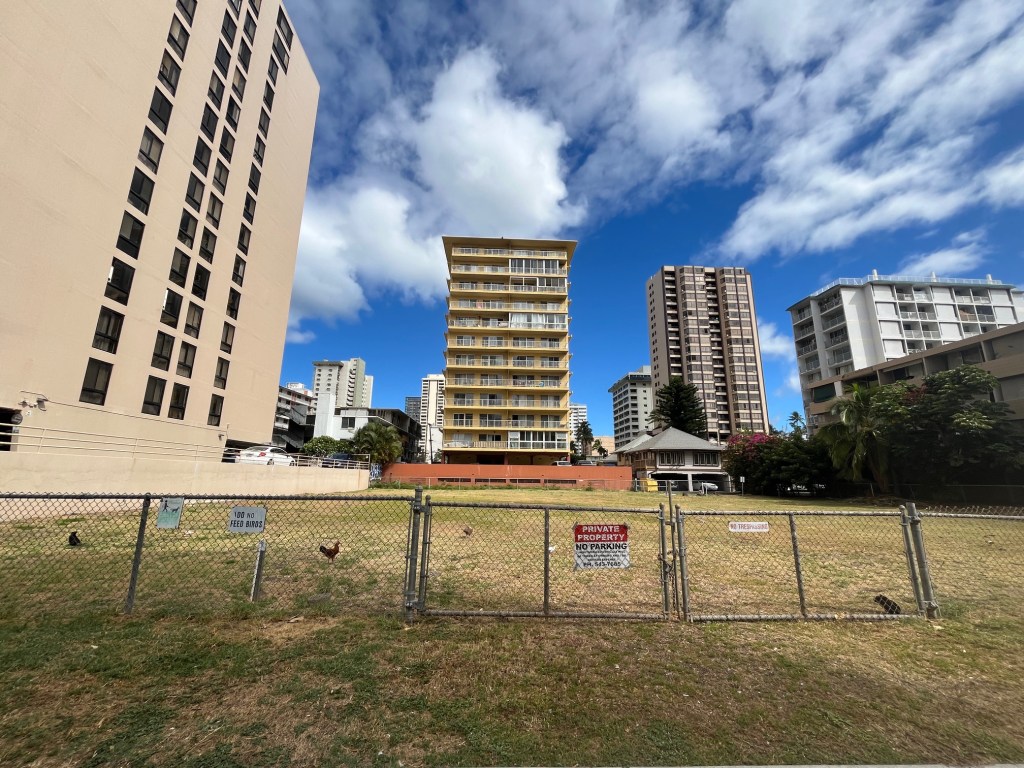
The chickens don’t suffer from a lack of space. Their home is a palatial 17,000 square-foot lot valued at $4.6 million with views of the Ala Wai canal.
But Kamahele said six roosters crow at all times of the day, and unimpressed by their swagger and involuntary wakeup calls, she looked for help to get her neighbors to clean up their act.
She quickly discovered that a pecking order exists when it comes to feral chicken control depending on whether the pests are on state, county or private property.
If the chickens were hanging out in a state park or a public school or library, the relevant state department would be the point of contact.
But in this instance Kamahele took a guess and started with the City and County of Honolulu.
The city’s Department of Customer Services politely punted the issue in an email, as Honolulu is only responsible for feathered foragers on city parks and golf courses.
In this case the owner of the property turns out to be Hawaiian Electric Co., but Kamahele told Civil Beat she hadn’t received a response to an email she sent them.
HECO has investigated reports of chickens living on the property 302 ʻŌhua Ave., the company’s media relations manager, Darren Pai, said Thursday in an email. “Our security teams have visited the site multiple times but did not see any chickens at the time of their inspections.”

And that is the problem – these foragers are notoriously mobile. It took two attempts (and an early morning stakeout) by a Civil Beat photographer to verify their presence last week.
Pai also said the company has the property listed for sale, and teams will continue to maintain the lot while they go through the process.
Photos show the lot is well maintained, but Kamahele thinks that could actually encourage the feathered visitors.
“What’s distinguishing about this lot is that Hawaiian Electric keeps the weeds low as a grass lawn because the lot is for sale … I think this is why the birds and fowl like this lot. Something they like to eat thrives in the shorter weeds,” she said.
HECO will reinspect the ‘Ōhua Avenue lot after Civil Beat’s inquiry, Pai said, and it would trim back overhanging branches from trees on an adjoining property that have created shade area where chickens and other birds may be roosting during the day.

Kamahele is off-island for now, but via email she said if the problem persists, her next move might be to file a noise complaint with the Waikīkī District police station when she returns.
The Honolulu Police Department handles initial noise nuisance and excessive poultry complaints on private property and calls on the Hawaiian Humane Society for assistance if needed.
Private property owners of all types can make use of the city’s cage and disposal service that’s been in place since September, 2023, customer service department spokesman Harold Nedd said in an email Friday.
“We have not closed our eyes to the feral-chicken issue, tried to shrug it off, or made excuses not to get involved,” but all levels of community and government need to be engaged in a coordinated effort, he said.
The department’s fact sheet has more information on the existing resources for feral chicken control.

Who Can Be Contacted?
Joanna Markle is Hawaiian Electric’s customer ombudsman. Her number is (808) 543-2550.
Update: Kapālama Hale Gets A Site Visit
A Fix It! published two weeks ago highlighted the state of the parking lot at the city’s satellite city hall at Kapālama Hale. The busy lot is scarred and rough driving, and traffic directions are confusing.
And the city agrees.
As promised, the Department of Facilities Maintenance conducted a site visit to evaluate repaving there after the story published, information specialist Chassity Santiago said in an email Friday.
“We are currently working to finalize a plan with our work crews and local asphalt producers that will allow us to complete the repaving of the parking lot with minimal disruption to the hundreds of people who travel to Kapālama Hale every week for services provided by the City,” she said. A start date is still to come.
Seeking More Tips For Fix It!
Tell us where the problem is, as specifically as possible. A cell phone photo would be helpful. Here are ways to get in touch:
You can submit in minutes using this form.
You can send us an email at news@civilbeat.org. Put “Fix It” in the subject line so it doesn’t get lost among the many other news tips we receive.
You can send a letter to the newsroom at P.O. Box 10857, Honolulu, HI 96816.
We won’t use your name without your permission but, if we pursue your fix, we will get back to you with what we find.

