Will Political Uncertainty Force Hawaiʻi’s Native Birds ‘Into Oblivion’?
Nonprofits are doing what they can to fill pukas left by the widespread firings, but they don’t have the resources to match those federal agencies.
Ever since the federal budget ax came for wetland and forest protection jobs earlier this year, nonprofits and private groups have been trying to fill the gap in hopes that the government would soon see the error in its ways.
But with limited resources, several of their leaders said, those efforts can only go so far and for so long.
“We’re not a long-term substitute for federal funding; it’s just not possible,” said Peter Stine, president of the nonprofit Friends of Hakalau Forest. “But we do everything that we can.”
Yet the threat to the work has not gone away.
Some of the local U.S. Fish and Wildlife Service and National Park Service employees who were fired in February managed to get their jobs back as legal challenges to the cuts moved through the courts. Some could lose their jobs again, however, as the threat of more cuts looms.

Others, meanwhile, opted not to return to their posts because the situation was so volatile.
“There was no job security,” said Steven Minamishin, who worked as a maintenance lead for the Kauaʻi National Wildlife Refuge Complex before his ouster through the Elon Musk-led DOGE cuts.
“It’s backward,” he said. “For decades, it was the federal government that was the secure job.”
Minamishin, who’s Native Hawaiian and considers himself a steward of the land, said he’d consider rejoining the agency under a different administration but “as far as right now, there’s no way.”
The situation could adversely impact an already troubling outlook for Hawaiʻi’s four waterbird species: the ae’o, or Hawaiian stilt, ’alae ke’oke’o, or Hawaiian coot, the ’alae ‘ula (Hawaiian gallinule) and the relatively more well-known koloa maoli — the Hawaiian duck. It could also have a lasting effect on other imperiled birds across the islands.
At Hakalau, Stine said, the DOGE cuts brought Fish and Wildlife employees down from 17 to 11 left managing that 32,000-acre protected forest on the Big Island.

Those crews erect fences to keep out pigs, goats and wild cattle, he said, plus check for mosquitoes that can spread deadly malaria among songbirds in the forest’s upper reaches and plant native koa trees after a century of cattle operations led to massive deforestation there.
“It never ends,” Stine said. “It takes a lot of effort, a lot of labor.”
The Friends organize as many as 12 field trips a year into the forest to pitch in, plus they’re raising an endowment to support that work. “We just fill in and help as much as we can where the most urgent needs are,” Stine said, but “long-term this isn’t really sustainable.”
He and others leading Hawaiʻi-based conservation nonprofits weren’t sure how much longer they could make up for the loss of federal workforce.
A Honolulu-based Fish and Wildlife spokesperson did not respond to questions regarding the agency’s current staffing levels across the islands. Some federal representatives have been wary to weigh in on the controversial personnel cuts affecting their agencies under President Donald Trump.
On Kauaʻi, home to the best wetlands for Hawaiʻi’s endangered waterbirds, Fish and Wildlife regained just one of the four staffers it had lost who were key to maintaining those habitats: refuge biologist Bryn Webber.
Webber confirmed last week that she’s back at the agency but directed further questions to the local Fish and Wildlife spokesman, Ivan Vicente, who did not respond. In March, after she had been ousted, Webber described her work at the Kauaʻi’s national refuges as more of a calling than a job and said she had hoped to spend her career working on those lands.
Minamishin, who was Webber’s former colleague on Kauaʻi, spoke last week from Alaska, where he’s installing a water treatment system at Katmai National Park and Preserve as part of his new job with a private contractor.
His former Fish and Wildlife colleagues, Minamishin and others said, have been told they could face further so-called “reductions in force” — bureaucratic code for another round of firings.
A Downward Trend
At a Hawaiʻi Conservation Conference symposium last week, USGS Research Statistician Richard Camp said that efforts helped boost these native populations over a four-decade period. In the past 11 years, however, they’ve all seen troubling declines.
The goal is to get each of those birds’ total populations across the islands up to 2,000, Camp said, but none of the species is close. It’s estimated, for instance, that around 673 koloa and just over 700 ’alae ‘ula are in the wild.
Some of the main culprits include widespread loss of wetland habitat and invasive predators run amok. That makes places like the Hanalei Wildlife Refuge — where Webber returned — all the more important.

By some estimates, Hawaiʻi has already lost almost half of its total wetland environment.
The Hanalei refuge, according to Hawaiʻi Audubon Society Executive Director Keith Swindle, is considered the crown jewel of wetlands for the islands’ waterbirds.
However, he added, the recent cuts have left some of the infrastructure used to carefully regulate water levels in that sensitive habitat in disrepair. The water maintenance is critical, Swindle said, because those wetlands are boxed in by development and the water can’t move as freely as it would naturally.
Meanwhile, the Hawaiʻi Audubon Society launched what it called a Hawaiʻi Bird Crisis Fund in hopes of hiring some of the ousted federal workers so they could continue their work. The effort, Swindle said, raised $10,000.
That’s far less than would be needed to pay several personnel for even a year, Swindle said, but the dollars were used to successfully translocate Laysan finch birds off of Pearl and Hermes atoll last week.
“That’s what makes Hawaiʻi so unique, is all of our species are just on the edge of, you know, going into oblivion, yeah?” Swindle said Monday. “A little action like that might be the difference in keeping the species from winking out, you know, out of existence.”
Listening For Signs Of Life
Meanwhile, at Haleakalā National Park on Maui, Katie Van Dyk managed to reclaim her job as a National Park Service biological science technician after initially losing it in the DOGE cuts. She, like Webber, referred questions to the Park Service.
“We’re very happy to get Katie back,” said Chris Warren, the Park Service’s Forest Bird Program coordinator at Haleakalā. With Van Dyk’s help, Warren said, the program is refining a method to catch up on hundreds of thousands of hours of audio recorded across the forest there.
She and her colleagues listen for birdsong from the kiwikiu, which is on the verge of extinction, so they can better determine where its remaining individuals are located.
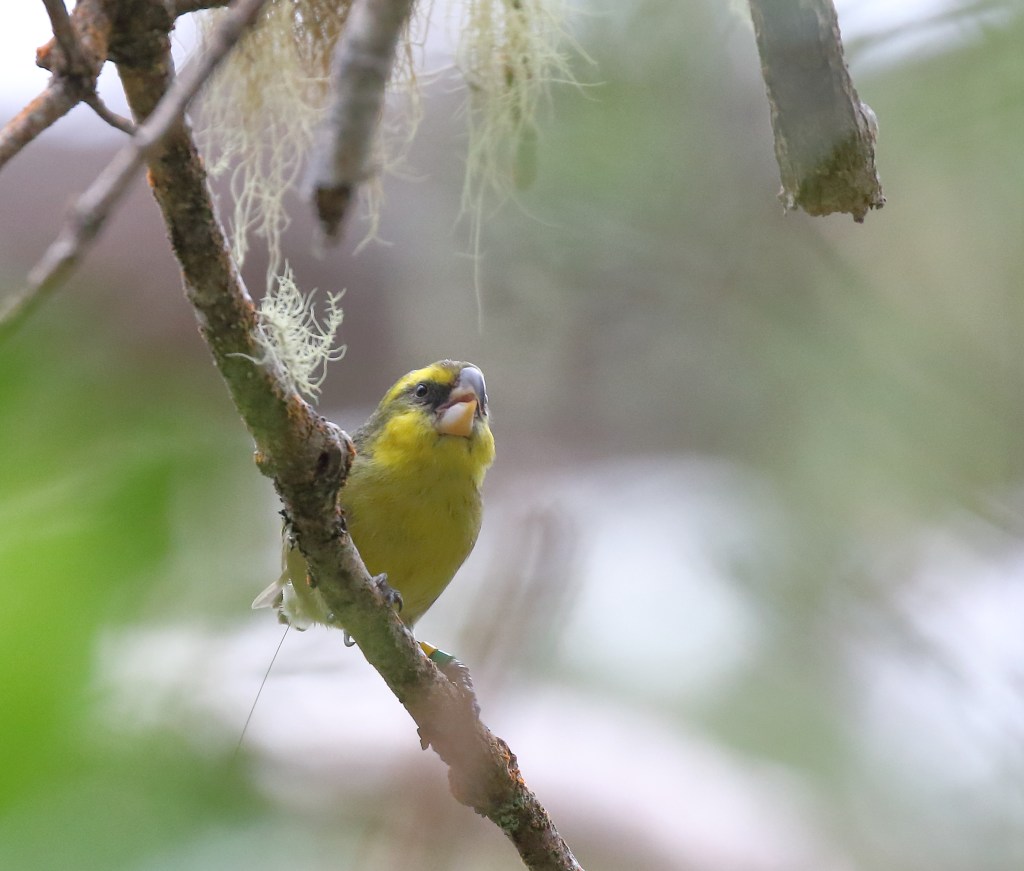
“It’s no secret that there’s a lot of uncertainty and we’re all worried about what may happen in the future,” Warren said. “Conservation funding is always fickle and we’re used to having to track those things down year after year. None of this has changed our resolve in needing this work. These birds are declining regardless… and it’s our job to protect them.”
Said Swindle: ‘I think the thing that does make me hopeful is that, if you step away from national politics, the majority of the US public … really believe in conservation and conserving wildlife, and eventually politicians will have to come around that.”
However, he added, that might be too late for bird species such as the akikiki, which is only now found in captivity, plus numerous other Hawaiʻi species on the brink of extinction.
Civil Beat’s coverage of climate change and the environment is supported by The Healy Foundation, the Marisla Fund of the Hawai‘i Community Foundation and the Frost Family Foundation.