Hilo Family Fights To Bring A Missing Woman Home From Oʻahu’s Streets
A 33-year-old woman with mental struggles disappeared after she was medevaced from Hilo to The Queen’s Medical Center. Then she ended up on the unfamiliar streets of Honolulu.
Kuuipo Surls-Kane, 33, had been homeless for eight years when a teenage boy attacked her under the dim glow of a quarter moon in the Hilo park she considered home.
It was shortly after midnight on Aug. 2 near the Moʻoheau Park bandstand, a haven for homeless people seeking shelter in downtown Hilo. A security guard who witnessed the mugging called 911. Police arrested a 16-year-old suspect, who they said had illicit drugs on him, and charged him with second-degree assault and a drug offense. He was then flown to a youth correctional facility on Oʻahu. Surls-Kane, knocked down by repeated blows, was transported by ambulance to Hilo Benioff Medical Center.
Over the course of a day, the assault spurred a series of events that would upend the fragile sense of security that Surls-Kane had in Hilo, where family members often checked in on her. Instead, she would find herself disoriented, wearing blue hospital scrubs, on the unfamiliar streets of Honolulu. Her family would declare her missing and, with limited means, set out on an improbable journey to find her.
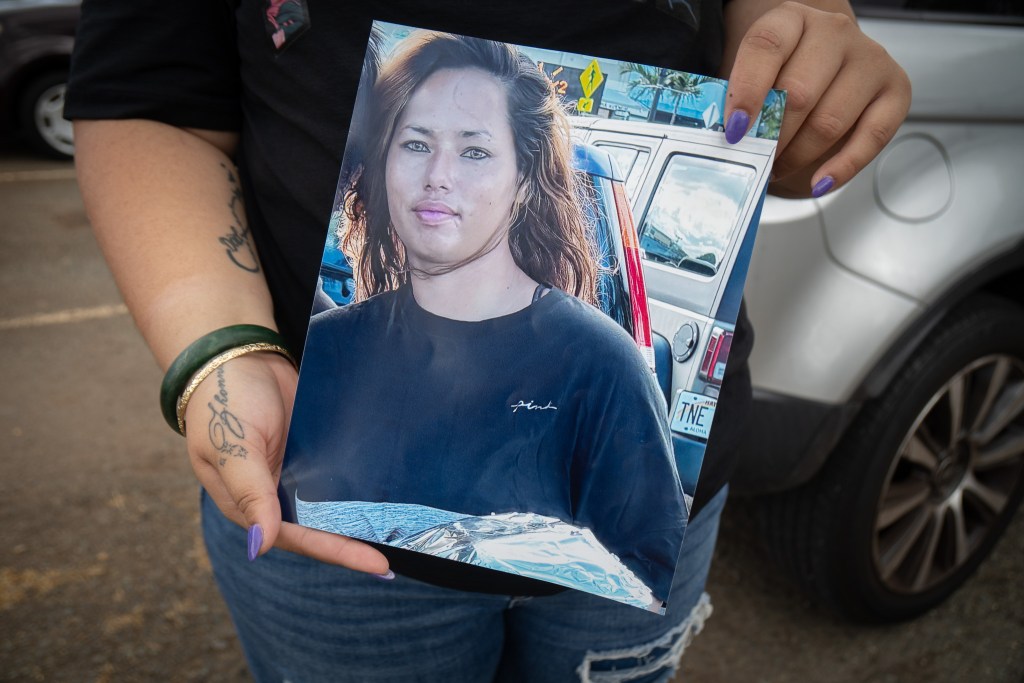
The assault left Surls-Kane with injuries — a broken jaw and brain bleeding — so severe that the Hilo hospital flew her to The Queen’s Medical Center in Honolulu. In Hawaiʻi, rural hospitals frequently transfer patients needing higher levels of care to better-equipped facilities in the capital.
Family members managed to trace her movements to Queen’s, where they said they were told that Surls-Kane, who suffers from drug addiction and a debilitating mental illness, was combative and refused care so she had been discharged. It’s unclear if she received any treatment there. When an adult patient is adamant about their refusal to receive care, hospitals have little choice but to let them go.
For people with serious mental health diagnoses, this is a common and damaging issue that some advocates say calls for a reexamination of the legal balance of power between civil rights and social justice.
“It does seem irresponsible to just say, ‘Well, alright have a nice day,'” said Louis Erteschik, executive director of the Hawaii Disability Rights Center. “Queen’s has a lot of people coming into the ER having psychotic episodes and they stabilize them and let them go in these kinds of circumstances — but these are guys that live here. If they medevaced her there, the least they could have done is called her family or brought her back to Hilo.”
The enduring challenge, according to Institute for Human Services Executive Director Connie Mitchell, is that it’s unlawful to treat someone with mental illness against their will unless they pose a danger to themselves or others. Yet in many cases, she said, it’s inhumane to allow someone to go without help when they aren’t well enough to know they need it.
One remedy, she said, could be better communication and information-sharing between hospital and social services providers. When a homeless person is discharged from Queen’s hospital after receiving treatment, the hospital often coordinates their discharge and follow-up care with Mitchell’s organization, especially with patients who appear particularly vulnerable. That doesn’t happen, though, when someone is released from the hospital after refusing to receive any care whatsoever.
Mitchell noted that gaps in the system “make it really challenging for people to get the care they need.”
“The protection of civil rights is pretty strong, and sometimes it’s hard to determine how much is a person’s choice and how much is really the mental illness talking, right? So hospitals have a burden of proof to show that, indeed, the person’s mental illness is really keeping them from making a sound decision for themselves. But I think, even if they want to do more to help, they’re very busy.”
Queen’s declined to comment, citing patient privacy laws, in an email from Chief Operating Officer Darlena Chadwick.
The Search Begins
As the sun began to set on Aug. 3, Surls-Kane walked out of the Punchbowl Street medical center wearing blue hospital scrubs, according to her family. She had no cellphone, no ID and no money. How she spent the next 13 days remains a mystery.
The family began looking for her, including posting about their plight on social media.
“Discharging someone like Kuuipo like that, it’s like you’re releasing somebody out into the wild,” Surls-Kane’s childhood friend Michelle Pagtama, 37, of Hilo, said. “It’s just like releasing a fish out in the ocean — ‘Go out! Go free!’ — but it’s like, well, what are they going to do after that?”
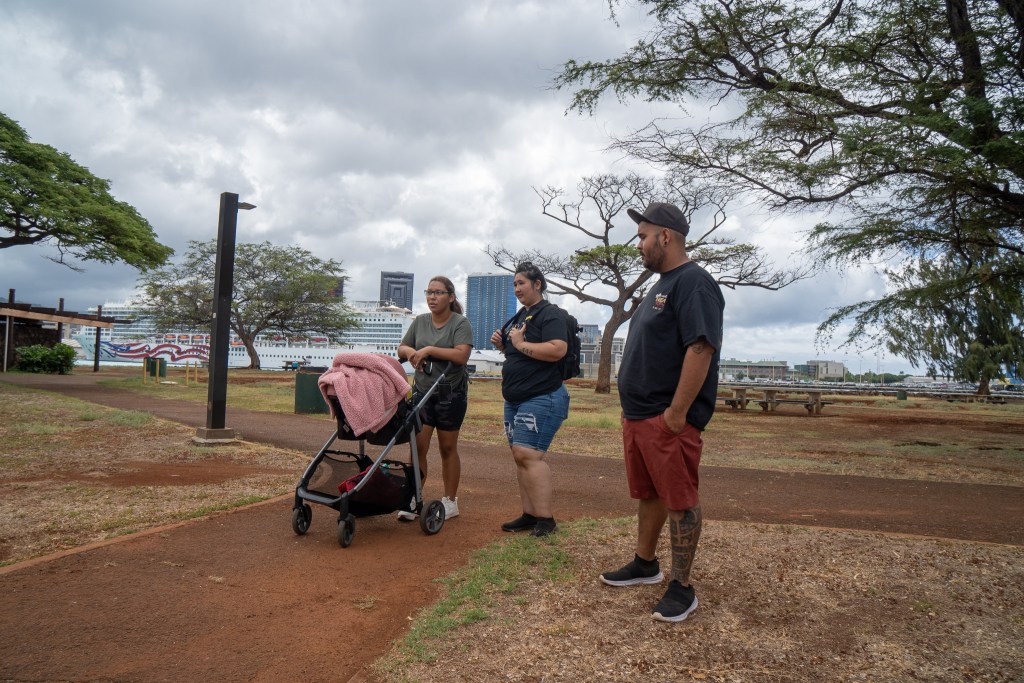
Pagtama was the first to go looking for Surls-Kane, flying to Honolulu from Hilo to walk the blocks around the hospital with a handmade missing person’s flyer.
That excursion led to no sightings but delivered a clue: A homeless man in Chinatown said he’d seen Surls-Kane a few days prior. She was crying, the man said, and appeared to be lost. She seemed to think she was on the Big Island.
Surls-Kane has schizoaffective disorder, her family said — a serious mental condition characterized by hallucinations, delusions and severe swings in mood. The illness has damaged her ability to think, concentrate, recall memories and make decisions.
Descent Into Homelessness
A checkered history of drug abuse has further undermined Surls-Kane’s ability to build a productive life, according to her family. In her 20s, they said her addiction led the state to take her three children away from her. Her youngest son was removed from her care soon after a doctor cut the umbilical cord.
They recalled that losing her children to foster care led Surls-Kane to get clean for a time, but intensified her psychiatric symptoms. From there, it was a swift descent into homelessness.
For years, Surls-Kane squatted in vacant houses around Hilo and stole food to eat. When many friends and family members gave up on her, her sister and niece doubled down, routinely checking in on her, bringing her blankets and fast food meals or taking her shopping for clothes at Walmart.
She was never difficult to find. She liked to hang out around the McDonald’s on Kinoʻole Street and often sought shelter at the bandstand or bus terminal at Moʻoheau Park. A network of family friends in the area also kept an eye on Surls-Kane. If she seemed in need of help, they would call her sister.
“I was homeless once on the streets before and I know what it’s like to be on the streets,” Santini Meafou Tauanuu, Surls-Kane’s older sister, said. “I never, ever forget my sister.”
Family members describe Surls-Kane as fun and free-spirited, but they say her behavior was largely compulsive — a reflection of her desires in that moment. When sober, she’s also soft-spoken and generous. She has a five-inch scar on her forehead from a two-car collision. After the crash, her relatives say she rushed to check on the passengers of the other vehicle before assessing her own condition.
“She’s just really sweet and she has a big heart, so she cares for others before she cares for herself,” said her niece, Kylee Ramirez, 24. “And she’s very quiet. She doesn’t really like to talk out unless she’s being talked to. And then, since she has schizophrenia, she’ll make up stories in her mind — but only with the people that she’s really, really close to, like me or her sister.”
Before she introduced her aunty to her boyfriend, Ramirez said she showed her a photo of him.
“I remember him from 9/11, I remember him from when Hitler was around,” Ramirez recalls her aunty saying.
Several years ago Surls-Kane spent nearly four months at a Hilo psychiatric treatment center, according to her family. When she was discharged, she returned to the streets. Her family can’t recall another time when she received routine mental health treatment. Her mental illness has largely gone untreated.
Experts in homelessness, addiction and mental illness agree that it is sometimes impossible to deliver effective psychiatric or substance abuse treatment to a person with no place to live.
Sometimes, especially during periods when she was sober, Surls-Kane would climb into her sister’s car and come to her house for family dinner. She could never be persuaded to stay. She always returned to the streets.

Found But Lost Again
Twelve days after Surls-Kane’s family declared her missing, a distant cousin who lives on Oʻahu made a second attempt to find her. At a Sand Island homeless encampment he struck it lucky. He spotted her near a gray tarp fastened to a chainlink fence. Her hair was cut short with a fading magenta dye.
She was in rough shape and didn’t recognize him. After numerous attempts, he couldn’t compel his cousin to get in the car with him.
Back in Hilo, her niece, Ramirez, received a series of text messages from the cousin, including photos of Surls-Kane and her makeshift tent in the Sand Island homeless encampment. She had already planned to fly to Honolulu the next day to try to find her. Now she knew where to look. Suddenly, the prospects of retrieving her aunty seemed promising.
Ramirez, who is her aunty’s emergency contact, said she felt the hospital should not have released her onto the streets of Honolulu without calling her. It was hard to imagine how her aunty ended up at Sand Island, which is about six miles from Queen’s hospital.
“I feel like they just left her like she was nothing,” Ramirez said.
She said her family members tried to file a police report with Honolulu police but were unsuccessful.
“They didn’t take it seriously because they said that they don’t do missing person reports for homeless people,” she said.
Honolulu police spokeswoman Alina Lee denied in a prepared statement that police declined to process the report. “HPD accepts missing person reports for all individuals, including those who are homeless,” the statement reads. However, Lee said police have no record of anyone trying to file a missing person report in Surls-Kane’s name.
The night before Ramirez’s flight to Honolulu, she sat her boyfriend down and talked him through her plan: Go to Sand Island, find her aunty and coax her to check into a hospital. Later, once her injuries had been addressed by a doctor, Ramirez planned to buy her a plane ticket and fly with her back to Hilo.
“I felt so confident I would be the one to bring her home,” Ramirez said.
The intervention didn’t go as planned.
On Saturday, Ramirez still had hope. Her mind wandered on the 55-minute flight to Honolulu from Hilo, imagining how she’d find her aunty in the homeless encampment. Her aunty would hug her and ask for help.
Ramirez stopped to talk with Transportation Security Administration agents in Honolulu about whether her aunty could board a plane without any identification. The agents told her she could still fly, with additional screening and a medical note. It all seemed so promising.
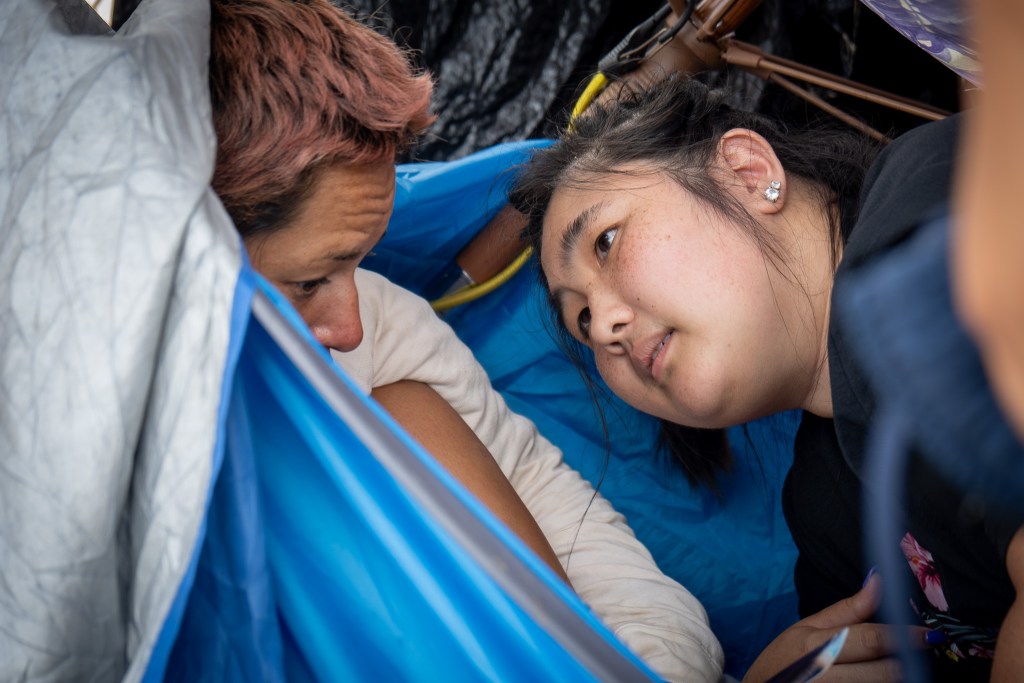
At Sand Island, Ramirez found a man who had eaten dinner with her aunty just the other night. The men her aunty was hanging around with, he said, liked to supply women with drugs only to take advantage of them. He pointed to a gray tarp with a pair of bare feet poking out.
Ramirez approached the makeshift tent and cautiously tried to draw her aunty out onto the street.
“It’s me, Aunty Ipo, it’s me,” Ramirez said.
Surls-Kane stuck her head out of the tent. Her face was blank. Ramirez’s heart dropped. Her aunty didn’t recognize her.
She asked her aunty to step out of the tent. Then she noticed she didn’t have any pants on. Ramirez handed her aunty a pair of navy shorts she had brought for her.
“I don’t have any family, that’s not my family,” Surls-Kane said to the man with her under the tarp as she slipped the shorts on. “You’re just going to let them take your property? I’m your property.”
As Ramirez tried to engage with her aunty, Surls-Kane’s eyes latched on the gold bangle on her niece’s wrist. Ramirez bought the bangle, and a matching one for her own little niece, just two weeks earlier at a craft fair. She used the jewelry to try to entice her aunty to come out of the tent.
“Do you want this bracelet?” Ramirez said. “You have to come outside of the tent so I can give you this bracelet.”
“Why don’t you come into my house?” her aunty replied.
Ramirez ducked under the tarp and knelt down beside her aunty. She slipped the bangle off her wrist and presented it to her aunty, trying to win her trust. Then she showed her aunty a photograph of herself. Surls-Kane puffed on a hand-rolled cigarette. Her eyes were vacant.
“Who is this lady?” she said. “That’s not me, but I’ll help you find her.”

Ramirez called Surls-Kane’s sister on FaceTime but the interaction didn’t jolt her memory.
“I don’t have any family,” she insisted, growing increasingly agitated.
In a last ditch effort to help her aunty, Ramirez called the police. The officer who responded asked Surls-Kane whether she wanted to hurt herself or others. She said no. The answer meant he couldn’t take her away in the police cruiser.
Ramirez left the encampment without saying goodbye. Her aunty was angry at her for calling the cops.
“It was just heartbreaking to leave without her knowing she’s on the streets, we don’t have any way of contacting her and if something bad happens to her we’ll never know,” Ramirez said. “From Saturday to today I was just crying. I’m just trying to figure out how to get her back. I’m going to keep trying.”
Civil Beat reporter Madeleine Valera contributed to this report.
Civil Beat’s reporting on economic inequality is supported by the Hawaiʻi Community Foundation as part of its work to build equity for all through the CHANGE Framework; and by the Cooke Foundation.