Lahaina Fire Survivors Make A Home Without A House
Kuhua Camp had the highest concentration of wildfire deaths. The plight of this homeowner shows the challenges of rebuilding two years after the blaze.

Follow Mario Siatris and U‘i Kahue-Cabanting as they rebuild their lives. Read more stories about them here.
Mario Siatris looks out at the bare residential tracts surrounding the gravel lot where he has been camped out since becoming the first homeowner to return to the Lahaina neighborhood that was among the hardest hit by the deadly wildfire two years ago.
A layer of coarse rock has been spread over the area as a form of erosion control after the flames left it a wasteland. But a relentless wind manages to kick loose dirt into the air and down Mario’s lungs. He clears his throat with a cough.
“It’s hard, it’s dusty — but it’s quiet, it’s beautiful,” Mario said during a recent interview on his homestead in the once densely populated, working class neighborhood of Kuhua Camp.
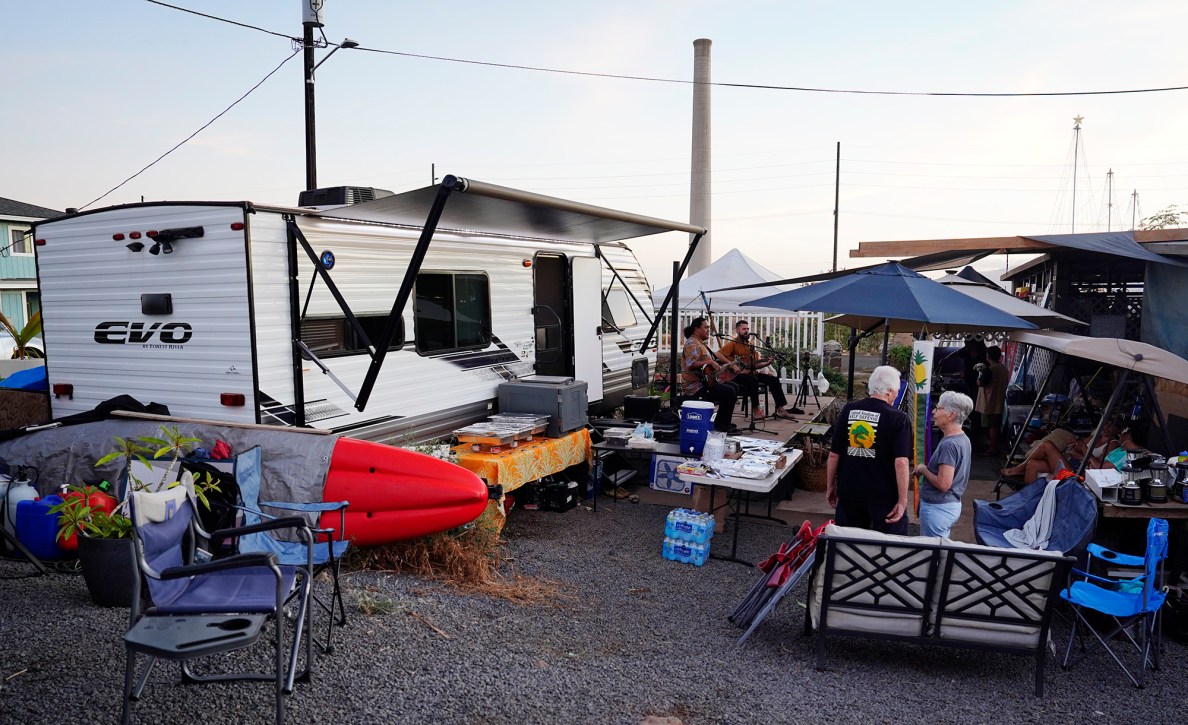
In the 393 days since Mario and U‘i Kahue-Cabanting, his friend, tenant and business partner, returned to live on Mario’s property in the area with the highest concentration of Lahaina wildfire deaths, they’ve tried to reimagine what home means without a house.
‘It’s Still A Home’
When they returned last summer, Mario and U‘i were living in defiance of county rules forbidding homeowners from staying in the disaster zone past 6 p.m. No one hassled them.
U‘i slept on a blow-up air mattress, Mario slept on a porch swing and they used a 5-gallon bucket as a toilet. At night, they were alone in pure darkness and silence — no neighbors, no construction crews, no houses.
U‘i now sleeps on a bed in a towable, 26-foot RV trailer equipped with a kitchenette, a bathroom with a shower and a fireplace.
Mario sleeps on a pull-out sofa bed tucked under one of two gazebos he has erected on the lot. A generator and string lights keep total darkness at bay. A white picket fence serves as a psychological boundary between the life Mario and U’i are rebuilding and the empty void.
“This is just a person — Mario — who’s lived in the neighborhood for 45 years returning home,” U’i said. “There’s nothing not pono about that. If anything, we tried to help our neighborhood by bringing life back.”
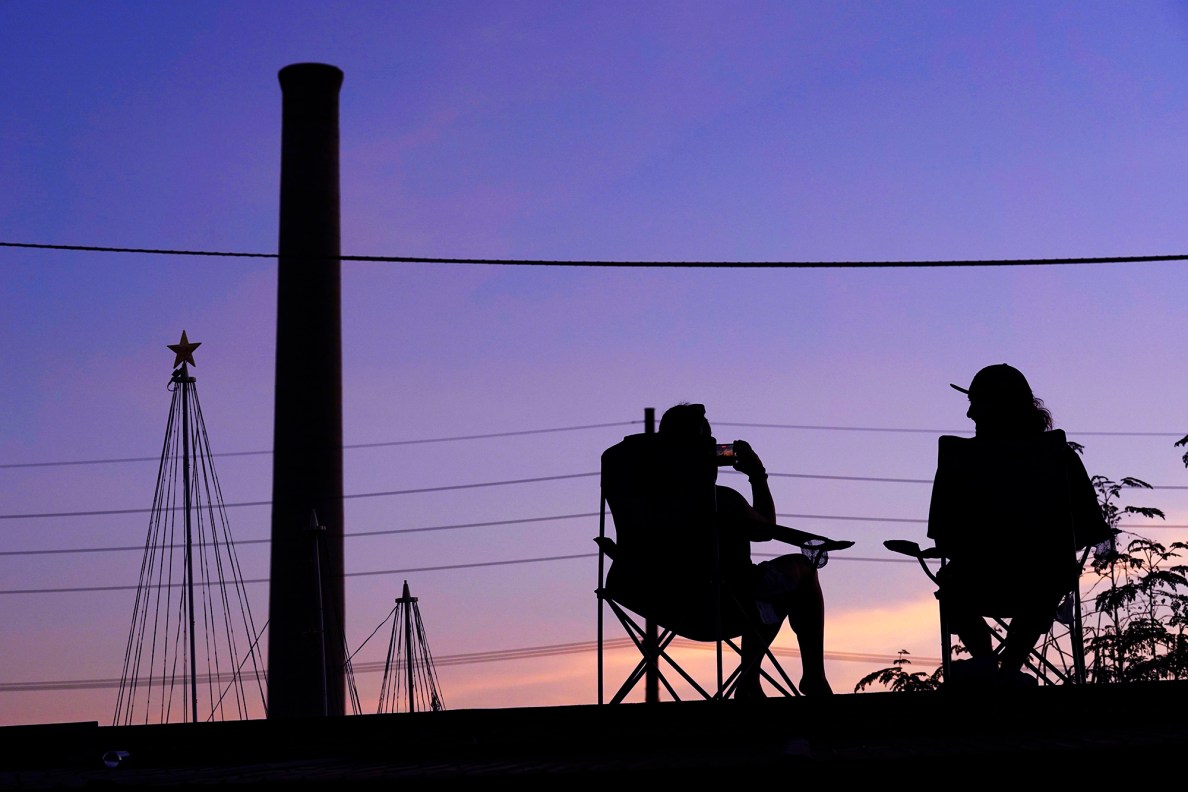
The nearly century-old Pioneer Mill smokestack towering in the background is a reminder of the area’s history, beginning as a plantation camp that was built in the 1920s to provide employee housing for the sugar mill.
Today the neighborhood is perhaps better known as the death trap where the bodies of nearly three dozen of the 102 people who died in the Lahaina wildfire were found.
People often ask Mario and U’i whether they sense the spirits of those who died or if they hear their screams at night. (They don’t). Others ask how they manage to sustain themselves off-the-grid in such rudimentary conditions.
Living this way is often hot, dusty and uncomfortable, but it’s on their own terms and one step closer to the end-goal of rebuilding Mario’s house.
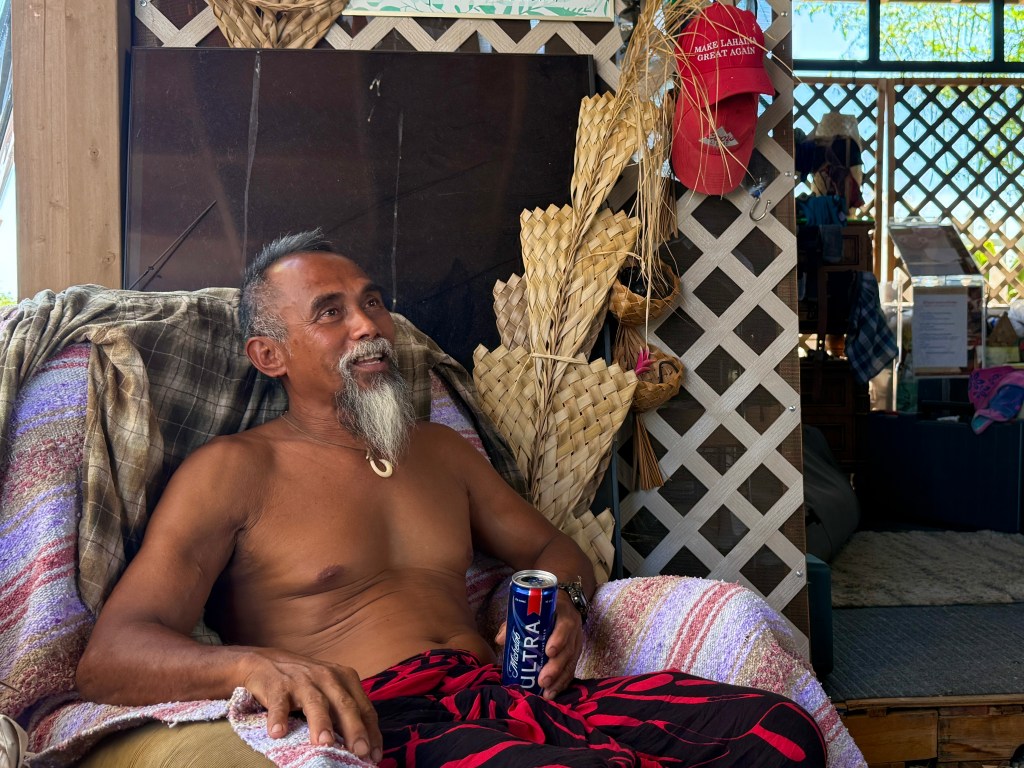
“I have a motto: Learn to desire less,” Mario said. “I want to be at peace and I feel at peace here. It’s still home.”
‘How Is This Safer?’
Since the county restored fire-damaged sewer, water and electricity systems, Kuhua Camp is coming back to life during the day with construction workers and other property owners plotting their rebuilds.
Mario and U’i welcomed back their first neighbors last month after watching a larger house go up in place of the one they lost in the fire. That house is packed with multigenerational families, a common practice on an island that is becoming increasingly unaffordable for many. So many cars line the narrow streets that some have to park on a nearby vacant lot.

Most of the houses that burned Aug. 8, 2023, haven’t been rebuilt in the Kuhua Camp neighborhood, however.
Mario and U‘i welcome access to basic utilities and see signs of progress, but they also see broken government promises. They’re frustrated that the infrastructure hasn’t been upgraded even as bigger houses with more tenants are being planned around the same narrow roads.
Neighbors who died in the fire may have actually survived had a number of key roadways been extended to offer better evacuation options, according to computer modeling that the U.S Army Corps of Engineers provided to Maui County. Many who perished had been trapped by fallen trees and power lines as they tried to escape on narrow, dead-end roads built nearly a century ago.

Maui County has taken early steps toward acquiring the land it will need to extend key Lahaina roadways to give residents safer evacuation routes during emergencies, but these upgrades will probably take years to materialize.
“How is this safer?” U‘i said. “Nothing has changed. So while we gather our resources to rebuild, we’re not just watching, we’re observing to see how this plays out.”
Mario is determined to rebuild after the loss of the 2-story, 1927 plantation home on Mela Street that he bought decades ago from his adoptive parents. But his plans are complicated by a $600,000 insurance payout, which only covers about two-thirds of the estimated cost to rebuild.
A prefabricated home would save on the traditional cost of construction but generally falls short of the needs of Kuhua Camp’s multigenerational households, where families bunked together with as many as 12 people sharing a two-bedroom plantation home.
Mario’s house needs to accommodate at least eight people — his daughter’s five-person family, his son and his two dogs, U’i and himself.
He’s wary of taking on a new loan in part because he worries that the debt might one day fall on his children, who are struggling to earn a living wage. It seems everybody’s hiring on Maui these days, but few jobs pay enough to keep up with the astronomical cost of living.
Mario had just a few more payments to make on his mortgage when the fire burned his house down.
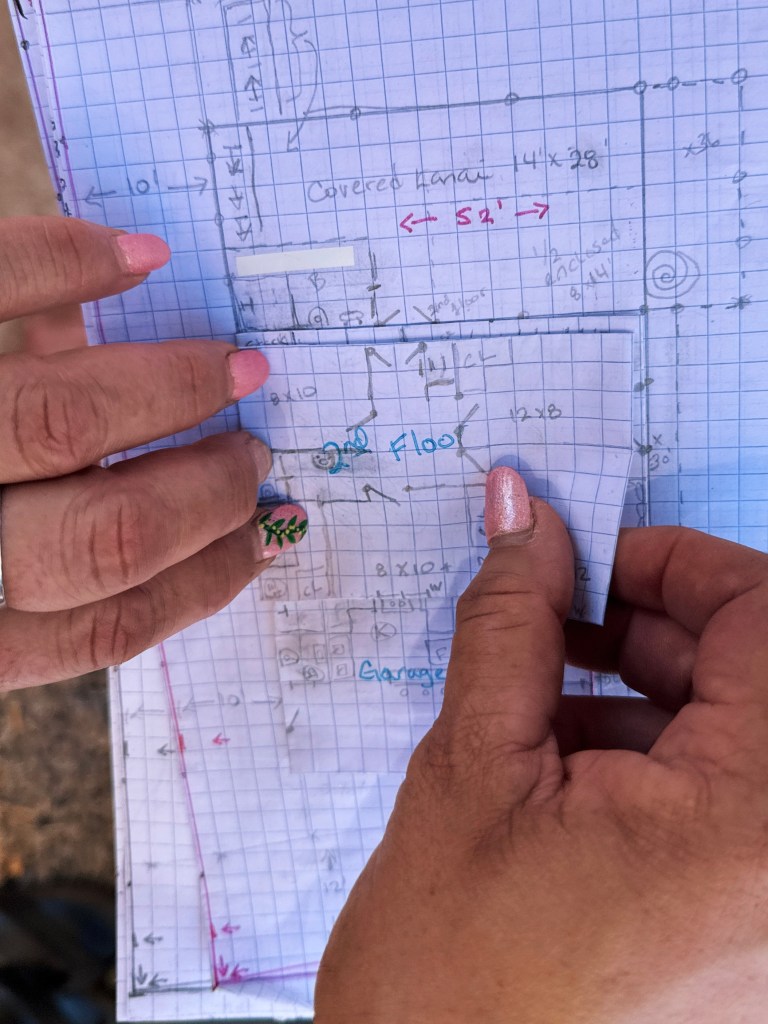
U’i, who briefly worked for an engineering firm decades ago, has drawn up draft plans for a simple house with a garage and a large, wrap-around lanai. She hopes what she’s sketched could be built for a sum closer to the insurance payout of $600,000. Then, when more money comes in, Mario could renovate the garage into a studio suite for his daughter’s family, who are currently living in a luxury rental home with help from disaster relief money in Wailuku Heights.
U’i and Mario figure they could get by sleeping on the covered lanai. Mario, for his part, said he prefers dozing off under the stars.
U‘i is looking for an architectural engineer to formalize her ideas into plans that Mario could submit for a county building permit. Mario hopes to start construction in 2026.
In the meantime, the friends have frugally assembled an off-grid shelter, careful not to overspend on a temporary refuge. Mario and U‘i coexist here, cramming their two lives onto a 4,925-square-foot lot, about the size of a basketball court.
One of the first improvements they made was planting ti, Hawaiian plants believed to bring good luck to new homes. Breadfruit, moringa and plumeria trees soon followed.
Vegetating the bare lot will over time bring food, flowers and cool shade. As much as he mourned the incineration of his house, Mario, a master gardener, wept for its lost botanical treasures, most of all the giant mango tree and its waxy, kidney-shaped fruit.
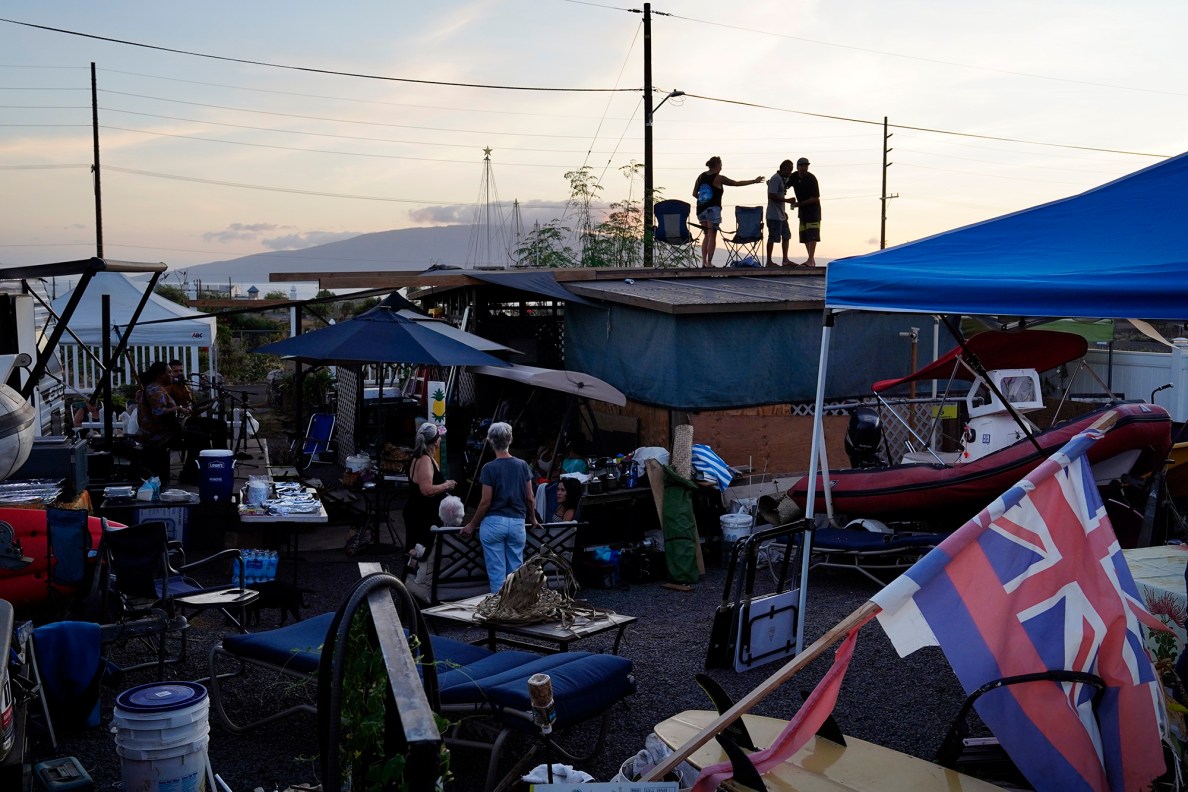
Mario has a knack for repurposing construction scraps, liquidated hotel furniture and other discarded or gifted items into the trappings of a makeshift home.
The property has a stackable washer and dryer, marble countertops, a television, two small fishing boats, an air fryer and a coffee maker with a milk frother. Garden lattice panels form breathable gazebo walls. A portable stage that once hosted a hotel hula show offers an elevated seating area off the dusty ground.
U’i gestures to the stage and declares that Mario is no better than Fred Sanford, the junk dealer who could turn down no treasure in the 1970s sitcom “Sanford and Son.” But she acknowledges the many benefits of upcycling this way — less landfill waste, less money spent.
“We could live like this, but the kids cannot,” U’i said. “Mario and I, we’ve got to provide for our families at a time when everybody’s kids are leaving. We already had a housing crisis and now a whole community is gone, so we are doing this for them. There’s still a long battle ahead.”

Mario and U’i co-own Maui Grown 808, a plumeria orchard and native plant nursery that they operated for 10 years until the fire incinerated it as well. Mario and U’i now teach people how to weave coconut fronds into durable hats and baskets to help deepen connections to Hawaiian culture.
Their lives are entwined by this work and a friendship that has only deepened since the fire set them on the difficult course of navigating the bureaucratic red tape for disaster aid.
On Saturday, Mario’s friends and family gathered on the lot he’s called home since he was 12 years old to surprise him with a 60th birthday party. The discarded hula stage made the perfect platform for a pair of musicians whose festive Hawaiian songs pierced the quiet air looming over an all-but-abandoned neighborhood.
This article was funded in part by the Maui Strong Fund of the Hawai’i Community Foundation.
Civil Beat’s coverage of Maui County is supported in part by a grant from the Nuestro Futuro Foundation.