Future Of Commercial Fishing In Protected Pacific Waters In Courts’ Hands
Conservationists scored an early court victory, but a larger decision looms on whether the fishing opened up under Trump can continue.
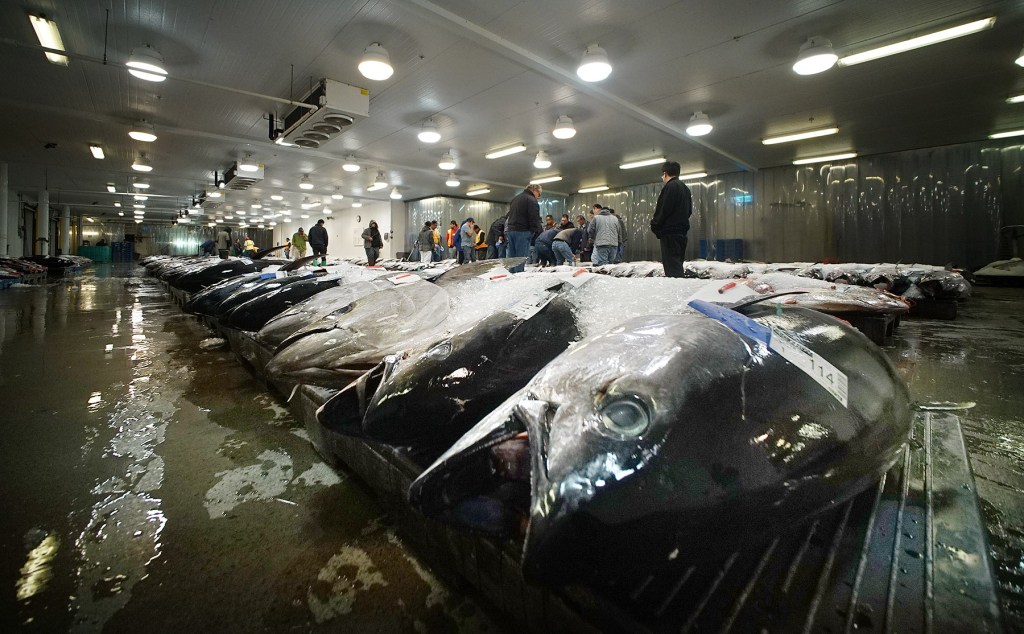
Hawaiʻi-based longliners have logged more than 900 hours pursuing tuna in previously protected parts of the Pacific Ocean, online tracking data shows, since President Donald Trump lifted a commercial fishing ban in late April.
That new fishing opportunity disappeared recently when a district court judge ruled that U.S. fishery officials didn’t follow proper procedures before opening up the vast waters that form the Pacific Islands Heritage Marine National Monument.
The remote area has become the latest flashpoint between conservationists who want more of the Pacific placed off-limits to better protect tuna stocks and sensitive marine environments and regional fishing leaders who say they need access to more fishing grounds — who now have Trump’s ear.
Those leaders have already stated they’d like to see the waters around the Papahānaumokuākea National Marine Sanctuary opened up as well.
For the monument, Judge Micah Smith found that officials should have sought public input before enacting Trump’s order, which ultimately aims to reopen more than 400,000 square miles of deep ocean. Smith said they also need to publish new, proposed fishing rules in the Federal Register.
Smith’s ruling stops commercial fishing around Wake and Jarvis islands and Johnston Atoll for at least the next few months. But it doesn’t get to the heart of a lawsuit filed in May by conservationist groups against the federal government, which challenges whether Trump’s order itself is even legal.
Court arguments on that more fundamental question are slated to begin in October. A ruling could determine whether commercial tuna fleets will be kept out of the Central Pacific monument waters for good.
“We’re very happy to have scored this first-round victory,” said David Henkin, a Hawaiʻi-based attorney with the environmental advocacy group EarthJustice, who represents the groups that sued.
“We’re going to be on our toes” as the court battle proceeds, Henkin said. “But to know the commercial fishing is not happening now, that’s a huge victory.”
In the suit, local environmental groups Kapaʻa, the Conservation Council for Hawaiʻi and the Center for Biological Diversity argue that the Antiquities Act allows Trump to create national monuments, but it doesn’t give him the authority to revoke those protections. Only the U.S. Congress, the suit argues, has that authority.
Testing The Waters
At least seven U.S. longline vessels based in Honolulu Harbor have fished in monument waters outside Johnston since April 25, when fishery officials allowed commercial fishing there again, according to data from Global Fishing Watch.
However, after Smith’s Aug. 8 ruling, the federal National Marine Fisheries Service removed that advisory from its website. The page instead reads: “Something Fishy is Going On … The content you’re trying to access is unavailable.”
The last longline fishing activity in monument waters outside Johnston recorded on Global Fishing Watch occurred on Aug. 7.
“We’re not going to fish there,” Hawaiʻi Longline Association President Eric Kingma told Civil Beat this week. “We abide by what the court says.”
The other two areas opened up to commercial fishing by Trump’s order, around Jarvis and Wake islands, saw virtually no activity during the nearly four months. Only one longliner visited Jarvis, according to the online data. At Wake, a Chinese-flagged vessel, the Weiyu18, appears to have logged several hours fishing. Such fishing by foreign boats in U.S. waters is prohibited unless the boat has special permits. It’s not clear whether the Weiyu18 had such a permit.
Kingma described the recent fishing in monument waters as small and the catch numbers reported unimpressive. If the catch rate had been higher, Kingma said, it might have drawn as many as 80 other longline boats to fish there.
Instead, Kingma added, the longline fleet has spent its time in recent months fishing north of the Main Hawaiian Islands, an area that’s open to them.
The Pacific Islands Heritage monument was established by President George W. Bush, shortly before he left office in January 2009, to help protect remote ocean ecosystems and the imperiled marine animals that rely on them. It also aimed to help boost tuna stocks across the rest of the Pacific.
President Barack Obama expanded the monument’s protected area in 2014. That expansion is the area Trump is trying to reopen to U.S. commercial fishing.
While the fishing there hasn’t yet proven lucrative, Kingma said, “the whole point is to have opportunities to fish when the fish are there.”
The fleet also values those waters as an area where it can fish with much less competition from foreign vessels, Kingma said. In the meantime, “we follow what the government says we can do. If it’s prohibited, we won’t fish there.”
Civil Beat’s coverage of climate change and the environment is supported by The Healy Foundation, the Marisla Fund of the Hawai‘i Community Foundation and the Frost Family Foundation.