‘Elvis Would Be Totally Against That’: Feral Cat Battle Reaches Fever Pitch
A new county measure outlawing cat feeding on the Big Island is expected to become law this week, pitting feral cat advocates against politicians.
Hawaiʻi helped shape Elvis Presley’s legacy. The influential King of Rock & Roll starred in several movies shot and set in the islands, plus his 1973 “Aloha from Hawaii” concert is considered one of his most iconic performances.
Now, Presley’s widow, Priscilla Presley, says she’s prepared to never again set foot on the Big Island after decades of visits there and she’ll encourage others to avoid it as well.
Unless, that is, the Hawaiʻi County Council revokes a local ordinance it passed last month.
The measure that’s driving a wedge between Presley and the Big Island is Bill 51. Starting next year, it prohibits anyone from feeding feral animals on any county land, most notably the thousands of feral cats in scores of colonies across the island.
“If Elvis was alive today, he would be totally against that as well,” Presley told Civil Beat last week. “I’m definitely going to spread the word, what’s happening over there.”

She’s aligned with some of the island’s most vocal feral cat feeders, who leave food for the felines and try to manage their colonies. Her involvement shows just how big of a lightning rod the conservation measure has grown to be across the sprawling island.
It’s also a test of how much power those feeders have as they advance negative publicity campaigns against the county and whether the new cat policy can survive all the blowback.

Bill 51 aims to better protect Hawaiʻi’s vulnerable native species, including the nēnē goose and marine mammals, plus the islands’ degraded ecology, from threats posed by the roaming cats and other feral invasive animals such as goats and pigs.
Anyone caught leaving food for animals on county land will be hit with a $50 fine. Repeat offenders could face fines up to $500. It’s largely in tune with the stronger approach local conservationists have advocated for years to deal with the estimated hundreds of thousands of feral cats that inhabit the Main Hawaiian Islands.
But most Big Island feeders believe the new policy to deprive the cats of a food source they’ve come to depend on is cruel and inhumane. The opponents’ numbers appear to be formidable, including some 23 grassroots advocacy groups across the island, according to Debbie Cravatta, president and founder of the animal rescue group KARES, which represents hundreds of cat feeders.
An online petition opposing Bill 51 had more than 7,400 names listed last week, and several hundred opponents filed written testimony ahead of the County Council’s final 6-2 vote approving the measure.

“They’re not listening to us,” Cravatta said last week. “This is going to get bad.”
‘Your Reelection Is Coming Up’
County Council members, along with Mayor Kimo Alameda, are trying to delicately navigate the island’s highly charged cat politics.
Shortly after the bill passed, Alameda spokesman Tom Callis told the Hawaiʻi Tribune-Herald that Alameda would sign the bill. Last week, however, Callis told Civil Beat that Alameda would instead let the bill take effect on Thursday without his signature.
Alameda made that decision, Callis said via email, after completing his review of the benefits of the bill and the concerns against it.
Alameda added in a statement provided by Callis that Bill 51 should be paired with “a stronger commitment to island‑wide spay and neuter programs.”
“By expanding access and availability of these services,” Alameda said, “we can address the root cause of overpopulation in a more humane, effective, and sustainable way.”

At the Aug. 6 meeting, Waikoloa resident Nancy Charles-Parker addressed County Council members via remote feed, sitting behind a pair of wooden fold-out tables arranged in the Council’s Waimea office.
Charles-Parker warmly thanked the Council members for their hard work, saying “I’m sure you’re underpaid.” She then politely informed them that as many as 6,000 people at that time had signed the petition opposing Bill 51.
“As you’re probably aware too,” Charles-Parker continued, “your reelection is coming up and I don’t think I need to remind you that all 5,000 to 6,000 of us will definitely vote for your opponent if you choose to go through with 51.”
“I hope you’ll consider working with us, not just blowing us off,” Charles-Parker added, “because if you vote for this it means you’ve blown us off and you really don’t care about our views.”
Nonetheless, a Council majority opted to pass Bill 51 and send it to Alameda’s desk.
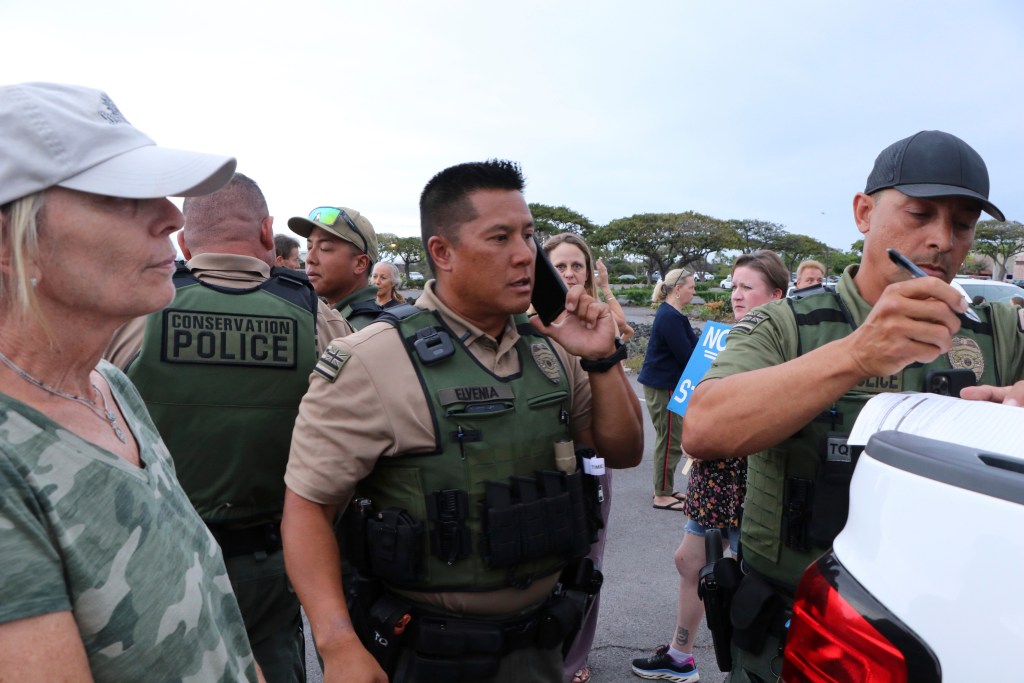
During an April 2023 protest, Charles-Parker and another woman were cited by state conservation officers for putting bowls of cat food on the ground at Queen’s Marketplace in Waikōloa. The women were also warned by marketplace security, according to a Department of Land and Natural Resrouces release, that they were trespassing.
That protest among feral cat supporters flared up shortly after DLNR banned cat feedings there. Too many nēnē were taking food from cat feeding stations, the state agency said in ordering those stations removed.
Several months after the citation, the Hawaii Tribune-Herald reported, a judge dismissed those charges against Charles-Parker and the other feeder.
Gearing Up
Bill 51 has stoked the feral-cat debate on the Big Island, but the dilemma over how to best to manage colonies while protecting Hawaiʻi’s native species crosses the island chain.
Most feral cat advocates, along with some Big Island council members, support strengthening local penalties for pet abandonment and ramping up trap-neuter-release programs instead of stopping the food.
At the Aug. 6 meeting, testifier Kealoha Ho’omaikalani Lee said it’s often difficult to measure whether a trap-neuter-release effort is working — but it’s clear that Hawaiʻi’s native species are in decline. Manu, or birds, are tied to Hawaiʻi’s “living culture,” Lee said, “and as you know our living culture is dying. We cannot afford to gamble with extinction.”
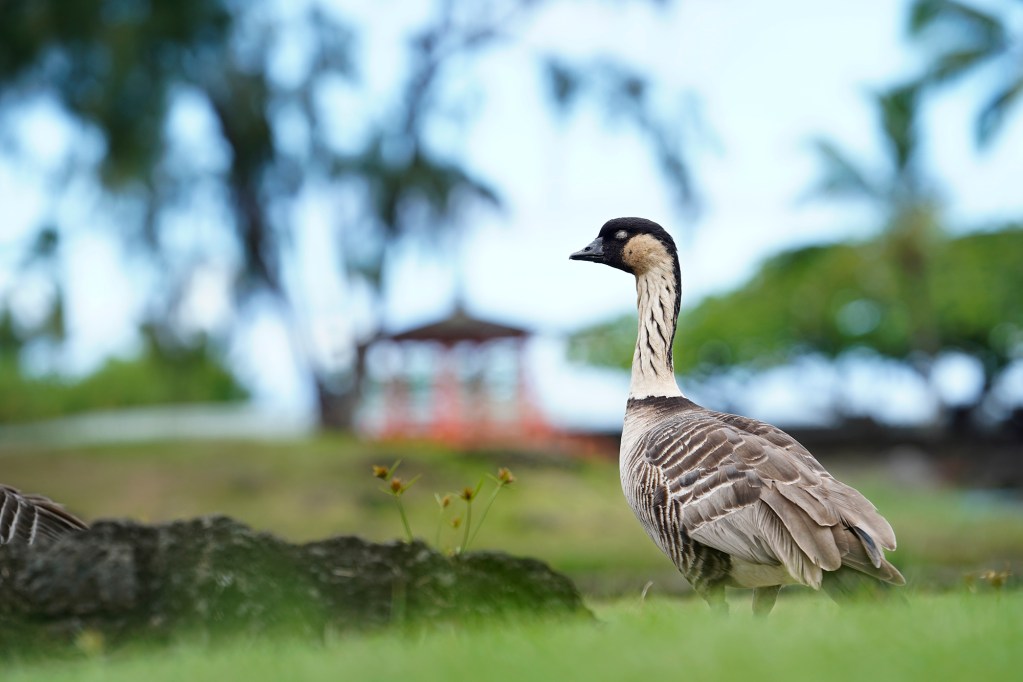
The nēnē population has rebounded in recent decades, going from fewer than 30 birds in the wild in the 1950s to around 3,800 today. The endangered native geese still do occasionally die where cat feedings regularly occur, however. The birds often seek out the cat food, changing their natural behavior as they become too comfortable around cats and humans.
Last year, a male nēnē at Lili‘uokalani Park in Hilo was killed in a vehicle hit-and-run as it crossed a road toward a popular cat-feeding site. Its body was found next to a road sign warning drivers to slow down for endangered wildlife.
The same nēnē had fathered a gosling suspected to have died of toxoplasmosis, a disease carried by cats that’s deadly to Hawai‘i wildlife, including monk seals, spinner dolphins and nēnē.
With his internal crowd-sourced map data, Jordan Lerma, co-founder of the nonprofit group Nēnē Research and Conservation, has estimated there are some 900 feral cat colonies across Hawaiʻi.
Lerma had considered making that data public, despite initially telling the cat colony managers who shared colony whereabouts with him that it would remain private. Ultimately, Lerma said last week, he opted to share the data only with John A. Burns School of Medicine researchers to help them measure the prevalence of toxoplasmosis in the environment.

Going forward, however, Lerma plans to expand his crowd-sourced Hawaiʻi data to include other feral animals and make the new information available next year on a phone app, which will be called “Feral Map.”
Hawaiʻi County’s Parks and Recreation Department also plans to use the Feral Map data to help track feral animal activity on the grounds it manages. The data, Department Director Clayton Homa said, can “help mitigate the impacts feral animals have at our parks.”
Lerma said Feral Map will also help local officials assess how effective Bill 51 is at keeping the cats, pigs and goats away from nēnē and other native species.
Things have gotten more tense with cat feeders, Lerma added, following the bill’s passage. He’s come to be known by many in that community, he said, as the “nēnē Nazi” for his staunch advocacy for Hawaiʻi’s native goose species.
Many cat feeders, meanwhile, believe the felines are often unfairly blamed for nēnē deaths. Cravatta said she and other cat advocates are planning a global campaign to get visitors to boycott the Big Island due to Bill 51, with Presley’s help.
“Debbie keeps me involved,” Presley said of the situation. The two women, she said, have been friends for years after meeting on the Big Island. Earlier this year, they visited an animal shelter in Austria. They have advocated for more sustained efforts to trap, neuter and release the cats instead of what Presley described as “slaughtering” the felines by depriving them of food.
“I’m along with Debbie. I mean, Debbie’s telling me all what’s going on there,” Presley added. “I feel how Debbie does.”
Civil Beat’s coverage of climate change and the environment is supported by The Healy Foundation, the Marisla Fund of the Hawai‘i Community Foundation and the Frost Family Foundation.