

Hawaiʻi Supreme Court: OHA Trustees Bound By State Ethics Code
The court also upheld dozens of charges against former Trustee Rowena Akana.
Trustees of the Office of Hawaiian Affairs are considered state employees and must abide by the state ethics code, Hawaiʻi Supreme Court justices said in a unanimous opinion Wednesday.
The ruling stems from a series of ethics violations against former Trustee Rowena Akana, who was found to have accepted illegal gifts and used her trustee allowance for personal use on food purchases, television service and Hawaiian Airlines Premier Club membership. Most of those expenses violated both state law and OHA’s internal policies. The court opinion also upheld the 47 ethics violations against Akana as well as a $23,000 fine.
Last year, OHA argued that it should have its own ethics commission to oversee the conduct of trustees and staff. The office was created in 1978 to improve conditions for Native Hawaiians.
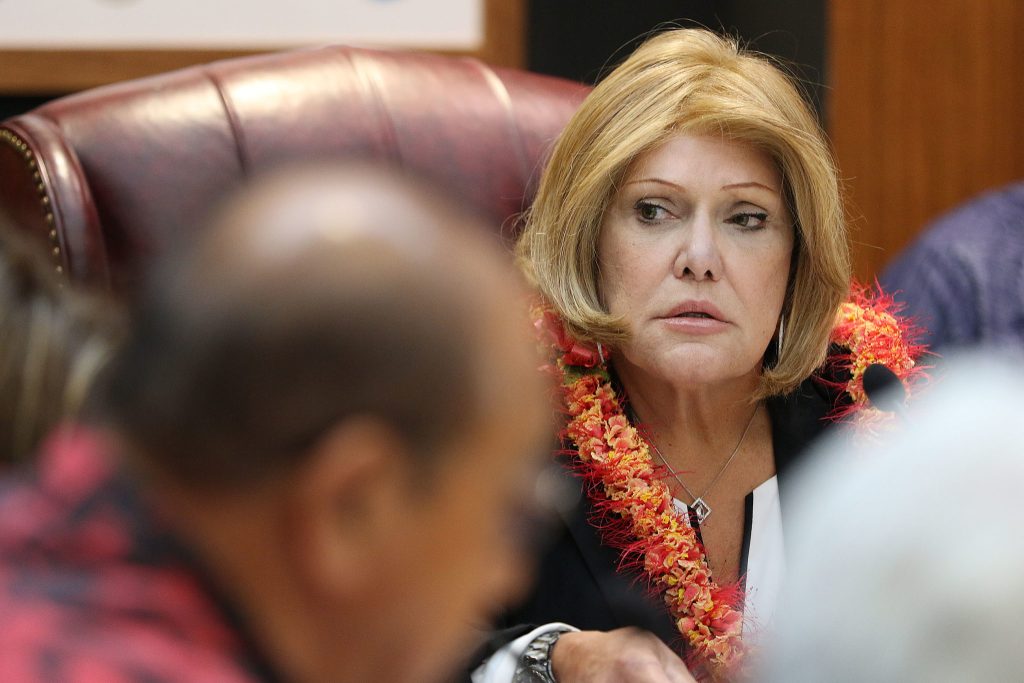
Akana’s lawyers also argued that the state Ethics Commission, the agency that oversees the ethical conduct of all state employees and brought charges against Akana, didn’t have jurisdiction over OHA.
“We disagree,” Chief Justice Mark Recktenwald wrote in the opinion. “OHA is not a political subdivision such that it requires a separate ethics apparatus.”
But in ruling that the state ethics code now applies to OHA trustees, the justices also said that the Ethics Commission should defer to OHA’s bylaws and internal policies. The high court recognized the OHA Board of Trustees’ broad powers to improve the lives of Native Hawaiians.
“OHA trustees carry out duties distinct from the responsibilities of other members of state boards and commissions,” Recktenwald wrote.
For example, trustee allowances could be used to support “beneficiaries in their personal quest for self-improvement, capacity building, and for education” — all things beyond the scope of what would be considered allowable expenses in other state agencies.
The opinion goes on to say that the Ethics Commission should consider the office’s bylaws when it is weighing charges against trustees. OHA’s most recent policy manuals already require trustees and employees to follow the state ethics code. They also have additional provisions regarding acceptance of gifts, travel expenses, the use of trustees’ allowances and internal staff interactions.
In Akana’s case, the Supreme Court said that the Ethics Commission did consider OHA’s internal guardrails as it brought charges against the former trustee.
For example, the commission found that food Akana bought for staff parties with her trustee allowance fell outside OHA’s policies. Conversely, the commission also declined to charge Akana for a $75 donation to the Hawaiian Humane Society because it was unclear if OHA’s policy prohibited that type of transaction.
Board Chair Kai Kahele said in a written statement that the ruling ” strengthens our Board’s ability to continue governing in a way that centers the needs of the Native Hawaiian community, while upholding public trust through ethical and transparent conduct.”
The board undertook reforms in 2018 to curtail expenditures from trustees’ allowances, according to Kahele.
“These reforms underscore our dedication to responsible governance and ethical stewardship,” Kahele said, adding that the office will work with the Ethics Commission to ensure OHA’s internal policies align with state laws.
State Ethics Commission Chair Wesley Fong said in a press release that the commission was gratified by the ruling, “which reaffirms that no state official is above the public’s expectation for integrity.”
Reached by phone, Jim Bickerton, Akana’s lawyer, said he had not yet read the opinion and would need to talk to Akana before commenting.
Read the court’s opinion here.

