Can Hawaiʻi Turn Around Another Deadly Year On The Roads?
An executive order emphasizes enforcement and safety education, but data shows infrastructure is also a major factor in many fatal accidents.
In less than 15 hours on a Tuesday in June, three separate traffic accidents occurred on Oʻahu, leaving five people dead in a grim halfway point of a year that has seen an alarming increase in fatalities.
Initial police reports show the deaths involved a combination of speeding, people not wearing seat belts, a pedestrian hit while crossing the street and a motorist who fled the scene — a microcosm of the year-to-date on the state’s roads.
The problem is most acute on Hawaiʻi’s most populous island, which has seen 65 traffic fatalities so far this year compared with 52 in all of last year. As local officials sound the alarm over the surge in road deaths, new federal transportation data shows the state falling behind national road safety indicators for the second year in a row.
The response has been swift. Gov. Josh Green issued an executive order last month calling for new regulations for e-bikes, stronger enforcement of traffic violations and more safety education programs.
But a Civil Beat review of state data and police reports shows the issues that need to be addressed are formidable, ranging from an onerous prosecution process that may allow those responsible to escape consequences to longstanding and hard-to-fix infrastructure problems.
“In a lot of places in Hawaiʻi, we have sidewalk infrastructure, bike infrastructure that’s extremely underdeveloped,” said Justin Tyndall, an assistant professor of economics at the University of Hawaiʻi who researches transportation issues. “And road design that allows people to drive very quickly. And limited enforcement to prevent people from speeding or driving dangerously. So I think that’s a recipe for having a lot of fatalities.”
Overall, in the first six months of this year, traffic fatalities in Hawaiʻi increased by 48% over the first six months of 2024 — more than twice the rate of the next closest state, Kansas, where road deaths surged by 21% over the same period, according to estimates released Sept. 16 by the National Highway Traffic Safety Administration.
Hawaiʻi also was one of only 11 states where road deaths in the first six months increased, compared with an 8% decline nationwide — the largest first-half-year reduction since 2008. And it’s the second year where the state saw an increase in fatalities. In 2024, deaths on Hawaiʻi roads increased by 10% while nationally there was a 4% decline.
Taken as a whole, the last two years of data show that without major changes, the traffic toll will continue to disproportionately impact the most vulnerable road users — particularly pedestrians —and lower-income communities on Oʻahu. A map of the 2025 traffic fatalities shows heavy concentrations of accidents on the Westside, and central and Windward Oʻahu.
Records show the traffic death toll on Oʻahu has averaged around 60 per-year since 2003. That number has already been exceeded so far this year with 65 fatalities, followed by the Big Island with 16, Maui County with 13 and Kauaʻi with five.
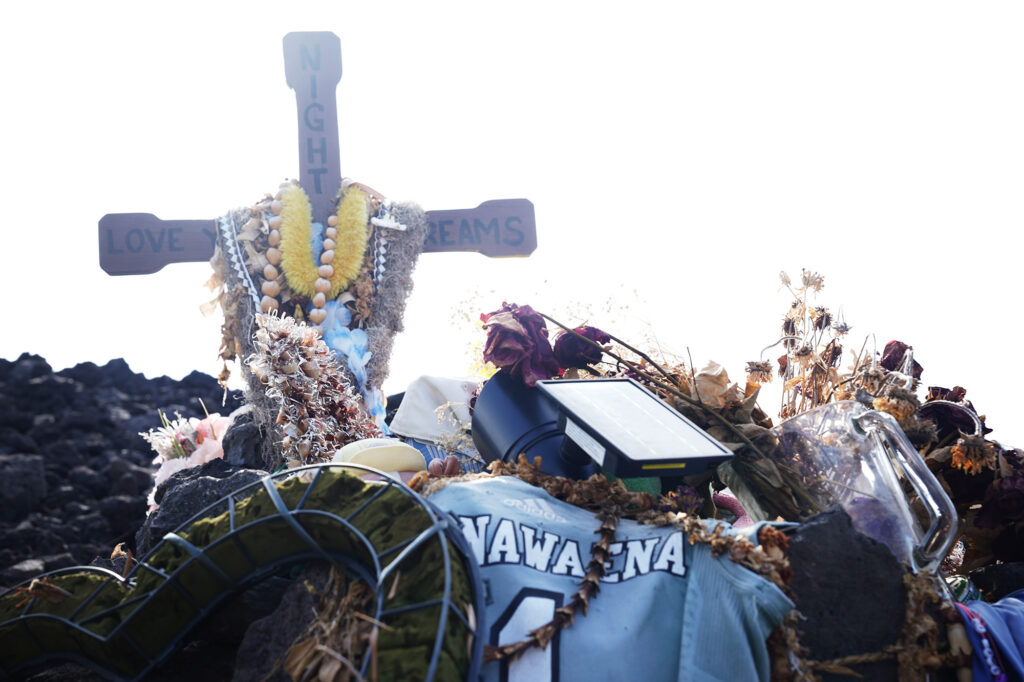
“It’s an extremely important public health issue for everyone,” Tyndall said.
Green’s executive order said the increase in deadly traffic accidents demonstrated the need to “reinforce behavioral change through education and accountability.”
State and county transportation officials say that safety is a priority, but roundabouts, speed bumps and pedestrian refuges are slow to implement.
Painfully Slow Prosecutions
Additional enforcement has been shown to be effective in reducing the toll in the short-to-medium term.
But prosecutions of negligent homicides are often painstakingly slow, and in at least 10 instances over the past two years, drivers fled the scene of the accident without being identified and were never apprehended.
In at least 20 of the fatal accidents on Oʻahu this year, the cause of the accident was not immediately known, according to the Honolulu Police Department’s Traffic Division.
Lt. Tamyra Torres from HPD’s vehicular homicide division said the problem is that cases often involve a range of factors such as speed, alcohol or drug impairment and distracted driving.
“In some incidents we are awaiting toxicology results or lab analysis, while in others we’re waiting to identify drivers who fled the scene,” Torres said.
Drivers fled from at least four accidents so far this year and six in 2024, data show. Torres said she could not comment on individual investigations or say how many had been later identified.
In other instances, drivers who were potentially at fault remained at the scene.
HPD traffic records for 2025 show at least 10 instances where a driver potentially contributed to the death of another motorist by turning contrary to a signal or disregarding a stop sign. Two of those motorists were arrested for alcohol-related offenses.
But it usually takes months of evidence gathering before the division can determine whether to refer charges to the Honolulu Prosecutor’s Office.
A lot of the unit’s work is information gathering by 18 HPD investigators, including tracking down additional witness statements and video sources. “Sometimes we get lucky where a city bus is in the area of the incident and usually have very good surveillance videos that we can recover,” Torres said.
The department could not say how many of the investigations from 2025 or 2024 had been closed, according to HPD spokesperson Kathleen Lee.
Eight negligent homicide cases have been referred to the prosecuting attorney by HPD this year, special counsel Christine Denton said in an email Tuesday. A deputy prosecutor has been assigned to handle all negligent injury and negligent homicide cases since September 2023, she said.
An automated camera enforcement program that catches speeders and people who run red lights will start issuing fines in November after months of only sending warnings, reported KHON2.
“If you’re not willing to penalize people for breaking the rules,” Tyndall said about the program, “then why even have the rules?”
Dangerous Roads For Pedestrians
The number of pedestrians killed in traffic accidents on Oʻahu through Sept. 29 was 18, equal to the total for last year, and the rate has been ticking up since 2023. Hawaiʻi island and Maui have both had seven fatalities and Kauaʻi had three this year. A dozen of the victims were homeless, according to the state Department of Transportation.
“A lot of your major roadways are these wide, fast and dangerous roads,” said Abbey Seitz, director of transportation equity at Hawaiʻi Appleseed Center for Law and Economic Justice. “That obviously is going to create an environment where it is particularly dangerous for pedestrians.”
Some pedestrians were killed while walking in areas that lack protective infrastructure, including a 90-year-old woman in a Kahuku neighborhood that doesn’t have sidewalks. The official posting from HPD said she was attempting to cross Leleuli Street outside a marked crosswalk at around 7:30 a.m. on Feb. 21 when a 27-year-old driver hit her.
Pedestrian deaths have been increasing throughout the country. That’s due in part to cars becoming bigger — and safer — for their occupants, but more dangerous for the people they hit, experts and officials said.
Hawaiʻi’s pedestrians are particularly vulnerable. Pedestrian deaths accounted for 18% of traffic fatalities nationwide in 2022. That same year, they accounted for 26% of fatalities in Hawaiʻi, a number that increased to 35% in 2024.
While men still account for about two-thirds of Oʻahu fatalities, a higher percentage of women have died this year, and the crashes have claimed more young people than in 2024.
At least 30 of the traffic deaths in 2025 — over 40% — were aged under 30, including three juveniles. Last year that figure was 20%.
Around 20 people aged between 60 and 90 were killed this year, about the same as 2024.

One of the June 17 fatalities was a 74-year-old woman who died after she was struck by a car while walking in a crosswalk on Makaloa Street in Ala Moana. The motorist left the scene and hasn’t been apprehended.
Six hours earlier, at 6:10 a.m., a 22-year-old man driving north on Kamehameha Highway near Haleʻiwa left the road and struck a tree. Investigators found no contributing factors, but he was not wearing a seatbelt.
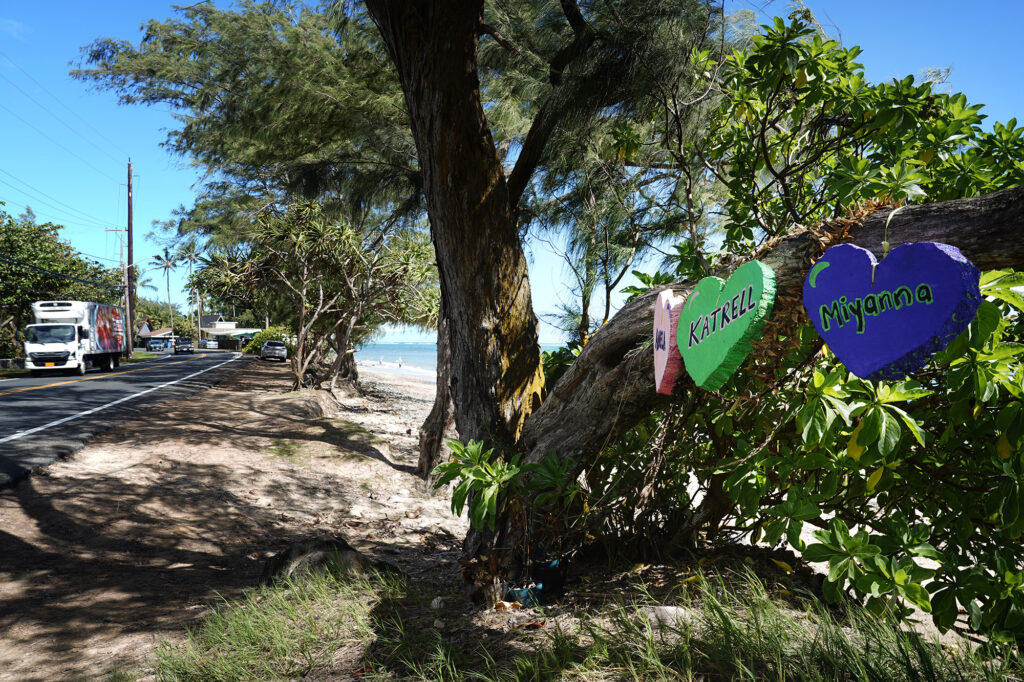
And just before 9 p.m., a car carrying four young women from the same family traveling south on Kamehameha Highway was in a head-on collision with a 17-year-old motorist at Punalu‘u.
Katrell Plunket, 28, and Miyanna Haiola, 19, died at the scene. Anela Yuen, 28, died nine days later, according to Honolulu’s Office of the Medical Examiner. A 19-year-old passenger and the 17-year-old driver of the other vehicle survived and were not identified.
Speed was believed to be a contributing factor in the Punalu’u accident, according to the HPD’s Vehicular Homicide Section, and none of the occupants were wearing seatbelts.
Disturbing Trends In Speed, Seatbelts And Alcohol
Speeding remains one of the most difficult driver behaviors to curtail, accounting for 30%, or 12,000 of all the traffic fatalities nationwide in 2023, according to the U.S. Department of Transportation.
But that same year speed was a factor in 58% of Hawaiʻi traffic fatalities — the highest in the country by 13 percentage points above Rhode Island.
The governor’s executive order did not specify how many of the fatalities from 2025 were speed-related, but a Civil Beat review of the Oʻahu accidents shows that speed contributed to at least 23 of the 65 traffic deaths so far this year, not accounting for open investigations.
The lack of seatbelt use was a factor in more than half of the traffic deaths statewide this year, according to the governor’s order — a sign that Hawaiʻi is also slipping from its position as a state with one of the highest rates of seatbelt use, according to the National Highway Traffic Safety Administration.
Hawaiʻi is also heading in the wrong direction in one other area – the percentage of accidents where drivers were impaired by drugs or alcohol.
Between 2014 and 2023, Hawaiʻi had the largest increase in impaired driving fatalities, increasing by 11 percentage points from 31% to 42%.
Of the 57 fatal motor vehicle accidents between January and August 2025, 25 of the deceased had some level of ethanol or other substance detected, including the presence of ethanol within the legal Blood Alcohol Content limit, according to data provided by the Office of the Medical Examiner.
The data was provided as a raw number, city spokesman Ian Scheuring said. “The Honolulu Medical Examiner does not make any determinations about whether or not those substances played a contributing factor in the accident involving the decedent.”
Hawaiʻi’s roads were developed largely after cars had become the dominant form of transportation, Tyndall and others said, and the transportation network therefore prioritized moving lots of cars quickly. Additionally, unlike on the mainland, where many crashes occur along vast stretches of interstate highway, pedestrians are more prolific on the island roads.
“You’re pretty likely to encounter pedestrians on everything except the few large highways we have,” Tyndall said. “So yeah, I think it’s just an exposure question: In Hawaiʻi you’re a lot more likely to be driving near to where you would find pedestrians.”
That’s especially true in Honolulu.
“We are a really dense city,” Honolulu’s Complete Streets coordinator Renee Espiau said. “But we designed our roads kind of like highways. So it’s sort of this incompatibility.”
Roads like Kamehameha Highway have single-family homes on them despite being hotspots for high-speed crashes. Crosswalks in urban Honolulu have been blacked out because the roads they span are dangerous for pedestrians, but that leaves people with longer distances to cross the street.
It took a long time to build this infrastructure, Espiau said, and it will take a long time to rebuild it to be safer.
That point was echoed by state Department of Transportation director Ed Sniffen, who said this year’s rhetoric focuses on individual behavior because that’s something that can change quicker than the built environment.
“As we’re moving forward with the infrastructure adjustments,” he said, “we’re moving forward with the education for the community and we’re trying to appeal to the community.”
Sniffen has become notorious for his department’s mass rollout of speed bumps. While some residents welcome them as a way to slow down traffic, others find them to be a nuisance.
“When we start putting in these speed humps in different areas, it’s to ensure that if a drunk driver is coming through, it’s going to disrupt their rhythm to ensure that they wake up a little bit,” Sniffen said. “If you’re driving distracted, that hump will bring you back to reality.”

The state is also trying to hasten the pace of bureaucracy. Sniffen said the DOT is using monitoring equipment and Google data to proactively see where people are speeding and braking hard. Those spots can then be targeted for infrastructure improvements before crashes occur.
“Infrastructure does take a long time,” said Seitz of Appleseed. “I think no one would deny that. But, at the same time, I think that we need to be treating this like the public health crisis that it is.”
Seitz said some safety improvements could be made quickly, like giving pedestrians a head start crossing the street at traffic lights, which Espiau acknowledged could be one simple and quick strategy.
Overall, however, projects live and die by funding.
President Donald Trump’s administration has sliced funding for billions of dollars in transportation projects, including projects that would reduce automobile capacity, Bloomberg News reported. Honolulu is pursuing projects like that, though Espiau and Sniffen said Hawaiʻi’s transportation agenda has so far come out unscathed.
Sniffen said he spoke with officials from the federal Department of Transportation Friday morning in light of the current government shutdown, which freezes federal spending.
“We’re in good talks with them,” he said, “to ensure that we can start seeing where we can get more adjustments, more investments from the federal government, to incentivize more safe travel.”