

Hawaiʻi DOE Wants Another $30M For A Facility That Hasn’t Been Built
The Department of Education is pinning its local food buying goals on a central facility, and the budget is getting bigger and bigger.
The Department of Education plans to ask state lawmakers for more than $30 million in additional funding next year to retrofit 19 school kitchens in Central Oʻahu so they can serve meals prepared at a centralized food facility.
The request will raise the tab to at least $85 million for the department’s planned 17,500-square-foot mega-kitchen in Whitmore Village, a food processing operation that is intended to provide a blueprint for similar operations statewide as part of efforts to boost local food production.
The centralized kitchen and the surrounding Central Oʻahu Food and Agricultural Hub are at the fulcrum of what Sen. Donovan Dela Cruz, who represents the area and chairs the Senate Committee on Ways and Means, has dubbed the “Nourishing Hawaii’s Future” initiative.
At least one lawmaker, however, is concerned about the ballooning cost of the massive facility, which is slated to be completed in fall 2027.

The education department had justified centralizing operations because it said it would be too expensive to renovate existing kitchens to be able to process locally produced food.
Rep. Amy Perruso is concerned the centralized kitchen is poised to eclipse the cost of renovating the existing kitchens, leaving the state with an inflated bill for what she believes is an ill-conceived project.
“I did back-of-the-envelope math for how much more this kitchen is going to cost us, versus the ʻĀina Pono program,” Perruso said in an interview, “and it’s staggering.”
Perruso, who represents the area in the state House, pointed to cost estimates for a previous ʻĀina Pono initiative, which was launched by former Lt. Gov. Shan Tsutsui and piloted by a handful of state schools from 2016 to 2018.
In the final ʻĀina Pono report, it was estimated it would cost $800,000 to retrofit Kauaʻi’s school kitchens to facilitate scratch cooking and, according to Perruso, about $19 million for the entire state.
Former education official Randy Tanaka, ousted in 2023, estimated that it would cost the state $10 million per kitchen — a number Perruso said is “super inflated.”

Having initially budgeted about $30 million for the Whitmore operation, the state would now be on the hook for north of $85 million to implement what would be the first of seven such kitchens statewide.
The Board of Education last week approved the department’s plan to request the additional $30 million to retrofit the school kitchens.
It will be part of the department’s overall budget request during the legislative session that begins in January. Department officials are also poised to ask for the creation of an additional 26 school food services positions to support the initiative, costing $1.2 million.
Perruso’s view has long been shared by advocacy groups, who pushed back against the project, though they have mostly gone silent since the state signed on contractors to build the Oʻahu facility and Senate leadership threw its weight behind the project.
Nourishing The Future
The education department has been developing the centralized kitchen model for several years since being tasked with integrating more local food into public school meals — 30% by 2030 and 50% by 2050.
The department missed its first mandated hurdle, failing to spend more than 5% of its food budget locally last year, even when including bottled water. In the meantime, education officials have reassured lawmakers that the centralized kitchen will be the panacea.

The model is built on the premise that the state can be a reliable customer for Hawaiʻi’s agricultural sector, providing security to farmers and ranchers by ordering large amounts before their crops are planted.
“It’s going to potentially provide an additional market, a dedicated market and reliable market that makes certain farmers get paid,” Hawaiʻi Farm Bureau Executive Director Brian Miyamoto said.
With greater security, the farmers and ranchers could theoretically scale up their production.
“What we want to see is additional growth in ag,” Miyamoto said. “We don’t want to just see a shift, of a farmer selling somewhere and just moving to sell to the regional kitchens.”
Within the kitchens, the education department will fully or partially prepare meals to be distributed throughout school complex areas, starting with the Whitmore facility, which will cater to the 19 Leilehua-Mililani-Waialua kitchens.
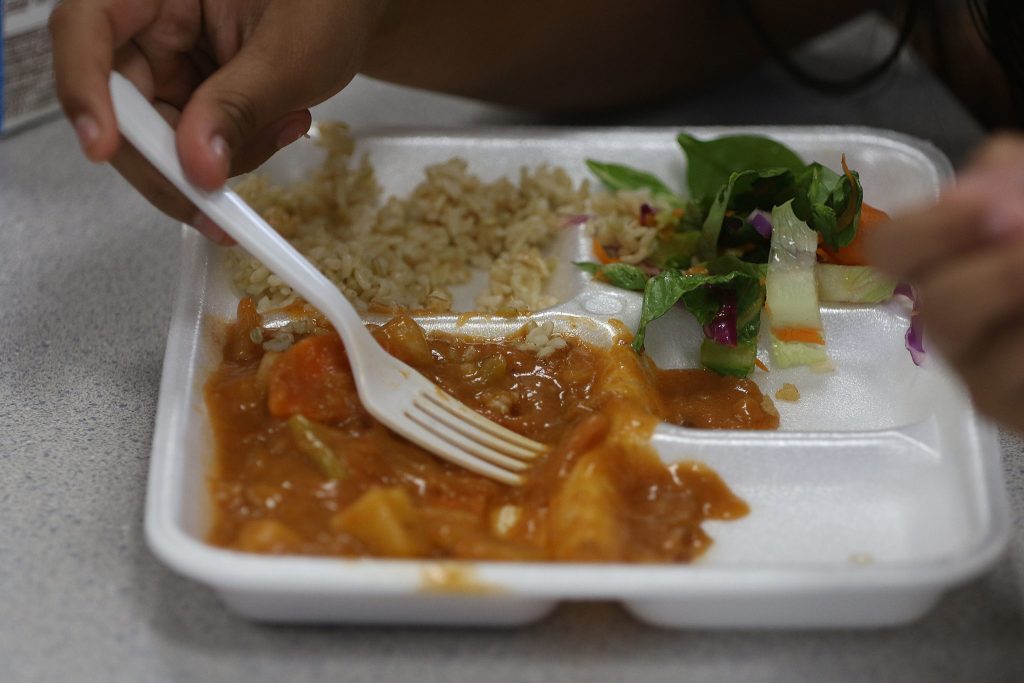
The vision has been compared to Zippy’s model of food preparation, with facilities that prepare spaghetti sauces or stews that are distributed to school kitchens to be reheated, like the popular Hawaiʻi fast food chain’s chili.
It will take about $30 million to retrofit the 20 kitchens within the Leilehua-Mililani-Waialua Complex Area so they can serve the food prepared in Whitmore, despite just 8% of the school kitchens and cafeterias being deemed in poor or critical condition.
Much of the approach makes sense on paper, according to Hawaiʻi Appleseed food equity director Daniela Spoto, but “there’s still a lot of unanswered questions about how these things will eventuate.”
What exactly that $30 million will go toward is unclear.
The Department of Education did not respond to several requests for comment.
Superintendent Keith Hayashi is scheduled to make a presentation Thursday on his agency’s vision to the Agribusiness Development Corp., which will be the agency’s landlord in Whitmore Village.
Expanding The Concept
The centralized kitchen on Oʻahu could become one of seven regional kitchens across the island chain, according to the state education department, which has already received $16.5 million to plan for sites.
The regional kitchen model fits into a broader scheme for the state, one that would see shared facilities built to help farmers reduce waste, add value to products and potentially help the industry build a stronger export market.

The food production campus will include cold storage, packaging and pasteurization technology, and about 100,000 square feet of warehouse space, among other things. Dela Cruz and state officials have drawn inspiration from other states and countries.
That includes Boulder Valley, Colorado, which Dela Cruz and state delegates visited to see how Hawaiʻi might tailor its approach. The delegates toured a regional kitchen, akin to the would-be Whitmore operation, as well as a slaughterhouse. The Legislature this year allocated $4 million for a slaughterhouse to be built in Kunia.
Dela Cruz did not respond to an interview request.
“Establishing regional kitchens in Hawaii will not only continue the efforts of diversifying Hawaii’s economy,” Dela Cruz wrote in an email newsletter last week, “but also ensure that every meal served helps sustain our farmers, our communities, and our keiki’s well-being.”
Civil Beat’s education reporting is supported by a grant from Chamberlin Family Philanthropy, and “Hawai‘i Grown” is funded in part by grants from the Stupski Foundation, Ulupono Fund at the Hawai‘i Community Foundation and the Frost Family Foundation.

