

Mainlanders Are Filling Up Kauaʻi’s Low-Income Housing Waitlist
The county plans to purge the list to help families in need as federal funding cuts loom over the Section 8 program.
On Kauaʻi, a long waitlist for low-income housing is bogged down by nonresidents, some from states thousands of miles away.
Temporarily closing the list, as the county plans to do next week, is more or less a housekeeping exercise aimed at awarding dozens of new Section 8 vouchers while purging unresponsive, far-flung applicants before reopening a fresh list, Kauaʻi Housing Director Adam Roversi said.
The federally funded Housing Choice Voucher Program, better known as Section 8, is a lifeline for Kauaʻi families struggling to afford the island’s astronomical housing prices. Since the current list opened five years ago, it has ballooned to include more than 3,000 applicants — more than triple the number of Section 8-eligible housing units on the island.
The county housing agency that administers the federal program has enough funding to underwrite about 30 new vouchers at this time, Roversi said.
The program requires the county to accept U.S. applicants regardless of where they reside. And although Roversi said the list is dominated by applicants who do not live on Kauaʻi, he said he expects few, if any, mainland-based applicants to relocate to access the housing subsidy.
Local agencies across the country that run the federal program typically close the list when they run out of vouchers. Kauaʻi is an anomaly in that the island’s designated number of vouchers exceeds the amount of federal funding available to underwrite them, so its waiting list stays open for long stretches of time. This can attract people in other states to join Kauaʻi’s waiting list, especially when the list in their own municipality is closed.
However, Roversi said county staff are not aware of any non-Kauai residents moving to the island to receive a voucher since he became housing director six years ago. Nevertheless, applicants from other islands and states continue to clog up the waitlist.
“Many things can be done online these days but to successfully find a rental and enter into a lease with a landlord is very difficult to do if you’re not physically present on Kauaʻi,” Roversi said.
Section 8 Pool Is Tiny
The nation’s largest housing rental subsidy program provides roughly $1.3 million a month to assist 856 Kauaʻi households with monthly rent payments. Vouchers allow tenants to put 30% of their income toward rent while the program pays for the rest.
The size of the program on Kauaʻi is partly limited by the availability of federal funding. Another hurdle is that even when people receive the vouchers, there are relatively few vacant rentals that accept it.
The island’s Section 8-eligible housing pool amounts to roughly 900 units, Roversi said. With 856 households already enrolled, this leaves few available units for future new voucher recipients.
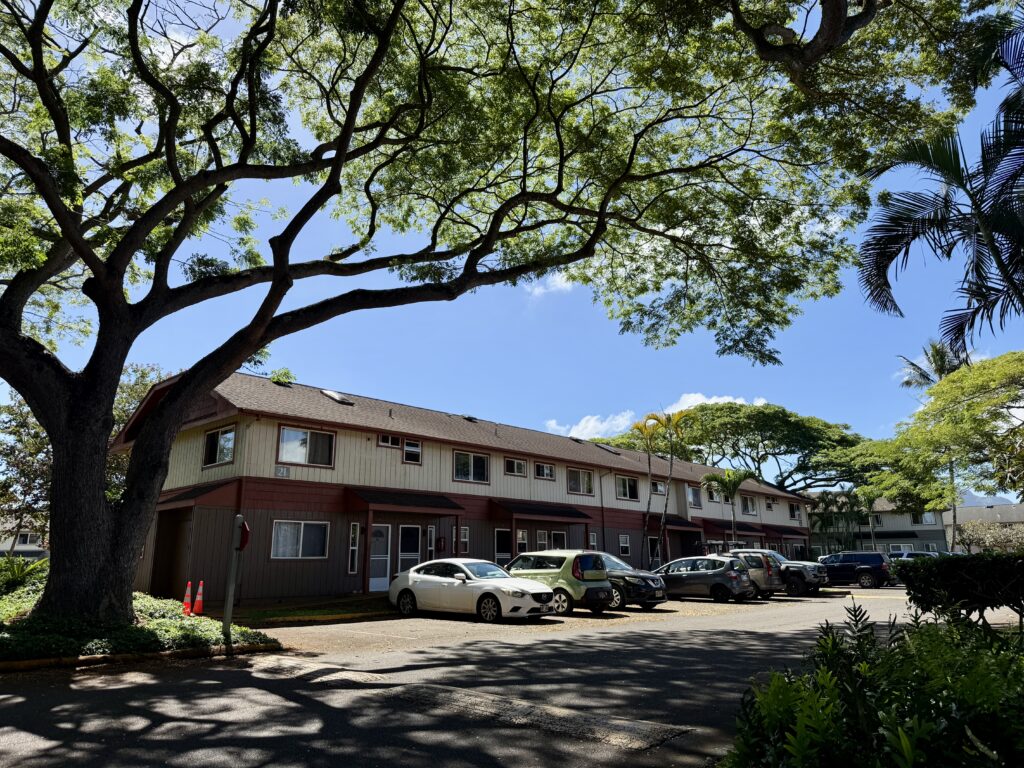
At Līhuʻe Court Townhomes, about a third of the 174 tenants receive help with rent payments from the Section 8 program, said David Nakamura, executive director of Mutual Housing Association of Hawaiʻi.
Nakamura, who runs the Honolulu-based nonprofit housing agency that operates the low-income rental housing complex in Līhuʻe, said the temporary closing of the Section 8 housing waitlist could affect some of the facility’s tenants who might be thinking about applying for a voucher, especially newer tenants.
“But a lot of our folks have been with us for awhile and it’s sort if like if they’re on the program then they’re on the program and if they’re not, they’re not,” he said.
Shutdown Looms Large
The Nov. 6 waitlist closure is not a reaction to the federal government shutdown, now the second-longest in the nation’s history. But Roversi said the shutdown does pose a looming threat to the program. Unless the government reopens for business, he said the Section 8 program is poised to run out of funding in mid- to late-November.
If the shutdown brings program funding to a halt, Roversi said the county has reserve funds it can tap to temporarily backfill the shortfall.
“We’ve had discussions about that with the mayor’s office and we have sufficient reserve funds to do that for a little while, but if the government shutdown continued for months and months, then we could not continue to use county money to pay people’s rents,” Roversi said.
It would be up to individual landlords to decide whether to evict their tenants, an action that may trigger court proceedings, Roversi said.
“If all of that plays out it could take a little while before people were actually getting kicked out on the street,” Roversi said. “Hopefully it never gets to that point.”
Meanwhile, roughly 168,000 Hawaiʻi residents will not receive their food stamps next month due to the ongoing federal government shutdown.
The U.S. Department of Agriculture has told states “there is not sufficient funding” for the Supplemental Nutrition Assistance Program and to “hold off on sending payments” for November, according to Scott Morishige, administrator of the state division that oversees SNAP.
At Līhuʻe Court Townhomes, Nakamura said the housing agency doesn’t track how many residents receive SNAP benefits but he noted that the residential complex is a Hawaiʻi Foodbank distribution site, making it easy for residents to stock up on essential groceries.
More broadly, Nakamura said he is concerned about a potential overhaul of the Section 8 housing program. Draft plans from the Trump administration would add work requirements and two-year time limits for people living in federally subsidized public housing.
“That could really be game-changing,” Nakamura said.
Civil Beat’s reporting on Kauaʻi is supported in part by a grant from the G. N. Wilcox Trust. Civil Beat’s reporting on economic inequality is supported by the Hawaiʻi Community Foundation as part of its work to build equity for all through the CHANGE Framework; and by the Cooke Foundation.

