

Packed Maui Animal Shelter Makes Desperate Plea For Help
The 2023 wildfires exacerbated the housing shortage on an island that’s already one of the hardest places to find a place to live with a dog or cat.
Volunteers and employees at the Maui Humane Society thought that they had reached a breaking point back in January. With more than 130 dogs in the organization’s care, overcrowding at their shelter in Puʻunēnē had become so severe that some dogs were doubled or tripled up in kennels while others were kept in offices.
Despite the group’s efforts to drum up adoptions, recruit more local fosters and increase pets’ visibility with potential adopters, the shelter population has only continued to grow. By mid-August, the number of dogs in Maui Humane Society’s care had ballooned to 193, according to Victoria Ivankic, the organization’s director of marketing and communications.
“Unfortunately, we’ve been dealing with capacity struggles for — gosh — years now,” Ivankic said. “But it just keeps adding up. We’ve gotten to a point where our capacity for care is just stretched beyond what is safe for our team to manage.”
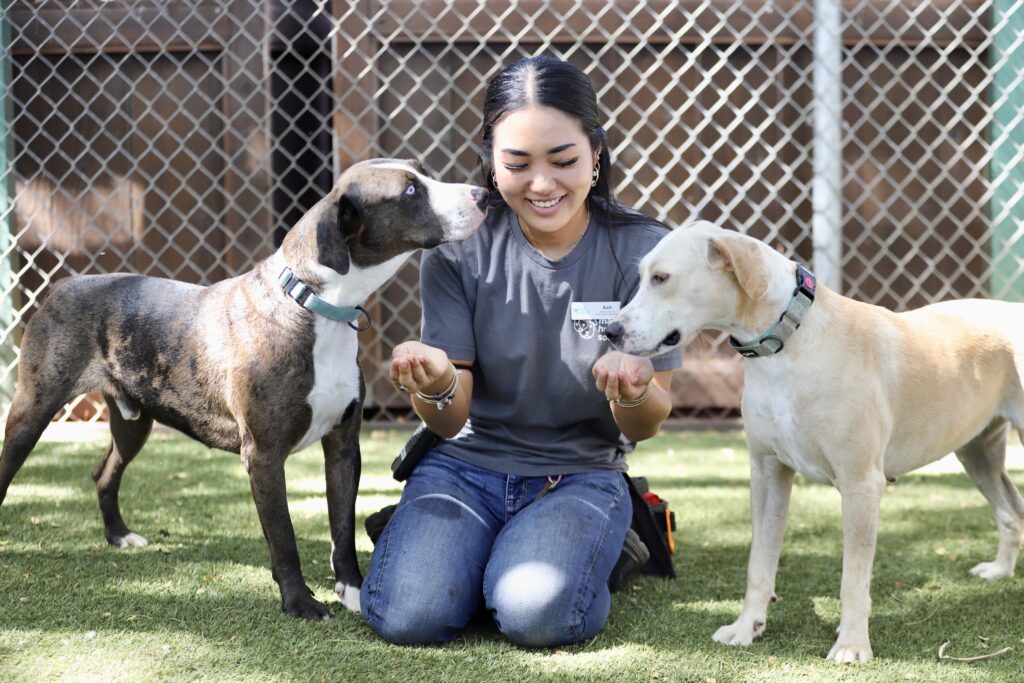
Hawai’i’s unique geography and isolation have long made the state’s shelters prone to overpopulation. The problem has become particularly egregious on Maui, where the 2023 wildfires exacerbated a longstanding housing shortage and wiped out many of the island’s pet-friendly housing options. Roughly 20% of those who surrender pets to Maui Humane Society cite lack of pet-friendly housing as a primary reason for their decision, according to Nikki Russell, the organization’s chief executive officer.
Just 39% of rental properties in Hawaiʻi allow pets — less than any other state, according to the Michelson Found Animals Foundation’s Pet-Inclusive Housing Initiative. In Maui County, roughly 28% of rental units allowed pets, said Ross Barker, the director of the initiative, which was created in the aftermath of Hurricane Katrina.
“Maui is definitely an extreme case because of the fires,” he said.
The number of adoptions has also been down, according to Ivankic, with 1,327 adoptions between Jan. 1 and Sept. 30, compared to 1,559 during the same period last year. Meanwhile, more dogs and cats have been coming in because of the closure of one of the island’s only other shelters at the end of last year and a new contract with the county government has required Maui Humane Society to take 107 rescued dogs from Molokaʻi since February.
Prioritizing Animals To Live
Earlier this month, Maui Humane Society made a desperate plea for help saving the most at-risk dogs. The society announced in a social media post that to make room for new animals, over 20 dogs with medical or behavioral challenges would be “humanely euthanized” unless they are adopted by Oct. 30.
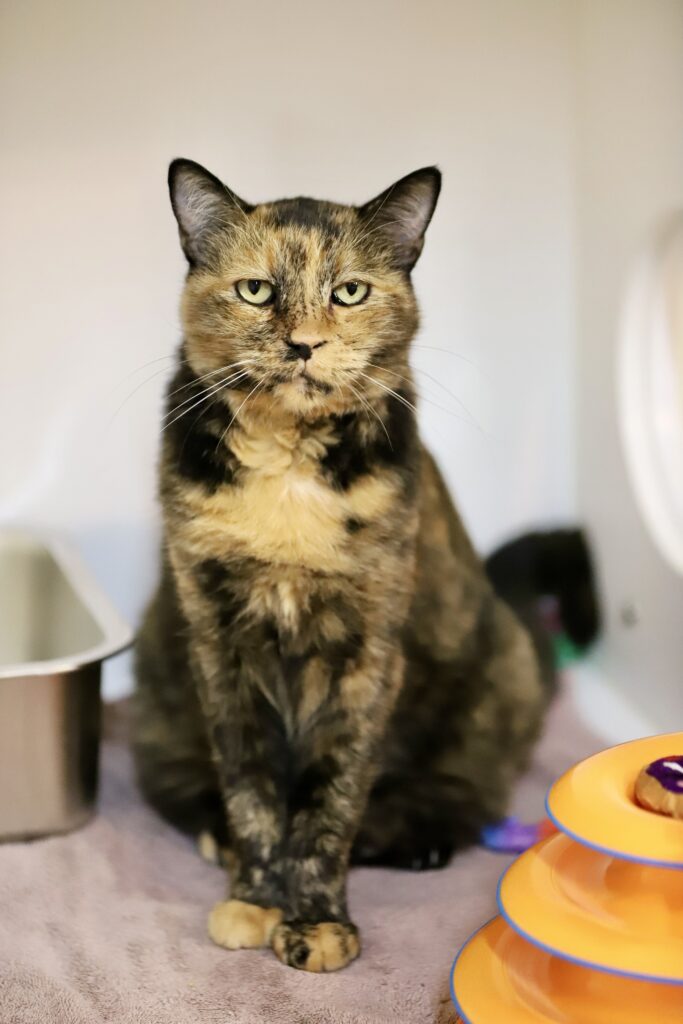
“As the only open-intake shelter on Maui, we have a responsibility to use our resources in ways that save the most lives and create the greatest impact for animals,” the social media post says. “To do this, we must prioritize animals with the highest chance of a live outcome.”
It’s never easy to make those kinds of announcements, Russell said, but some dogs are spending months in the shelter and reaching a breaking point.
“They’re barking at the front of their kennels, spinning and bouncing off the walls, no matter what we were doing,” she said, adding that shelter workers do a good job of giving dogs time outside of their kennels and opportunities for enrichment. “Every dog was getting out as much as possible, and it still wasn’t enough.”
As of Tuesday afternoon, 19 at-risk dogs have been adopted since the announcement, leaving only four more at-risk dogs in need of new homes, Ivankic said. A large number of adoption inquiries related to at-risk dogs have come from people who do not live on Maui, she added.
“People have really come forward,” Ivankic said.
So while the overcrowding problem persists the number of at-risk pets to be euthanized has fallen for now. On Tuesday, a sign at the shelter stated that there were 148 dogs, 355 cats, one rabbit and three red-eared sliders in Maui Humane Society’s care.
From January to September, 3,619 animals — predominantly cats and dogs — have come into the Maui Humane Society’s care. There have been 435 euthanizations during that time, 20 more than the same period last year.
“Because we are the only open-admissions shelter on Maui, animals come to us in all conditions,” Ivankic said. “When an animal’s medical or behavioral needs cannot be safely or humanely met within our capacity for care, or when continued care would cause unnecessary suffering, we make the compassionate decision to relieve that suffering.”
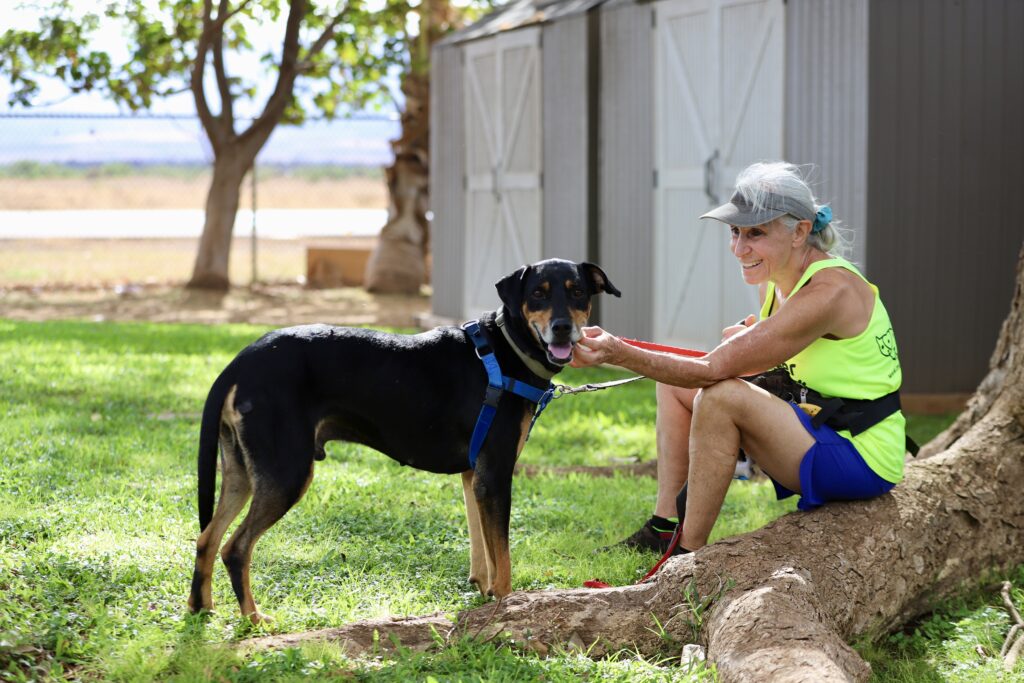
On Tuesday morning, shelter volunteer Alice Bennett beamed as she took a black and brown dog named Usher for a walk around the Maui Humane Society parking lot. Usher was shy and timid, but he had become a different dog since he was rescued from a house with too many animals six months earlier, Bennett said. That afternoon, Usher was finally expected to go home with an adopter, she said.
“It’s just the best,” she said about how she felt upon learning that Usher was on track for adoption. “He has come such a long way.”
Russell said it has been amazing to see so many dogs who have been suffering in the shelter environment get adopted, and she hopes people continue to show the same level of interest.
“Thank you to the people who are giving these pets an option, giving them a chance in a home,” she said.
Persistently Overcapacity
Brandy Shimabukuro, director of communications and marketing at the Hawaiian Humane Society on Oʻahu, said she empathized with Maui Humane Society’s staff and volunteers.
“We have absolutely been there, where we’ve been at our wit’s end, our staffing has just been pushed to the brink and our volunteers are absolutely constrained,” she said. “We’ve been persistently overcapacity for the past two years straight. There has never been a point where we have had empty kennels.”
Russell, Ivankic and Shimabukuro said they would like to see state and local governments provide more funding for animal shelters and pass legislation that would encourage landlords to allow pets and pet owners to spay and neuter their animals.
Earlier this year, Maui County officials increased funding for Maui Humane Society, in part
so the organization could expand its operations on Molokaʻi.
The widespread housing insecurity caused by the 2023 wildfires is certainly unique to Maui, Shimabukuro said, but “the lack of affordable, pet-friendly housing is impacting everybody in the state of Hawai’i.”
“Our cost of living is significantly higher than anywhere in the continental U.S. Having a career and trying to thrive in Hawai’i is really difficult,” she said. “You’ve got this perfect storm of conditions that make it so much worse in this state.”
Civil Beat’s coverage of Maui County is supported in part by a grant from the Nuestro Futuro Foundation.

