

Controversial Geothermal Firm Wants OHA To Invest $5 Million In A New Plant
Waikā Consulting said the agency’s involvement would lead to economic returns for Native Hawaiians, but it faced pushback from local communities on the Big Island.
This story has been updated to reflect additional information regarding OHA’s investment in a geothermal project in 2013.
A geothermal consulting firm that came under fire earlier this year during taxpayer-funded outreach efforts on the Big Island is asking the Office of Hawaiian Affairs for a $5 million investment in exchange for a stake in a future $275 million geothermal plant.
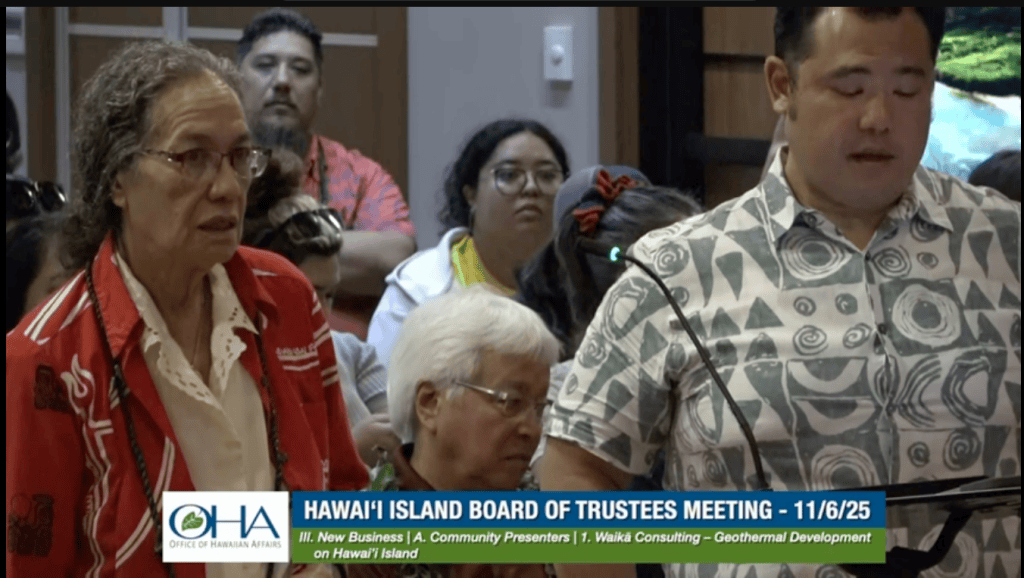
Principals and contractors for Waikā Consulting made their case to the OHA Board of Trustees on Thursday. The presentation indicated that the company would also seek $20 million from the Legislature next session.
The last geothermal investment by OHA in 2013, which also involved people related to Waikā, was a flop after Hawaiian Electric Co. rejected the project’s bid. An audit showed that OHA lost its money on that investment.
Geothermal energy is widely seen as one way to wean Hawaiʻi off fossil fuels as the island state strives to meet a goal of producing all of its electricity from renewable resources by 2045.
However, Hawaiʻi only has one commercial geothermal plant, and significantly more research is necessary to determine viable locations to host others. That prospect has faced vehement opposition from communities on the Big Island who believe that drilling into the Earth to tap its heat is unsafe and a desecration of the volcano goddess Pele.
In response to questions from an audience member, Board Chair Kai Kahele said trustees would not yet take a position on Waikā’s request. The agenda for the meeting only listed the presentation, and any action on funding would legally have to be announced in advance to give time for public comment.
The exact location of a future plant wasn’t specified during the brief presentation, although project proponents have acknowledged that more testing must be done to narrow down potential sites.
Promising Profit
Waikā President Ryan Matsumoto said the exploration and construction timeline could take about 10 years. A Waikā graph showed that OHA could expect between $25 million and $50 million in profit off a $5 million investment over 30 years.
OHA’s stake in the venture would amount to a 5% to 10% equity ownership depending on the size of the project.
Waikā has stumped for geothermal projects on a platform that its involvement would lead to economic returns for Native Hawaiians. The current geothermal plant in Puna is owned by the international company Ormat Technologies.
“If we don’t get the seat at the table in terms of the governance of this project so we can incorporate our values, our manaʻo,” said Mālama Solomon, a former senator who has been working for Waikā, “then we should not proceed.”

Waikā said it is looking for other investors and would put in $10 million of its own money as the general partner in the project. It also plans to seek $20 million from the Legislature in exchange for an unspecified stake for the state in the project.
Rep. Greggor Ilagan, who leads the House economic development committee and represents Puma, said in a phone interview that he hadn’t yet heard of Waikā’s proposal, but he supports geothermal energy so long “as we do it safe and effective.”
However, Ilagan said he is more focused on ensuring that the Puna Geothermal Venture, the current plant on the Big Island, gets up to maximum capacity. The plant has attained just a little over 25 megawatts of electricity despite plans to attain at least 38 megawatts.
“I’m more concerned with the existing plant than I am developing more geothermal in my area,” Ilagan said.
Negative Community Feedback
Earlier this year, Waikā hosted a series of contentious community meetings under a $3 million state contract for community engagement.
It got more negative reaction at Thursday’s meeting.
Bronson Azama said he opposed geothermal developments on Big Island over concerns that “cataclysmic landslides” could strike in areas where geothermal plants may be sited.
Sky Kauinoa, who originally came to testify on the military’s use of land, also pushed back against the funding request.
“I’m pissed,” she said. “And I’m even more pissed now after that geothermal presentation and those ridiculous asks.”
This wouldn’t be OHA’s first venture with geothermal.
In 2013, the OHA Board of Trustees approved a $1.3 million investment in Hu’ena Power, a partnership between the Eastland Energy Group of New Zealand and Waikā’s parent company that was controlled by local businesswoman Robbie Cabral.

The partnership planned to compete for a geothermal bid put out by Hawaiian Electric Co. but ended up losing money for its investors.
The deal with OHA came under fire by the Council for Native Hawaiian Advancement, now known as the Hawaiian Council, for a lack of transparency in the process. A year later in 2014, then-Trustee Oz Stender, a former Kamehameha School’s trustee who previously had been a proponent of Waikā, also said the investment was done with little financial analysis, according to minutes of the board meetings from that period.
Past Problems
By then, the project had already gone sideways. HECO rejected all the bids it received, then issued a new request for proposals that critics said favored PVG’s owner Ormat Technologies.
Hu’ena appealed to state regulators but lost out after the Public Utilities Commission determined that the company’s proposal would force consumers to pay higher rates.
“Instead of competition on a level playing field, Hu’ena seeks to be the only player in the game and to make all the rules,” commissioners wrote in an order denying Hu’ena petition.
Trustees in 2015 appeared convened closed-door sessions to discuss the investment but refused to talk about it publicly, the Hawaii Tribune-Herald reported.
Auditors who conducted a sweeping review of the office’s contracts and expenditures during that time period found only $600,000 in disbursements tied to the project, half the amount approved by the board. The audit also noted that OHA may have pulled back on the geothermal funding.
A separate report from 2019 couldn’t find documentation on how those funds were used and concluded that the office didn’t recover its money from “a highly risky investment from which OHA received no return.”
Eastland divested from the Hawaiʻi venture in late 2014 and noted a $1.2 million loss on the project in its annual report for that year.
“Significant experience, knowledge and capability were gained and these learnings will be applied to New Zealand geothermal projects,” the report said.
Cabral put it more bluntly in an interview in July: “We all ate it,” she said. “We all ate it together.”
Civil Beat’s coverage of environmental issues on Hawaiʻi island is supported in part by a grant from the Dorrance Family Foundation.

