

Honolulu Fire Department Relied On Risky Tactic In Deadly Blaze
Firefighters have a mantra: Risk a lot to save a lot. But a newly uncovered federal investigation into a firefighter’s death cautions fire departments against risking everything when they don’t know whether there’s anyone to save.
Heavy black smoke and flames were billowing from the first-floor window of the McCully home by the time Honolulu Fire Engine 9 arrived.
The kitchen of the residence on Young Street had been overtaken by the blaze, and Engine 2 firefighters were blasting it with water from the outside. To the acting captain of Engine 9, the hose team looked like they’d soon have the fire under control.
The next order of business would be to search the home for anyone trapped inside, he reasoned, according to an incident report he wrote later.
So his crew, including 25-year-old rookie Jeff Fiala and two other entry-level firefighters, entered the home. And they did so without a hose — a tactic the Honolulu Fire Department had embraced as an option in 2022 and incorporated into its standard operating guidelines just 18 months before the Young Street fire.
Within minutes, firefighters were scrambling for their lives, and Fiala suffered injuries that ultimately led to his death.

In the wake of the fire, current and former Honolulu firefighters are questioning the use of these so-called unprotected searches.
Proponents of the strategy argue it’s a useful tool for saving civilian lives. Unprotected searches allow firefighters to look for trapped occupants in a burning building without being slowed down by heavy equipment.
But its critics see it as a reckless practice that gambles with firefighter lives. And national workplace safety investigators determined it was a key contributing factor in Fiala’s death, according to an investigation obtained by Civil Beat that has not been reported on previously.
“The only exception for entering a structure without an operational hose line is when an occupant can be seen or heard within a few feet of the structure entry or the fire area,” said the report by the National Institute for Occupational Safety and Health.
In the end, it turned out that there had been no occupants in the Young Street fire to save.
Fiala’s death ended a remarkable decades-long streak in which the Honolulu Fire Department had no fire-related fatalities. His passing marked the first time a Honolulu firefighter was killed in a fire since the attack on Pearl Harbor in 1941.
The Young Street tragedy is now raising questions about whether unprotected searches are worth the risk and whether Honolulu crews are adequately trained to conduct them safely. Some are calling for HFD to reverse its policy.

The Hawaiʻi Fire Fighters Association has requested a meeting with HFD leadership to discuss the issue and has called on all island fire chiefs to run new training proposals by the union.
Union president Bobby Lee, who served as a Honolulu firefighter for 36 years, told Civil Beat he was shocked to learn upon Fiala’s death that HFD was doing unprotected searches. He believes the department should revert to its past practices.
“The No. 1 priority is firefighter safety,” he said. “We have to be able to protect ourselves. We cannot help anybody if we cannot protect ourselves.”
Hawaiʻi workplace safety investigators determined after Fiala’s death that the Honolulu Fire Department had failed to ensure its supervisors could recognize hazards, maintain safety and health protections and reinforce employee training. The agency fined HFD $16,550 for what it labeled a “serious” violation.
So far, the Honolulu Fire Department has not made any policy changes. Department leaders told Civil Beat there is an ongoing internal review of the Young Street fire, however, which will result in recommendations.
“It’s a tragic accident that we can learn from,” HFD Assistant Chief Joe Kostiha said.
In the meantime, unprotected searches remain an option.
‘Mayday, Mayday’
Detractors of unprotected searches note that fires are dynamic environments that can seem manageable one moment and become deadly the next.
Indeed, on Young Street, it only took two minutes for everything to change, according to the federal investigation.

The four firefighters of Engine 9 entered the home to discover what appeared to be favorable conditions, the acting captain wrote. There was only light smoke present, and visibility was excellent. The lights were still on, and the fire seemed to be contained to the kitchen, which was located behind a closed door in the back of the home.
Weighing the risk with what the acting captain considered the importance of initiating a search early, he decided to proceed.
The crew that included Fiala had barely made it to the second floor to search for possible victims when fire started rapidly climbing the stairwell with the intensity of a blowtorch, the acting captain said.
Moments earlier, a member of another search crew downstairs had kicked down the door of a bedroom that they likely did not realize was connected to the burning kitchen, fueling the flames with oxygen and spreading the fire throughout the first floor.
On the second floor, the acting captain said, the fire was suddenly on top of them, they couldn’t see anything, and the heat was stinging the captain’s ears, arms and legs.
The acting captain radioed a distress signal. He called for water.
“Mayday, Mayday, Mayday,” he said. “E09 on the second floor, we’re cut off by fire. We have flames coming up the stairwell. We need help. We need a line.”
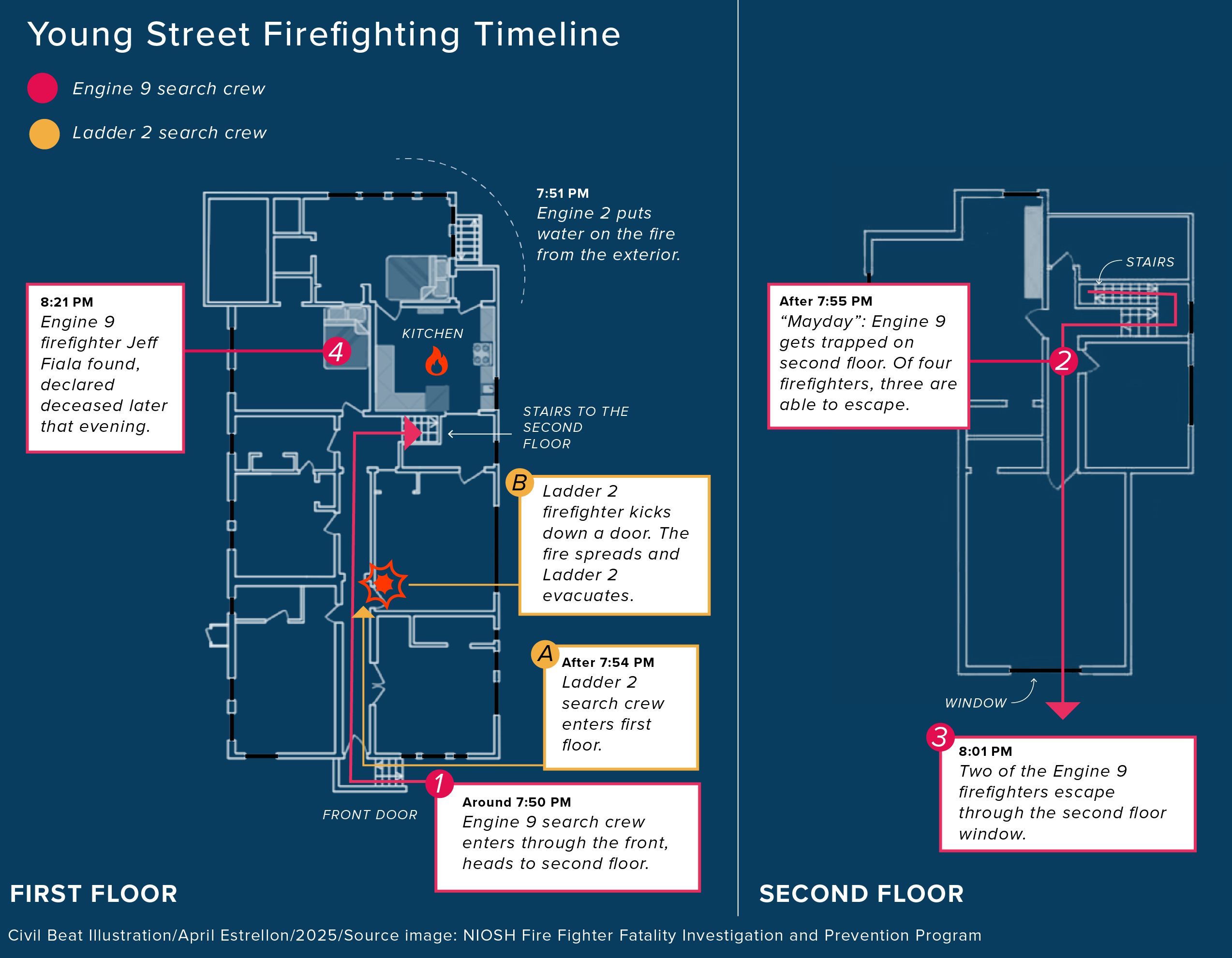
But a hose line didn’t come. The downstairs search crew had also entered without a hose line. The rapidly spreading fired forced them to evacuate.
Engine 9 was trapped on the second floor, alone.
Desperate to find a way out, the acting captain and one of his crew members burst through a bedroom door with an axe, climbed out a window and descended a ladder to the ground. A second crew member also escaped, although city and federal records don’t indicate how.
Meanwhile, the fire raged on and the roof of the home partially collapsed.
Fiala was missing for about 20 minutes before another firefighter found him in a first floor bedroom. He was declared dead at the hospital that evening, having succumbed to burn injuries and inhalation of combustible materials, according to the Honolulu Medical Examiner.

Before becoming a Honolulu firefighter, the 2017 Radford High School graduate studied at the University of Hawaiʻi, according to his obituary. He had entered HFD’s 115th recruit class in July 2023 and became a full-fledged firefighter in March of last year — just nine months before his death.
Fiala was known as an enthusiastic and positive person who was fiercely devoted to his family and friends and was always ready for an adventure, his remembrance states.
Honolulu held a final salute for Fiala in January. Hundreds gathered to pay their respects as bagpipes blared during a solemn procession of emergency vehicles traveled through closed streets. A fire department helicopter dropped flowers from the sky, a public display of the department’s grief.
In a statement for the funeral, Fiala’s family said he was very proud of being a firefighter and loved serving the public.
“We know at the end of Jeff’s life, he was working as a team of professionals searching for life, searching for a stranger in need,” they said.
Fiona Fiala, who he married in November 2023, declined to be interviewed for this story. In a written message to Civil Beat, she said only that “Jeff is loved and missed beyond words.”
A Desire To Save More Lives
For decades, the Honolulu Fire Department took a more risk-averse approach to searches, several department veterans told Civil Beat.
“We didn’t use that technique,” retired battalion chief Keith Yasui said of unprotected searches. “We never used to do that.”
Back in his day, Yasui said, firefighters had to be able to see someone who could be rescued, for instance a person yelling out of the window of a burning home. Only then would firefighters make the call to go in, he said, and even then, they’d want a hose line to help combat fire and provide a pathway back out of the building.
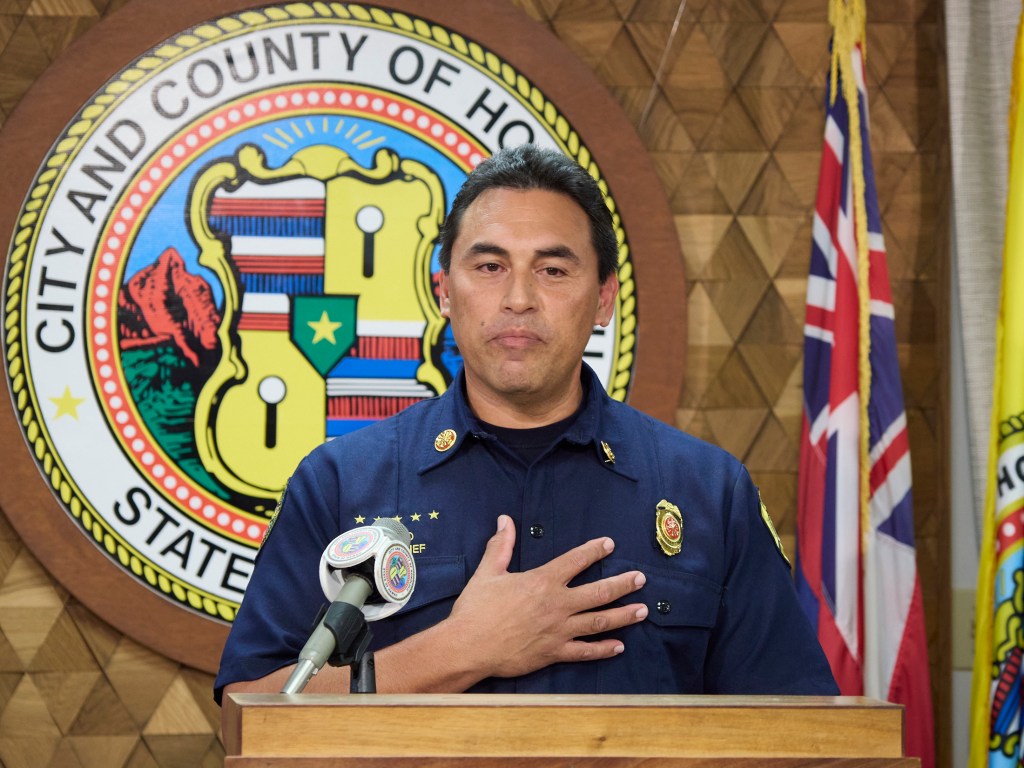
That changed after Fire Chief Sheldon Kalani Hao took over. Hao declined to be interviewed for this story but made two of his subordinates available, Kostiha, the assistant chief, and Battalion Chief Justin Brownfield.
Previously, searching was not a priority until the fire had been put out, Brownfield said.
In the past, Kostiha and Brownfield said, HFD lacked written standard operating guidelines, so searches were conducted at the discretion of captains, who would either order their crews to search or not, depending on their risk assessments.
Kostiha said he himself has searched without a hose line in cases that he felt were “tenable.”
When Hao took over as chief, there was a desire to align HFD with national practices to save more civilian lives, Brownfield said.
“I don’t think that we’re serving the public that we’re here to serve by not doing the tactics and tasks that we’re able to do,” he said.
Unprotected search training was conducted in the second half of 2022, according to Kostiha. And the department put the strategy in a written standard operating guideline in July 2023. During a search, it says, “a fire attack hose line should be readily available if needed.”
“If needed” is left undefined.
“Does the individual who makes the decision have all the right tools to make that decision of what is needed?” Lee asked. “That’s really the question.”
The rollout of the training was somewhat controversial in the department, several current and former firefighters told Civil Beat, with some openly questioning its safety. According to Lee, some captains privately told their crews, in essence: We’re not doing that.
Those who objected were the “older, more seasoned guys,” Lee said.
Kostiha, who leads the fire operations division, noted that there were valid reasons HFD introduced unprotected search training.
He described firefighting as a high stakes balancing act between saving civilian lives and keeping firefighters safe — one that involves split-second decisions. In his career, Kostiha said, he tried to respond to burning buildings as if someone he knew was inside.

“I treated every call that way,” he said, “and I made decisions based on that feeling.”
The trouble is that the line between potentially saving one life and risking another isn’t always clear.
“If I felt like I could dominate the risk to the point where I can do something, then I would,” Kostiha said. “But if I get somebody hurt or killed, then I wouldn’t do it. But you don’t know that, right? You cannot ever know that.”
Other than advising against unprotected searches, the NIOSH report made several other recommendations.
The agency urged HFD to use higher-capacity hose lines for tougher fires, conduct training on fire flow paths, be more proactive about firefighter rescue operations and ensure the Honolulu permitting department communicates change of occupancy information with the fire department.
In the case of the house on Young Street, a single family home was converted into apartments decades ago, possibly before the city had a process for alerting the fire department. Officials at HFD and DPP said they did not know when exactly that process started.
If the conversion were done today, HFD Assistant Chief Reid Yoshida said, it should trigger a notification to the Honolulu Fire Department, which would do an inspection to inform its response to future fires. Yoshida said HFD and the permitting department are in talks to improve their communication.
Lack Of Consensus On Unprotected Searches
There are different schools of thought within the firefighting profession about unprotected searches.
To Bob Krause, a retired battalion chief in Toledo, Ohio, who has studied firefighter fatalities, searching a burning building without a hose line is “risky business.” The hose is useful not only to provide water but also as a guide for a firefighter to retrace his steps out of a building if he gets disoriented.

“It’s going to be much slower,” said Krause, who also works as an emergency services consultant. “It’s a little bit harder. But it’s very, very high risk – very high risk – without the hose.”
New York City fire Lt. Dan Gordon has a different point of view. At FDNY, he said, unprotected searches are routine. And he cited a voluntary national survey by firefighterrescuesurvey.com that found the majority of rescues reported to the website were done without a hose line.
“We’re here for the people we serve, and if we’re unwilling to search for them, then what are we doing?” he said. “Is it possibly dangerous? Absolutely. Should we tell police they shouldn’t respond to armed robberies because there’s a gun? To me, that’s kind of the same thing. Yes, there is some level of danger.”
Asked about NIOSH’s recommendation not to enter without a hose line unless a specific victim is seen or heard, Gordon said he would “emphatically disagree with that.”
It’s not always obvious that people are trapped in a burning building, and the longer they are exposed to heat, smoke and burning toxic gasses, the worse off they are, Gordon said.
“During that time that we’re waiting for a hose line,” he said, “they’re being exposed to all those.”
How long that delay could take is highly dependent on the department and specific circumstances, according to Gordon.
“I don’t think anyone took this job not knowing that there was going to be some risk,” he said.
That’s not to say unprotected searches are done at every New York City fire. If the fire is too heavy, there are strong wind conditions or a delay in establishing a water source, Gordon said that would factor into the firefighters’ risk assessment.
“Is it possibly dangerous? Absolutely. Should we tell police they shouldn’t respond to armed robberies because there’s a gun? To me, that’s kind of the same thing.”
Lt. Dan Gordon, New York City Fire Department
Lee noted that Honolulu’s building construction is vastly different from that of New York City. The islands have a lot of single-wall construction that burns quickly, he said, compared to skyscrapers and walk-ups built to withstand snow.
“What may work on the mainland is not necessarily what we want to do here,” he said.
Krause said he was more on board with unprotected searches when he was younger.
“As I got older and as I got smarter, I realized the value of searching with a hose line,” he said. “Is it slower? Yes. Is it better for you and any potential victims? Yes.”
Toledo, where Krause worked for 31 years, learned a lesson from its own tragedy: In 2014, two local firefighters died after entering the second story of a burning building with an uncharged hose line — one without water readily available in it.
Unprotected searches on a second floor, above a fire are a “no-no,” Krause said.
“You don’t go above the fire,” he said. “That is taboo.”

Krause understands a firefighter’s desire for speed. But if the end goal is to find survivors, he said, you’re going to want water to keep them safe, as well as yourself.
Krause noted though there is a risk in making any policy too rigid. After Toledo’s firefighter fatalities, the department implemented a policy that stated, in essence: You shall not enter a burning building without a hose line that is charged, or preloaded, with water.
After that came down, Krause recalls there was a fire in which a woman reported her husband was on fire on the second floor. Firefighters did not enter.
“They did not go in the building, just up a flight of stairs to snatch this guy, until they were looking for a charged hose line,” he said. “I got there, and I looked up the stairwell, which was 15 feet up, and I ordered crews: ‘Get up there and get that guy.’ And they went, snatched him and brought him out, and he was burned horrifically.”
The man died, Krause said, and the fire captain was demoted, although the discipline was later reversed.
“You have to give them a little bit of leeway, guided by experience and training,” Krause said.
Honolulu’s policy should be augmented to say more than just that a hose line should be on hand “if needed,” according to Krause.
“A young firefighter may not understand what that means,” he said.

