

Longtime OHA Leader Rowena Akana Has Died
Her tenure as a trustee was marked by a commitment to Native Hawaiians but also ethical challenges and board power struggles.
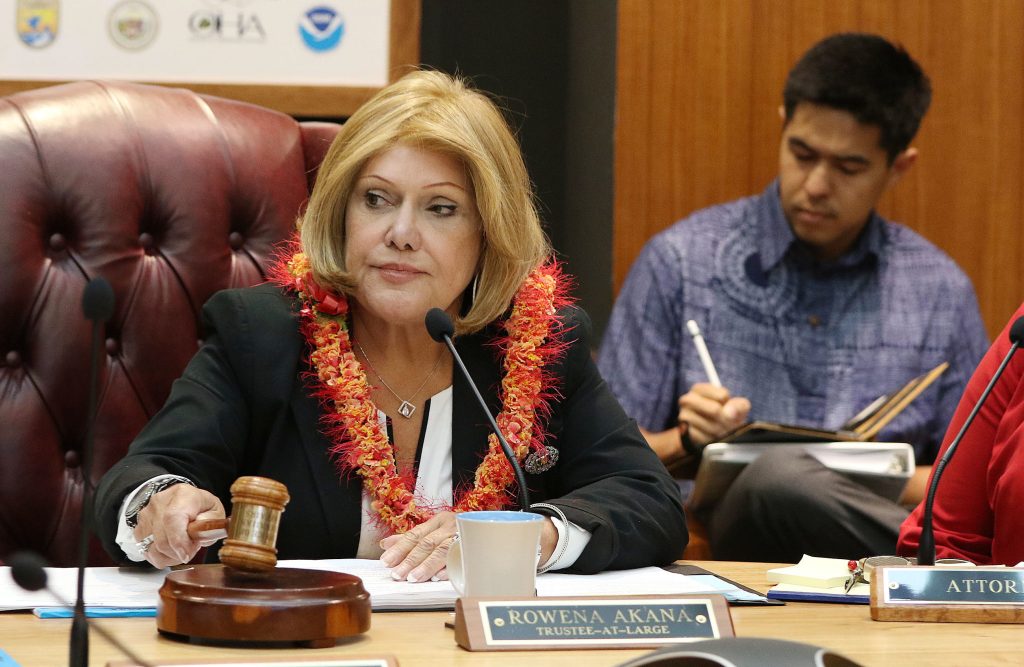
A long-serving member of the Office of Hawaiian Affairs Board of Trustees, Rowena Akana, has died. She was 82.
OHA announced her death Thursday. Further details were not immediately available.
First elected to a seat on the OHA Board of Trustees in 1990, Akana served nearly three decades in office. She was elected seven straight times and served twice as board chair.
She believed that OHA needed to have better control of its finances. A top issue for her was the housing crisis faced by many Native Hawaiians. Akana wanted OHA to partner with developers to build housing so that more Hawaiians could begin to rent or own their own homes.
But Akana was also often embroiled in ethical conflicts and clashed publicly with others at OHA over its leadership, finances and mission.
She served as board chair from 1998 to 2000 and — briefly — from December 2016 to February 2017, after the 2016 OHA elections changed the board’s composition. A majority of members soon voted to dismiss Akana as chair.
“She has caused nothing but turmoil in this organization since being elected chair,” Trustee Dan Ahuna said at the time. “And just within the last 48 hours she has gone on a spree personally attacking other trustees and she unilaterally filed a lawsuit yesterday on behalf of OHA that will likely end up being found frivolous.”
Still, Akana lost reelection in 2018, blaming negative publicity from “trumped up charges” brought against her by the Hawaiʻi State Ethics Commission just two weeks before the election, as she told the Honolulu Star-Advertiser.
Akana was charged by the Ethics Commission with accepting prohibited gifts, failure to report the acceptance of the gifts and for using her office for personal benefit. Her attorneys at the time, Bickerton Dang, rejected the claims.
Akana herself defended the expenses as allowed under OHA policies. She questioned whether the Ethics Commission had jurisdiction over the $600 million trust, a quasi-state agency dedicated to the well-being of Native Hawaiians.
In 2019, the Ethics Commission levied a $23,000 fine against Akana for 47 violations of the state ethics code. the former trustee appealed the ruling, a matter that was not settled until this September, when the Hawaiʻi Supreme Court said in a unanimous opinion that OHA trustees are considered state employees and must abide by the code.
“OHA is not a political subdivision such that it requires a separate ethics apparatus,” then-Chief Justice Mark Recktenwald wrote.
The justices also said, however, that the Ethics Commission should defer to OHA’s bylaws and internal policies. The high court said it recognized the OHA Board of Trustees’ broad powers to improve the lives of Native Hawaiians.
Kai Kahele, the current OHA chair, said in a statement Thursday marking the passing of Akaka, “Though her tenure was marked by challenges, her commitment to community, Native Hawaiian lands, and strengthening resources for our people reflects the deep sense of ʻohana and stewardship she carried. As we mourn her passing, we also acknowledge the many years she dedicated to the welfare of kūpuna, Hawaiʻi’s cultural legacy, and advocacy for Hawaiian self-determination. May her memory be a source of inspiration and may her spirit rest in strength and aloha.”
According to her website, Akana was a graduate of Roosevelt High School and attended Kapiʻolani Community College, the University of Hawaiʻi and New York University. The website said she was a former newscaster, an abuse counselor and substitute teacher for the Department of Education.
Akana’s website also said she was a member of several East Honolulu community organizations.
In a candidate Q&A for Civil Beat in 2018, Akana said she believed OHA was fulfilling its mandate to serve Hawaiians. But she said OHA was still not getting its fair share of ceded-land revenues from the state, a long-standing issue.
“I have always advocated for our beneficiaries to make sure that our trust dollars are spent on their needs,” she wrote. “Housing, health, education, loans, grants and lawsuits that force authorities to live up to their responsibilities to Hawaiians.”

