Rail Work Is Causing Pedestrian Hazards And Headaches On Dillingham
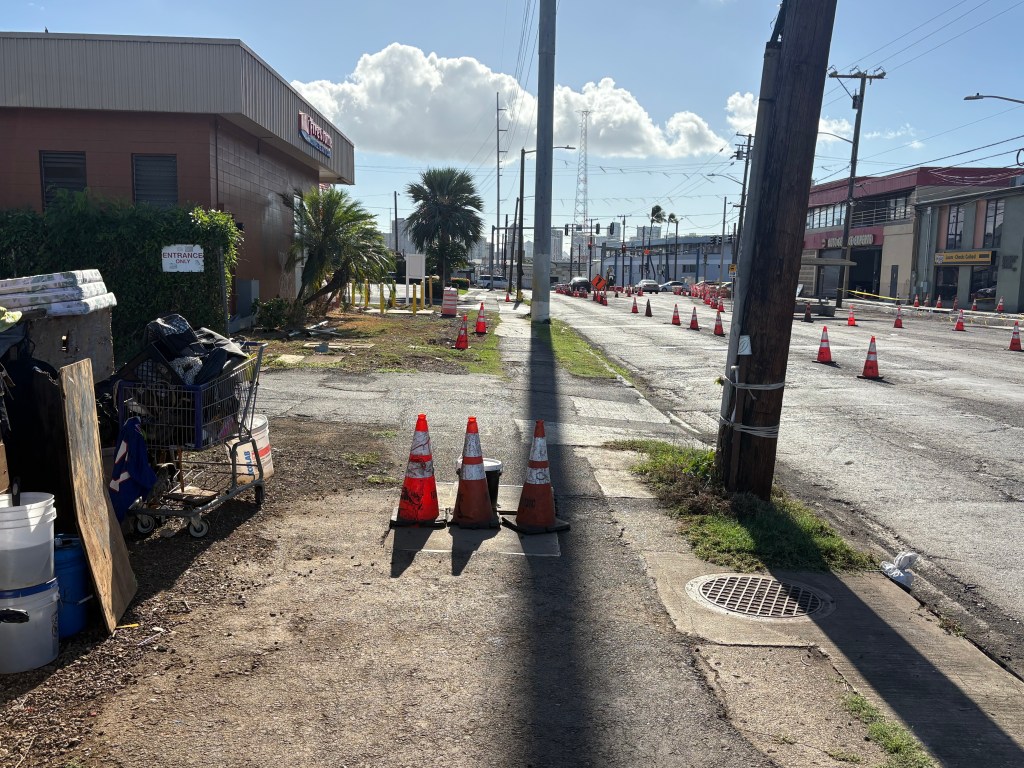
Construction crews have torn up not just the streets but also the sidewalks, leading to potential ADA violations.
In recent years, Skyline rail construction has turned Honolulu’s Dillingham Boulevard into an obstacle course for drivers, complete with cones, detour signs, metal plates and heavy equipment used to dig up the street.
That’s also made it an obstacle course for nearby pedestrians, such as Kalihi resident Lisa Jaso, who use the Dillingham sidewalks that haven’t been closed by the construction to get around the neighborhood.
Jaso, who’s legally blind, said she’s almost fallen several times while trying to navigate sidewalks near her home on McNeil Street that are obstructed by large detour signs, cones and uneven terrain.
“They need to make it safe,” Jaso said.
Jaso said she raised the issue with Honolulu Authority for Rapid Transportation officials in September during a neighborhood meeting on station design “and they kept trying to tell me to stop” because her concerns were off-topic.
Neither HART nor city officials responded to a request this week to discuss the Dillingham pedestrian issues.
Jaso also raised the issue with the Hawaiʻi Disability Rights Center, which advocates for people with disabilities.
“We’ve been on it,” Louis Erteschik, the center’s executive director, told Civil Beat last week. “It’s clearly still unresolved.”
The center, Erteschik said, made its own inquiries into the problem with the city and the state Health Department’s Disability and Communication Access Board.
That board, Erteschik said, told him in October that there appeared to be a number of Americans with Disabilities Act violations along the Dillingham corridor. The city’s ADA program manager told him on Oct. 8 that the city had addressed several of the concerns there by removing roadway signs blocking the sidewalk as well as a dust fence on Mokauea Street.
The manager further told Erteschik the city had addressed concerns regarding steel plates and plywood in the walkway.
Yet the sidewalk remains dotted with plates, obstructions and uneven terrain.
“They’re making a — what’s the word I’m looking for? — Half-ass … passage for people to walk through,” Jaso said, who called the efforts “a Band Aid.”
Erteschik said he also reached out in early October to Joey Manahan, who was HART’s government relations director, but didn’t get a response. He followed up with Manahan on Wednesday but got a reply that Manahan’s last day at the agency had been Nov. 21.
Erteschik added that he wants to approach the situation carefully so that the city doesn’t ultimately respond to the lingering ADA problems by closing off the sidewalks there entirely.
Who Is Responsible?
Honolulu Authority for Rapid Transportation’s media line: (808) 768-6159 or info@honolulutransit.org.
Honolulu City ADA Program Manager Yoko Tomita, (808) 768-8599 or City-HNL-ADA@honolulu.gov

Got A Tip For Fix It!?
Please tell us where the problem is, as specifically as possible. A cellphone photo would be helpful. Here are ways to get in touch:
You can submit in minutes using this form.
You can send us an email at news@civilbeat.org. Put “Fix It” in the subject line so it doesn’t get lost.
You can send a letter to the newsroom at PO Box 10857, Honolulu, HI 96816.
We won’t use your name without your permission but, if we pursue your fix, we will get back to you with what we find.