

Is Senator’s Affordable Housing Plan Happening? Depends Who You Ask
State authority says market conditions and project requirements put Aloha Homes on the shelf. Sen. Stanley Chang says the Kakaʻako development remains underway.
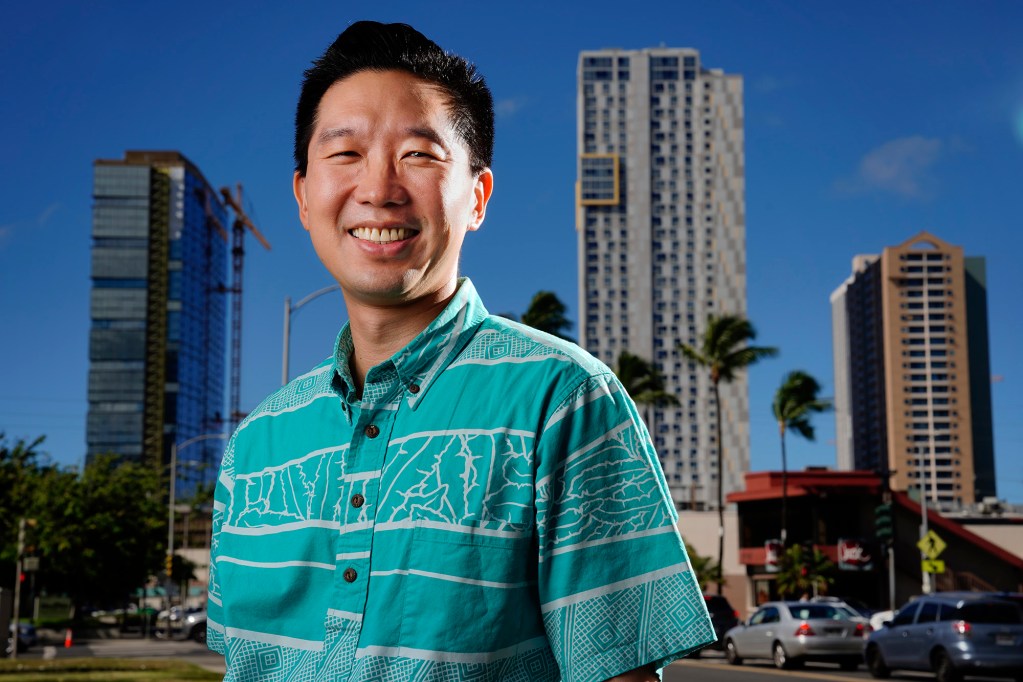
The Jack in the Box at a busy street corner in Kakaʻako displays no hint of state Sen. Stanley Chang’s aspirations to tackle Hawaiʻi’s housing crunch.
Until the end of September, the state-owned property the fast food restaurant occupies at Ward Avenue and Kapiʻolani Boulevard on Oʻahu was clearly a testing ground for a concept Chang has long argued could transform the state’s beleaguered housing landscape.
A constricted housing supply and sky-high real estate prices are blamed for contributing to Hawaiʻi’s steep cost of living, for driving locals to find cheaper housing elsewhere, and as a factor in high rates of homelessness.
Chang has pushed his Aloha Homes idea as a solution since at least 2018 — attracting some national attention for it along the way — saying it was a way to develop housing faster, less expensively and more efficiently.
The Jack in the Box property seemed to indicate his idea had gained traction. Now that’s uncertain.
Aloha Homes — for Affordable, Locally Owned Homes for All — is modeled on Singapore’s system of government-run public housing, home to about 80% of that island nation’s population. In Chang’s version, Hawaiʻi residents, regardless of income, could buy condominiums at below market prices with leasehold terms, under which the properties would revert to government ownership after 99 years.
Development costs would be recouped through unit sales, making projects “revenue neutral” so funds could be plowed into new projects, Chang said.
The idea inched ahead. In 2023, the Legislature allocated $1.5 million for preliminary Aloha Homes planning. Then, a breakthrough: Gov. Josh Green included $15 million for it in his 2026-2027 budget.
“I anticipate this will be the first 99-year leasehold, revenue-neutral project in the state of Hawaiʻi and it will hopefully be a big success and spawn the construction of many more,” Chang said during a briefing on housing legislation he held for the public after the 2025 legislative session.
Now, nearly a year after it won Green’s support, Chang’s vision may have faltered again, although the senator says it hasn’t.
“We had really high hopes for this. When I say that, I’m not giving it the kiss of death.”
Craig Nakamoto, executive director, Hawaiʻi Community Development Authority.
The head of the state agency charged with shepherding the project forward said it’s on hold, and that he let Chang know.
“We had really high hopes for this. When I say that, I’m not giving it the kiss of death,” said Craig Nakamoto, executive director of the Hawaiʻi Community Development Authority. “All it is saying is, we’re going to take a pause. Maybe in two or three years we can resurrect this project again. Or there’s another type of workforce housing project.”
Chang, though, put it this way: “There’s still a lot more work that needs to be done in the pre-development stage before shovels go into the ground and before the actual building gets built. But it’s underway.”
He told Civil Beat conversations are continuing about how to move it ahead, if perhaps at a slower pace.
“There’s just a bunch of different paths forward at this point,” Chang said.
Stipulations And The Market
Nakamoto said rising construction costs, high interest rates and climbing condo insurance rates are among factors that pushed up the cost of developing the project, to the point where units might not be saleable.
“Our goal, of course, is to develop a product that’s ultimately going to sell in the market,” he said. “If we can’t sell it, then ultimately the project is not successful.”
The project may also have been hampered, Nakamoto said, by some of the signature features of the Aloha Homes concept.
Those included stipulations that condo owners would have to live in their units and couldn’t own other personal or commercial real estate, which they would have to sell within six months of purchasing a unit.
Those conditions were intended to steer the units toward Hawaiʻi residents seeking the opportunity to own their own homes, rather than real estate investors hoping to take advantage of lower-priced condo properties.
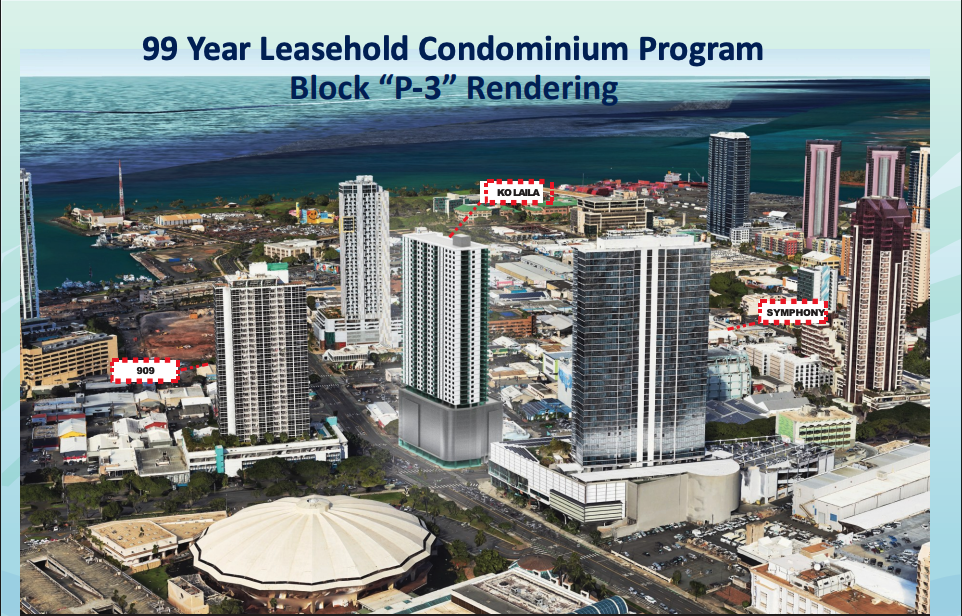
According to the minutes of a June 4 development authority meeting at which the project was discussed, it was to have 351 units, 60% of them designated as affordable. That would reserve them for buyers with household incomes between 80% and 140% of the median area income, currently from $85,000 to $149,000 on Oʻahu.
The remainder were to be sold at a “market” rate, with the largest units, which have four bedrooms and three bathrooms, costing $1 million. Comparable neighboring properties were priced at $1.5 to $1.7 million.
Another stipulation of the pilot project was that owners of affordable units would have to share profits from the sale of their properties with the authority. That stipulation wouldn’t have applied to owners of market-rate units.
Together with the 99-year leasehold terms, those conditions might have made the Aloha Homes condos a tougher sell, Nakamoto said.
“As we found out,” he said, “those things could have an impact on marketing and sales.”
‘It Wasn’t Prudent’
Although the authority had spent more than a year laying the groundwork for the project with a prospective developer, the decision was made that “it wasn’t prudent” to move to the presale stage, where the building would be marketed to potential buyers, Nakamoto said.
Chang, though, said those conditions were not set in concrete.
“It needs to be a project for local people, that’s the whole point,” Chang said. “But I think we can talk about different restrictions that we could remove without fundamentally undermining that purpose.”
He conceded the 99-year leasehold terms might be too onerous for some buyers and said he isn’t wedded to that condition.
“It needs to be a project for local people, that’s the whole point.”
State Sen. Stanley Chang
But he maintained there are many reasons that feature would be appealing. Those include that the leasehold is long enough that original buyers would not have to move during their lifetime. And the leasehold feature drives down costs, so Aloha Homes units would be priced considerably lower than comparable properties.
Also, Chang said, leasehold status offers far more security than is enjoyed by one group of potential Aloha Homes buyers — renters who have zero equity in their home and leases that are often month-to-month.
Adjustments Being Made
That the project had been deemed unrealistic even with the community development authority helming it wasn’t a good sign, said Justin Tyndall, an associate professor of economics at University of Hawaiʻi who researches housing.
Beyond construction costs, navigating the bureaucracy, regulatory and permitting hurdles that development projects face would have been key challenges faced by the Aloha Homes project, he said.
“If a government housing program is forced to navigate the same hurdles and uncertainty,” he said, “it is hard to see what advantage it would have over private development.”
At Housing Hawaiʻi’s Future, director of policy Perry Arrasmith said he hopes Chang’s idea can survive, even if it needs adjustments.
“The question we’re going to be asking ourselves in this next (legislative) session is if we want this model, if we want this experiment to continue, then what barriers need to be removed to help push it forward,” Arrasmith said. “We’re going to be looking to leaders like Sen. Chang for direction.”
The development authority is asking the right questions, Arrasmith said, when it comes to whether the special conditions attached to the Aloha Homes project would deter buyers.
“If it wants to succeed, it needs to be as flexible as it can be to market pressures,” he said. “And perhaps that’s where we need fewer restrictions.”
As of December, Nakamoto said nothing in the project’s status had changed and it remained on pause.
Chang, again, said things are moving forward.
Based on hard-won experience nudging Aloha Homes along, he said legislation is being drafted to address some of the issues Nakamoto raised, such as removing the condition that prospective buyers not own other real estate.
“That’s the main initiative right now,” Chang said.
There is also interest in how sales in nearby condominiums go, as an indicator of how strong the market is, Chang said, and he called the slight easing in interest rates in recent months a promising trend.
“Hawaiʻi’s Changing Economy” is supported by a grant from the Hawaiʻi Community Foundation as part of its work to build equity for all through the CHANGE Framework.

