Hawaiʻi Lawmakers Start New Session Under ‘Dark Cloud’
The investigation into a possible $35,000 bribe to a legislator can’t be ignored even as lawmakers promise more work on perennial state issues such as affordable housing.
The Hawaiʻi Legislature opened its 2026 session under what one lawmaker called a “dark cloud” hanging over the State Capitol — the mystery of which legislator may have received $35,000 in a paper bag as a possible bribe in 2022.
House Speaker Nadine Nakamura told reporters Wednesday after opening day formalities wrapped up that her chamber would now decide in the next few days whether to undertake a special legislative investigation into possible corruption. She had rejected the idea before.
Her announcement comes a day after Attorney General Anne Lopez reversed course and said her office would investigate the case in partnership with the U.S. Attorney’s Office. Lopez also had strongly opposed any state involvement while a federal investigation was still unfolding.
Lawmakers must decide whether to approve or reject a petition filed by government accountability advocate and attorney Alexander Silvert, who is calling for a legislative probe.
“We’re going to have an internal discussion in the next few days, and we will be discussing that with members, and then, based on the feedback that we receive, determine our next steps,” she told reporters after opening day speeches.
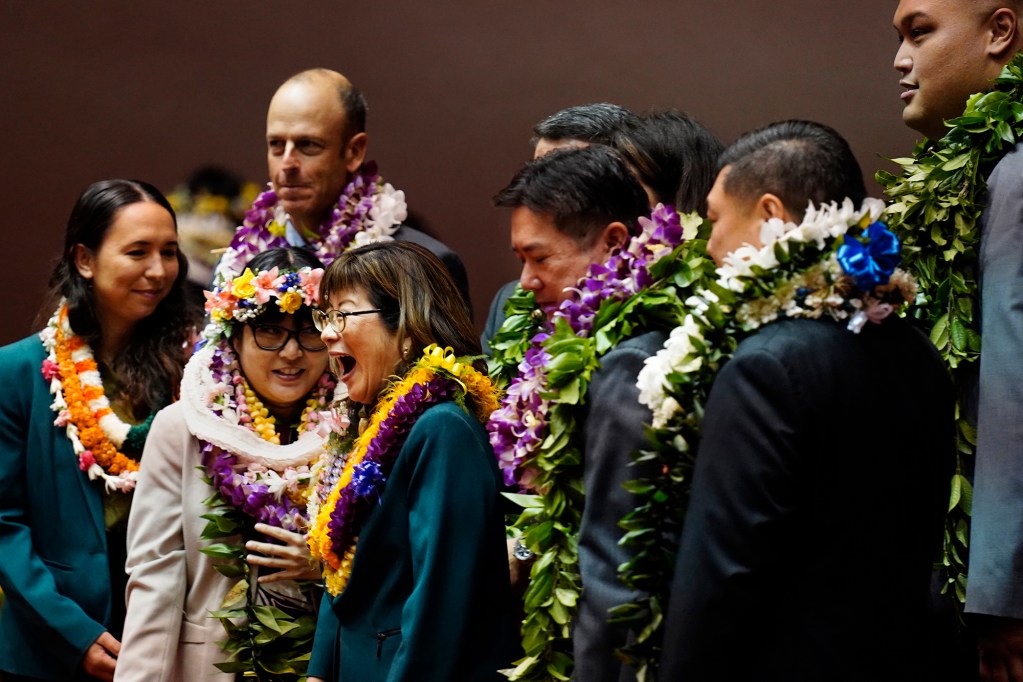
“I think this is a dark cloud over the Legislature, and this is something that really has taken so long to resolve,” she said. “I think that is what’s very frustrating for many of us here, many of us who you know, this is our career. This is what we have sacrificed to be here.”
Senate President Ron Kouchi said the Senate would wait to see what the attorney general would be doing. That view was supported by others in his caucus, who argued that a legislative investigation was not the best idea.
“I think one of the important things to remember is that the Legislature cannot actually prosecute, and so the reason why it’s appropriate that the attorney general took up the investigation is she has the capability to investigate,” Sen. Jarrett Keohokalole said Wednesday. “They have investigators. They have prosecutors in a special unit that’s tasked to do this type of work. But also, if there is a crime, she can actually file the indictment. If it turns out it’s some sort of other ethics or campaign spending commission violation, they also have subpoena and investigation authority.”
Kouchi said that if the mystery lawmaker was revealed to be a sitting Senator, appropriate action could be taken by the chamber such as possible removal from office, “either by force or voluntarily, based on the facts that come out.” He added that such a disruption could cause a realignment in the Senate.

Explore detailed legislator profiles, voting records and what happens in hearings on Digital Democracy.
A recent survey by Civil Beat showed nearly every lawmaker who has served in the Legislature since 2022 saying they are not the “influential” lawmaker who is the focus of the investigation.
Money Troubles
Also weighing on lawmakers are threats of a recession that might throttle the state’s tourism industry, and the possibility of additional cuts in federal funding for social programs in Hawaiʻi.
Gov. Josh Green’s administration estimates federal funding for programs such as Medicaid and the Supplemental Nutrition Assistance Program will be reduced by more than $600 million per year over the next three years, and Green has said he wants to shield low-income families from those cuts.
“You know, every day something new gets thrown at us,” Nakamura told reporters after the House floor session Wednesday. She said she believes lawmakers need to set aside some cash so the state is prepared to step in if need be to offset the impact of additional federal cuts.
“I don’t know if we’ve felt it all yet,” she said. “There might be additional tariffs from the European countries. We don’t know. So there’s so much uncertainty, and so that’s why we have to build in that cushion.”
House Finance Committee Chair Chris Todd said he believes the state does not yet need to tap the Emergency Budget Reserve Fund, better known as the rainy day fund. That fund now holds more than $1.5 billion in reserves, but Todd said the state has adequate operating cash for the moment.
Green has said he plans to pause at least some of the state income tax cuts lawmakers approved in 2024, and the administration has also suggested tax credits will be offered to lower-income families to provide at least some tax relief during the pause.
But House Republican Minority Leader Lauren Matsumoto said in her opening day floor speech the GOP caucus will push back on that plan.
House Republicans will introduce legislation to “ensure that the tax relief promised just two years ago is not taken away,” she said. “People need help now.”
“We as a legislature need to take a critical look at our budgets and our government spending before asking people to give up more of their hard-earned paychecks,” Matsumoto said. “We made a promise, and we should keep it.”
Todd told reporters Wednesday he plans to brief the Republicans on the budget situation, and “if they have an idea that’s going to fix this problem, I’m all ears, feel free to just throw that at us.”

But if the Legislature does need to pause the tax cuts, lawmakers will “make sure that it is not coming with an added cost to low and middle income families,” he said.
Fiscal Prudence Guiding Decisions
The Democratic majorities in the House and Senate share many of the same priorities for 2026, and they are much the same as in recent sessions: building more housing for local residents, preserving the social safety net, expanding workforce development and retention programs and diversifying the economy.
Leadership did not provide much in the way of specifics on those ideas Wednesday, speaking more generally about their initiatives. Kouchi spent much of his opening day speech thanking his colleagues for all their hard work.
“Clearly, what’s going to be huge coming up is AI, and that’s so broad, but it’s all the broad applications — how do we utilize it in our workforce, in our workplace, to be more effective in how we do our job? How do we protect privacy?” he told reporters.
Kouchi noted that Keohokalole had recently held an informational briefing on the rising concerns, particular regarding children, about artificial intelligence, and that proposed legislative solutions are in the works.
Kouchi also brought up the ongoing uncertainty with what the Trump administration is doing that could impact Hawaiʻi’s economy. He said that he worries “every day” about what the president might say that could send stocks plummeting and cause economic trouble for Hawaiʻi’s economy, including the state’s retirement system.
“It makes it hard to chart a financial path forward when there isn’t a consistency or a process about how we’re arriving at some of the decisions (when) he just gets up and says or tweets and has tremendous impact,” said Kouchi. “And then how do we deal with it?”
The answer, said Kouchi, is to be fiscally prudent, a strategy that has been adopted by the House as well and is supported by the federal delegation.
“Right now, the state’s fiscal management has been careful enough that they can absorb whatever craziness the federal government may throw in Hawaiʻi’s direction,” U.S. Sen. Brian Schatz told Civil Beat before catching a plane back to Washington, D.C. He attended opening day along with colleagues Sen. Mazie Hirono and Rep. Jill Tokuda.
“I think fiscal prudence needs to be the watch word here, and we also want them to have the latest information — not just about what Trump is wanting to do, but what’s actually possible,” Schatz said.
House Democratic Majority Leader Sean Quinlan told his colleagues in a passionate floor speech Wednesday that “as I stand before all of you today, I worry in some respects that I’m losing my country.”
He cited operations by federal law enforcement officers in ski masks and tax cuts for billionaires and threats “to invade, purchase or otherwise acquire Greenland.”
Quinlan said in the past he urged his colleagues to focus on Hawaiʻi and not worry too much about events on the mainland, but now “I feel compelled to speak out.”
“You know, things seem kind of grim, what are we to do? And to me the answer is very, very simple,” he said. “We have to hold on to our shared values, we have to stick together. Aloha, ʻohana, those are not just words.”
“Through these shared values, we will ensure that no child ever goes hungry in Hawaiʻi,” Quinlan said. “We will ensure that people have health care, so that when they’re sick they can afford to go to the doctor.”
As the audience in the House gallery began to applaud, Quinlan continued: “We will make sure that we protect working families every day through the work that we do in this building.”