

House GOP Caucus Wants Voters To Pick Chief Election Officer
Election integrity is a key initiative in the minority party’s legislative package for the 2026 session.
Hawaiʻi GOP lawmakers rolled out their priorities for the legislative session on Thursday in an announcement that was critical of their Democratic counterparts for focusing too much on the Trump administration and its potential impact on the state budget.
“What a waste of time. Not one issue about Hawaiʻi was mentioned,” Rep. Diamond Garcia, one of the House’s most outspoken members, said about the Democrats’ opening day speeches and press conferences. “It was about Trump, it was about ICE, it was about ski masks, it was about Greenland, it was about whatever else but the issues facing Hawaiʻi.”
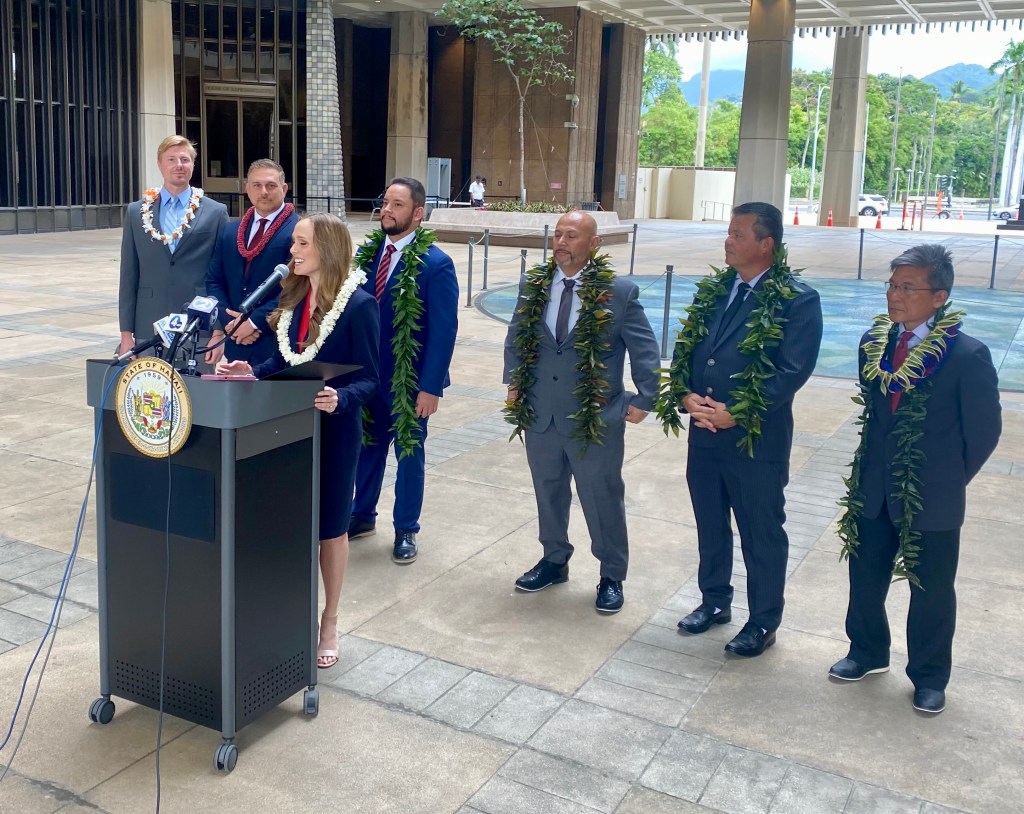
On Thursday, Garcia and seven of his GOP colleagues (sans Rep. Kanani Souza, who charts an independent course) held a press conference at the Capitol Rotunda to introduce their package of 2026 bills.
A top piece of legislation targets corruption and government reform in Hawaiʻi by having voters choose a chief election officer rather than have the position appointed. Scott Nago, the current chief election officer, has been the target of harsh criticism over his job performance, though a majority of the Hawaiʻi Elections Commission supports him.
House Bill 1761 would also increase access to voter service centers open on election day, require signature verification of ballots in the presence of official observers, abolish ranked choice voting, alter the mandatory recount process and use physical ballots during election audits.
“This is an important issue to the people of Hawaiʻi,” Garcia said. “If anyone’s been watching on social media, seeing the various meetings at the elections commission meetings, it’s been getting pretty contentious, and our caucus believes that is time for much-needed reform at the Office of Elections and at the Elections Commission.”
Garcia called HB 1761 the “election integrity bill,” but he rejected any notion that the title is in any way related to people like Donald Trump who question the outcome of the 2020 presidential contest.
“The bill has nothing to do with Trump at all,” he said. “This is just common sense realities. We need in-person access on election day. We need trust in the election system.”
Garcia said his caucus did not take a position on eliminating Hawaiʻi’s mail-in voting system, something the Elections Commission has proposed but that Democratic leaders have already rejected.
It will not be easy to persuade Democrats to adopt any measure proposed by Republicans. Rep. Lauren Matsumoto, the House minority leader, said that none of the caucus’s bills have passed during her 14 years in office.
The closest the caucus got was last session, when a measure to increase the maximum annual deduction for contributions and account levels for individual housing accounts survived until late in session before perishing with no reason given.
The bill is back in a revised version this session, and Matsumoto said it stood a good chance of passing.
“That’s probably the bill that has the most legs to move across this year,” she said.
Several other ideas from the caucus have also been raised before but have gone nowhere. They include abolishing the state individual income tax and exempting food and groceries from the general excise tax.
The latter bill would also expand a law passed in 2024 to exempt the GET from some medical and dental services provided to Medicaid, Medicare and TRICARE benefits to include all medical and dental services.
Rep. Chris Muraoka, speaking about the income tax bill, said, “This move will put more money directly into the pockets of Hawaiʻi’s hard workers, boosting our local economy and making living in Hawaiʻi just a bit more affordable.”
As for the tax exemption, Rep. David Alcos said, “The GET currently adds a significant burden on nearly every transaction, driving up prices for essential goods and service. With this bill, a family of four can save over $687 per year.”
Asked how the Legislature would make up for the loss of tax revenue, especially in a year when finances are tight, minority leaders said the savings would be made up through eliminating wasteful spending.
Also on Thursday, the Senate minority caucus — Brenton Awa, Kurt Fevella and Samantha DeCorte — issued a press release highlighting its package.
The measures include requiring a performance audit of the Department of Hawaiian Home Lands, “as nearly 29,000 Native Hawaiians remain on decades-long waitlists for homestead leases,” according to the release.
The Senate GOP also backs expanding same-day, in-person voting centers. And it is requesting additional investigation into the $35,000 bribery case involving an unknown state lawmaker.
The press release did not say who should conduct that investigation. The matter is already being reviewed by the U.S. Attorney’s Office and Hawaiʻi Attorney General Anne Lopez, and House Democrats said Wednesday that they will decide their own course of action within the next few days. The Senate, led by Democrats, has chosen to let the AG do the work.
The bribery allegation was very much on the minds of the House GOP Thursday, which has identified crime as a top legislative theme along with cost of living and government reform.
Referring to the eight Republicans at the press conference, Rep. Elijah Pierick remarked that none of the members except for Matsumoto were in office “when that mysterious transaction” happened in 2022.
“And it’s not her, OK? So none of us here are suspects.”

