

Maui Cops Could Still Aid Feds Despite Council Immigration Concerns
Activists say there’s a way out of the agreement with the FBI if the council really wants to take it.
A Maui County Council committee on Tuesday voted to kill a bill that would have authorized Mayor Richard Bissen to re-up a now-controversial agreement between the county’s police department and the FBI-Joint Terrorism Task Force.
But the council committee’s 8-0 recommendation on Tuesday that the full council file Bill 92 — government terminology for letting it die without further action — did not alter or overturn the existing agreement with the FBI task force, which has been in place for more than two decades, officials said.
In January, after activists had campaigned against Bill 92 for months, council members who previously supported the agreement with the FBI started to turn against it as federal immigration agents swarmed Minneapolis and killed two protesters, accelerating a nationwide argument over President Trump’s aggressive immigration enforcement campaign.
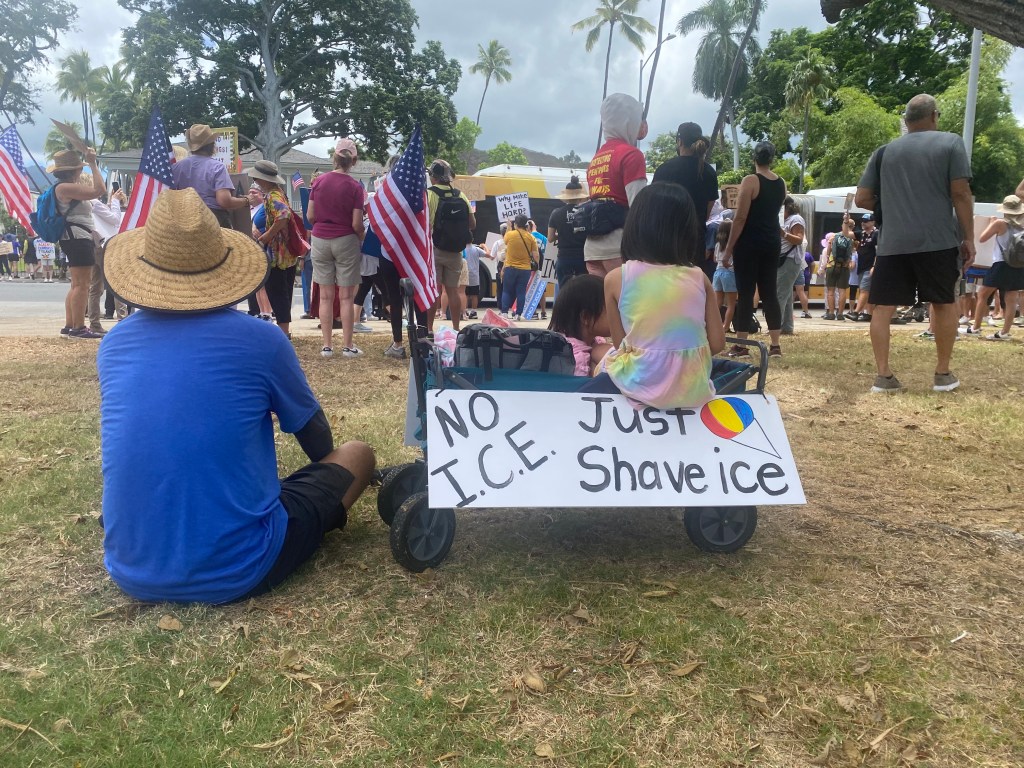
Council members on Tuesday expressed disappointment that they could not go further and more decisively reject the agreement with the FBI.
“The feds are off the rails right now,” said council member Gabe Johnson, a previous supporter of Bill 92.
“I want to end this,” he said at Tuesday’s meeting of the Budget, Finance and Economic Development Committee, referring to the agreement. “So how do we get to that?”
Council member Keani Rawlins-Fernandez, who opposed the agreement from the time it was sent to the council for renewal last year, said she would submit a resolution to rescind the existing agreement with the FBI task force that the council could vote on at its March 6 meeting.
Activists Disappointed By Outcome
Activists who have rallied against Bill 92 and the agreement welcomed Rawlins-Fernandez’s statement but said care was needed to ensure the resolution was effective and not merely a symbolic step.
“I would say, ‘Are you sure a resolution is going to have the teeth that it needs to really ensure that these contracts are not moving forward in any way,” Marnie Masuda said after the hearing. Masuda is the lead organizer with Maui Indivisible, a group that has led opposition to Bill 92 since last year.
Another Maui Indivisible leader, Jake Carton, said the group was also upset the budget committee did not move to investigate the terms of the existing agreement, for example, what the task force actually does, what Maui police officers who join it are required to do, and how much police officers must participate while they belong.
“It seems like the budget committee is not very interested in finding out what those answers are,” Carton, the group’s special projects leader, said after the meeting.
The issue has been complicated by the fact that police officials haven’t been able to find the most recent version of the agreement. On Tuesday, county attorneys said the most recent agreement between the police department and the FBI that can be found is the 2007 version.
If the county is working off that agreement, it could offer a way out should the council really want to end the police department’s partnership with the FBI task force, Carton suggested, pointing to a sentence in the 2007 document that says: “The MOU may be terminated at will by any party provided written notice is provided to the other parties of not less than sixty days.”

“If they’re serious about severing the connection with the (task force) … they could just get out right now, no excuses,” Carton said.
Carton said the group is also worried because the county’s corporation counsel has already issued several different legal opinions about whether the agreement places a financial obligation on the county, in which case the council must approve it before the mayor can sign it. The most recent opinion, in January, said the agreement does have financial implications for the county.
If county attorneys issue another opinion that the agreement does not place a financial burden on the county, that could open the door to Maui Police Chief John Pelletier to sign it without council approval, Carton said, noting that Pelletier was able in late 2024 to sign an agreement between his department and Homeland Security Investigations, a unit of the Immigration and Customs Enforcement agency, without needing council approval.
“The police chief could approve this contract if they get another lawyer, or the same lawyer who switched positions three times could switch positions a fourth time and give the police chief authority to do it,” Carton told Civil Beat on Tuesday.
Police Say They Would Resist Federal Efforts
Deputy Police Chief Wade Maeda tried to reassure the budget committee Tuesday that the department has no interest in taking part in immigration enforcement actions and would resist federal efforts to order Maui officers to do so.
“If the FBI tells our guy to do something quirky, we will tell our officer you are not to do that. And if he disobeys us, we’ll take away his police powers and we’ll sit him at a desk,” Maeda said. ”We’ve never done immigration enforcement and we won’t.”
In January, Pelletier told the council he wanted to add language to the agreement with the FBI to make it clear it won’t authorize his officers to join most forms of immigration enforcement. On Tuesday, his office said he had already submitted that request to the FBI.
A similar discussion over police agreements with federal law enforcement agencies and immigration enforcement seized Hawaiʻi County last spring. Eventually, the Big Island’s council approved a resolution authorizing the police chief to sign agreements with the FBI, ICE and Homeland Security Investigations, but added an amendment to say that nothing in the documents authorized Hawaiʻi police officers “to take any enforcement action against administrative violations of federal immigration law.”
Bill 92 is tentatively set to return to the full Maui council on March 6.

