Oceanfront Lahaina Property Owners May Get Buyout In Updated Disaster Plan
The county is seeking an amendment to create a voluntary buyout program with some of its $1.6 billion fire recovery grant from the feds.
Maui officials are planning to use a relatively small portion of federal disaster aid to offer voluntary buyouts to certain oceanfront property owners who lost their home or business in the Lahaina wildfire.
It’s one of the most significant changes that Mayor Richard Bissen’s administration has proposed making to the broader action plan that outlines how the county must spend the $1.6 billion grant awarded by the federal government in the aftermath of the 2023 blaze.
The so-called strategic voluntary mitigation buyout program would be funded by reallocating $50 million from other hazard mitigation projects, according to a revised version of the plan.
Maui residents have until March 3 to submit their feedback on the revised action plan. Public comments and questions will be consolidated and submitted along with the updated action plan to the U.S. Department of Housing and Urban Development for approval.
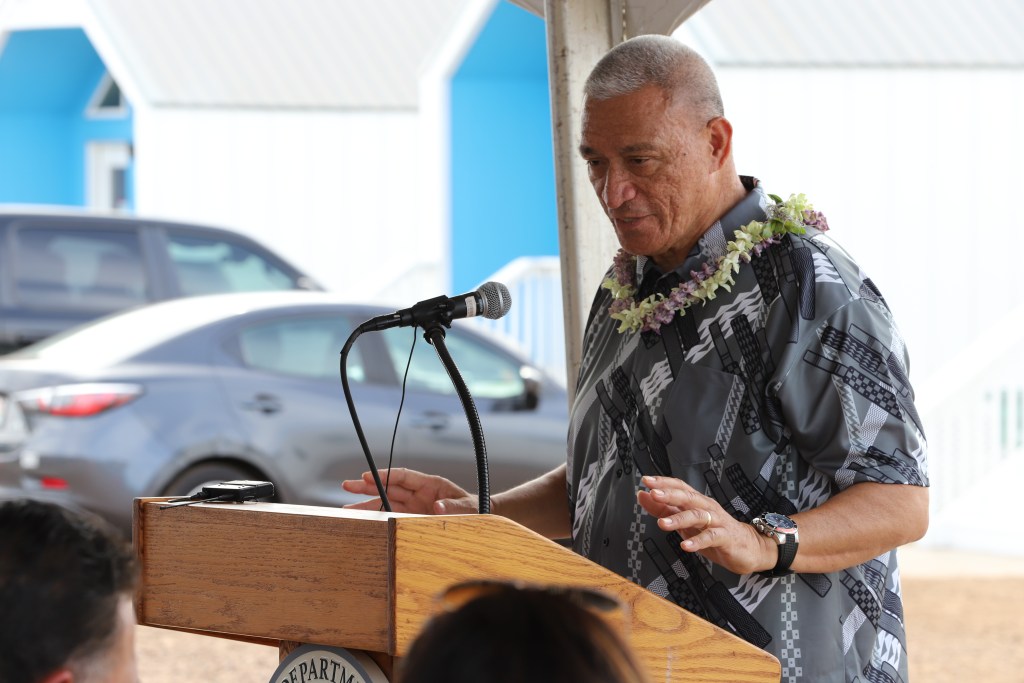
“I guess you could call it managed retreat,” Bissen told Civil Beat. “If they’re not gonna live there, they’re gonna sell it. If we buy it, we control what happens to it.”
The county can then clear the property and make it open space, a greenway, a park or add a stormwater feature or natural buffer, according to the revised plan. The amount would be based on post-disaster fair market value, and limited to direct shoreline properties makai of Front Street that are fully within specific Lahaina historic districts.

Other proposed amendments include updates to programs for fire survivors who are building single-family homes and the reallocation of $5.44 million from administration funds to establish a planning program to support the coordination of future disaster recovery and mitigation initiatives.
Bissen emphasized that none of the reallocated funds would be drawn from the $900 million currently allocated to housing programs.
The county has to set aside 15% of the overall grant, or $213.8 million, for projects aimed at reducing the chance of another disaster. Projects can include flood control, wildfire mitigation, fire-resistance infrastructure, backup power systems, water storage upgrades, transportation improvements, housing resilience and affordability, parking and more.
County officials proposed the amendments about seven months after county and federal officials finalized the action plan detailing how the county is expected to use the Community Development Block Grant Disaster Recovery funds, which were appropriated by Congress in late 2024 to support housing programs, infrastructure projects, hazard mitigation programs and other disaster recovery needs.
Voluntary Buyouts To Support Mitigation Projects
One of the most significant proposed amendments to the block grant action plan would allow the county to use $50 million in federal funds to offer voluntary buyouts to those who own property on the makai side of Front Street or in certain other areas that are more likely to be threatened by erosion, sea-level rise and other disasters.
After acquiring a property, the county would remove any existing residential or commercial structures and use the land for long-term risk reduction and resilience projects, according to the amended action plan.
“We can use that to mitigate future damage,” Bissen said, explaining that the voluntary buyout program is in part intended to reduce future disaster-related costs. “So there is a benefit to the public.”
While hundreds of property owners have been issued permits allowing them to rebuild their houses on the mauka side of Front Street, the county in recent years implemented more stringent restrictions on shoreline development intended to address future risks posed by climate change that have left many people who lost their oceanfront homes in the fires unsure whether they will be able to rebuild.

Unlike people who own property further from the shoreline, coastal property owners are not exempt from certain requirements to be approved for a special management area permit. They must also follow new regulations that prohibit construction outside the erosion hazard line.
The erosion hazard line runs right through the footprints of many homes that were destroyed during the Lahaina fire, meaning that some coastal properties would not have enough space to rebuild, Bissen said.
Ideally, the Lahaina community would help determine what the properties are used for following acquisition, Bissen said.
“You don’t want a guy from Kahului telling you how Lahaina should be,” he said. “We, the residents, should be able to determine not only our present, but our future.”
The county has already sent letters of interest to some property owners, Bissen said. Without sharing specifics, he said some have expressed openness to participating in a buyback program, while others were not interested in or were unsure whether they would participate.
The revised action plan would provide funding to formally establish the strategic voluntary mitigation buyout program, reducing the total amount allocated for other mitigation programs from $213.83 million to $163.83 million.
Bissen emphasized that the proposed amendment would only reallocate a portion of the small percentage of funds that the federal government prohibits the county from using for anything other than mitigation projects.
“It has to be used for mitigation,” he said. “If we wanted to, we couldn’t use it for housing at this point.”
He added that county officials do not have plans to seek enough funding to purchase all of the identified high-risk properties, and they know that some property owners are not going to be interested in a buyout. The goal is to provide property owners with an option that ensures the land is used in a way that benefits the community, he said.
Additional Amendments
From the beginning, the vast majority of the disaster block grant funds were set aside for housing and development programs and projects, including single-family homeowner reconstruction, single-family homeowner reimbursement, single-family new construction and first-time homebuyer opportunity programs.
The proposed changes would not affect how funding is distributed between these programs, but the revised action plan would include updated language that would expand the county’s abilities to build and sell single-family houses under the single-family new construction program and reimburse homeowners taking part in the single-family homeowner reconstruction program for pre-application costs.
Read the full revised plan below:
Civil Beat’s coverage of Maui County is supported in part by a grant from the Nuestro Futuro Foundation; coverage of climate change and the environment is supported by The Healy Foundation, the Marisla Fund of the Hawai‘i Community Foundation and the Frost Family Foundation.