Airbnb As Tax Collector? It’s A Familiar Debate In The Legislature
Taxpayer information collected by booking companies would be used to collect taxes but not to allow counties to crack down on illegal vacation rentals.
Lawmakers are once again pressing ahead with a bill to squeeze more money out of the widespread short-term vacation rental operations in Hawaiʻi by requiring hosting platforms such as Airbnb to collect taxes on behalf of the state and counties.
House Bill 1590 would require hosting platforms that collect booking fees from vacation rentals to register as state tax collection agents, and hand over to the state the appropriate taxes. Under the bill, any platform that fails to do so would be liable for the taxes owed.
Similar bills were vetoed in 2016 and 2019 by former Gov. David Ige, who was concerned they would essentially be “legitimizing” or providing a “shield” for illegal vacation rental operations in Hawaiʻi, and would encourage more property owners to rent out their houses to tourists.
A veto seems unlikely this year because Gov. Josh Green’s administration introduced two bills — House Bill 2330 and Senate Bill 3150 — that would also have required hosting platforms to become tax collectors for vacation rentals.
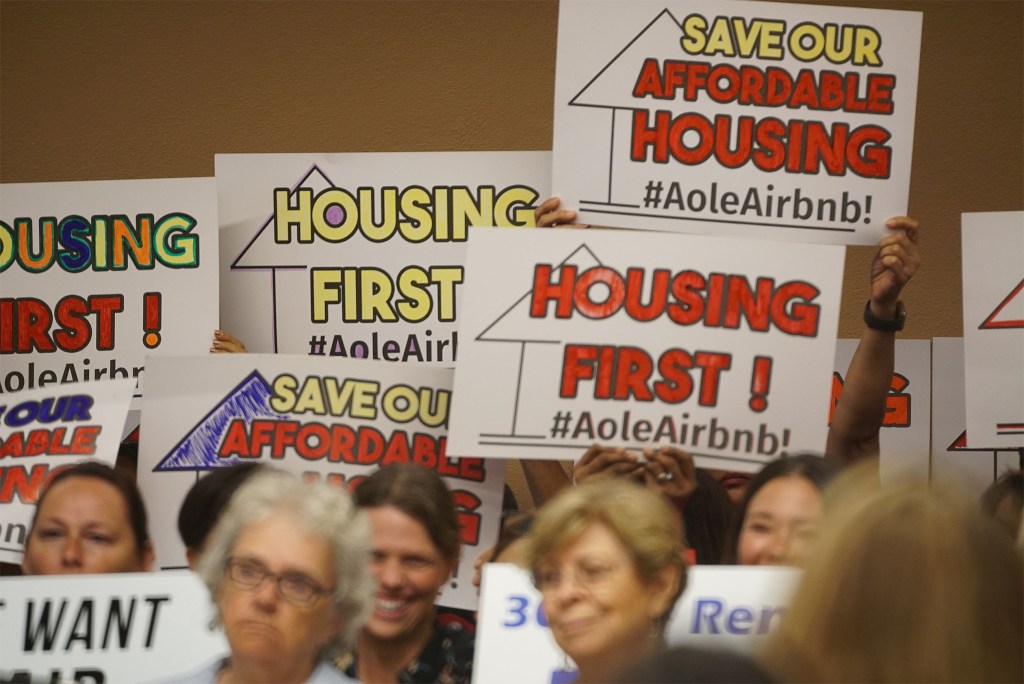
Vacation rentals have been a bitterly contested issue in Hawaiʻi, most recently with the furious debate on Maui following the 2023 Lahaina wildfires. The fire displaced more than 12,000 people on an island that already had a severe housing shortage, and the lack of affordable rentals on Maui and other islands is often blamed on vacation rental operations.
Kristen Sakamoto, deputy director of the state Tax Department, told Civil Beat HB 1590 is focused narrowly on getting both legal and illegal vacation rental owners to pay their state taxes, because there is ample evidence some of them don’t.
Vacation rentals are required to pay both general excise taxes and transient accommodations taxes, also known as hotel room taxes, and Sakamoto said last fiscal year tax audits identified 94 taxpayers who owed about $4.9 million in hotel room taxes alone.
Audits during this fiscal year zeroed in on another 69 taxpayers who owed another $4.9 million, and she said most of those were individuals and small businesses.
Sakamoto said the state has no estimate of how much in additional taxes the state might collect if HB 1590 passes.
Confidential, No Matter What
Both Airbnb and Expedia offered testimony on the bill, with Expedia’s Hawaiʻi Regional Manager Mackenzie Chase suggesting that making the platforms “tax responsible” for short-term vacation rentals “will both promote tax compliance and reduce tax leakage.”
It would also “likely increase tax collections for the state and simplify administration for short-term vacation rental operators,” Chase wrote.
Janel Cozzens, senior manager for public policy for Airbnb Hawaiʻi, said in a written statement that company also supports the state’s efforts to ensure hotel room taxes are collected from the short-term rental industry.
The bill would authorize the counties to use their share of taxes collected by the hosting platforms to police illegal vacation rentals, and the House version of the bill would require the hosting platforms to report the names of the operators and addresses of each vacation rental to state tax officials.
However, three Senate committees voted in a joint hearing Wednesday to amend the bill as requested by Airbnb to delete any requirement that the hosting platforms report the names or addresses of the rentals to the Tax Department.
In any event, Sakamoto said the addresses of the vacation rentals could not be shared with the counties as part of a crackdown on illegal short-term rentals.

“I think there is a longstanding understanding that tax information is confidential for tax purposes, and there’s good reasons for that,” she said. “It encourages voluntary compliance, it safeguards against fraud for sensitive information. This is kind of an understood concept, that we don’t share for non-tax purposes.”
The bill specifically addresses the confidentiality issue, declaring that the information collected by hosting platforms on each rental operation “may be used only for the purpose of levying and collecting taxes due under this chapter by tax collection agents.”
State law does allow the tax department to provide confidential tax information to investigators for inquiries into issues such as potential public assistance fraud or in child support cases, but Sakamoto said that sort of disclosure of tax information has not been proposed during lawmakers’ discussions of HB 1590.
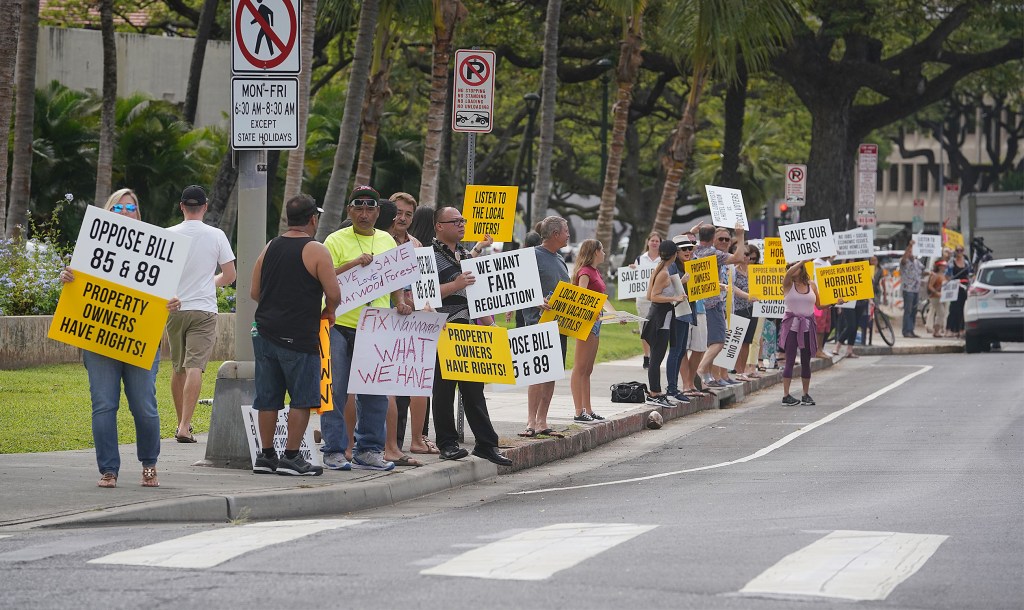
As for the concern Ige raised in his 2019 veto message that collecting taxes from illegal rentals might “legitimize” those operations, Sakamoto said state tax officials don’t think so.
“From our perspective, paying taxes doesn’t make the activity legal,” Sakamoto said. “Counties still have their enforcement mechanisms. This just deals with the tax aspect of the business.”
County Frustration
Honolulu City Councilman Tyler Dos Santos-Tam told Civil Beat it is “incredibly frustrating” the bill does not require the tax department to share the information it collects with the counties. He said enforcing regulations on vacation rentals needs to be a cooperative effort between the state and counties.
“We need all the tools that we can get to meaningfully enforce,” he said. “We’re in a housing crisis. We’re not in a tourism crisis. We need as many tools as we can get to make sure that these vacation rentals are being rented legally, and not taking away housing illegally.”
House Tourism Committee Chair Adrian Tam, who was lead sponsor of the bill, said he wants to help the counties enforce their regulations governing vacation rentals, and supports the idea of sharing information about those vacation rentals with the counties.
Tam also said he believes it is important for the state to collect the taxes owed by the vacation rentals, legal or illegal.
“I think that it’s reasonable for us to collect taxes on illegal activity because they’re still engaged in some form of transaction,” he said, “and if we aren’t able to collect taxes during the time that they operate illegally, what kind of a message are we sending to those who are operating legally and are paying taxes?”
House Bill 1590 now advances to the Senate Judiciary and Senate Ways and Means committees for further consideration.
This story was updated March 31 to include a written comment from Airbnb.
“Hawaiʻi’s Changing Economy” is supported by a grant from the Hawaiʻi Community Foundation as part of its work to build equity for all through the CHANGE Framework.