‘Very Scary’ Stack Of Bills Seek To Boost Taxes On Lots Of Stuff In Hawaiʻi
A stack of bills under consideration by lawmakers would increase taxes or impose new levies on cars, liquor, real estate, capital gains and more.
Much attention has focused this year on backpedaling by Democrats at the State Capitol from the income tax cuts they approved in 2024, but lawmakers are also contemplating a variety of new taxes on activities ranging from real estate transactions to performing arts events.
In the past two weeks the state House has also given preliminary approval to bills that would increase the state capital gains tax, increase liquor taxes and impose a new tax on sales of gasoline-powered vehicles — and forwarded each of those proposals to the Senate.
The House also backed a bill for a ballot question that would ask Hawaiʻi voters to amend the state constitution to allow the state to impose a property tax surcharge on investment properties to help finance public education. Currently the constitution allows only the counties to levy property taxes.
It is unclear if the Senate will buy into many of those ideas in an election year, a time when lawmakers are usually wary of angering the public by raising taxes.
However, the House and Senate both gave preliminary approval last week to similar versions of a bill to ramp up the state conveyance tax on real estate sales to non-owner occupants. Those votes suggest that idea may have momentum.

Most of the tax proposals approved by House Democrats this year were roundly criticized by House Republicans in floor debates last week.
“This strikes me as the continuation of Hawaiʻi’s Democrat machine,” said House Minority Floor Leader Diamond Garcia. “Their way to continue dealing with issues and problems is to further increase taxes.”
House Finance Committee Chair Chris Todd told Civil Beat that most of the tax bills advancing this year are aimed at people with very high incomes, or the visitor industry. He considers them “options on the table” for the Legislature to use to preserve the 2024 income tax cuts for everyone else.
There is “a pretty substantial hole in the budget,” he said, and “at some point we’re going to have to come to an agreement between the House, the Senate and the administration about what that figure is, and how we get there.”
Money Problems
The backstory for all of this tax talk is the state’s fiscal situation, which suddenly looks shaky.
Two years ago the House and Senate voted unanimously for a multibillion-dollar series of income tax cuts for all Hawaiʻi tax filers that was to roll out over eight years, an achievement legislators proudly declared to be the largest tax cut in state history. Gov. Josh Green promptly signed that tax cut bill into law.
State taxpayers have already benefited from the first three phases of those income tax reductions — in 2024, 2025 and this year — but Green is now proposing the state “pause” the next five years of scheduled tax cuts.
The problem, Todd said, is the experts’ projections of state tax collections in the years ahead have been revised downward by $3.5 billion, mostly as “a direct result of global uncertainty, declining consumer confidence and worrying trends in our tourism-based economy.”
At the same time state expenses are projected to increase, Todd said in an interview. That is partly because state government must hire new employees to handle tasks the federal government is offloading on the states, and also to cover costs such as negotiated pay raises for public workers in the years ahead.
Rather than suspend the scheduled tax cuts for everyone as Green proposed, the House and Senate each crafted bills this year that seek to preserve the scheduled income tax cuts for low- and moderate-income households, while suspending the tax cuts or actually increasing taxes for households with the highest incomes.

The House proposal in House Bill 2306 would leave in place the scheduled increases in the standard deductions that all income tax filers claim, but suspend a series of adjustments in income tax brackets that were part of the 2024 tax package. Suspending those changes in the tax brackets would reduce the taxpayer savings from the 2024 tax cuts in the years ahead.
At the same time, the House proposal in HB 2306 would increase the top marginal income tax rates for the wealthiest Hawaiʻi taxpayers in the top three income tax brackets.
Todd said Monday if that proposal passes in its current form, it would allow the state to balance the budget without any other tax increases. But it is too soon to say if the Senate will accept the House plan.
The Senate is proposing some similar changes in Senate Bill 3125, which would also maintain the scheduled increases in the standard income tax deductions from the 2024 law.
However, the Senate draft differs from the House version because it would also increase the tax brackets for lower- and middle-income taxpayers as called for in the 2024 tax package.
In other words, under the Senate proposal low- and middle-income taxpayers would enjoy the full benefits from the tax bracket and tax deduction changes in the 2024 tax package, while wealthier taxpayers would see less benefit.
For high-income families, instead of seeing the increases in the tax brackets called for in the 2024 law, their tax brackets would be frozen. That would apply for individuals making $175,000 or more; for heads of households making more than $260,500 and for and joint filers making $350,000 or more.
That would effectively halt any state income tax savings those high-income taxpayers would have enjoyed from the changes in the tax brackets under the 2024 law.
Eyeing A Conveyance Tax Increase
Both the House and Senate also appear to be seriously considering an increase in the state conveyance tax on real estate sales.
The House gave preliminary approval to House Bill 2049, which would increase conveyance taxes on sales of homes worth more than $2.2 million, and impose “significant increases on the higher value properties,” according to Housing Commitee Chair Luke Evslin, the lead sponsor of of the bill.
The measure would raise an extra $170 million in new taxes for the state, he said, but would reduce the conveyance tax or leave it unchanged for 75% of home sales in Hawaiʻi.
The bill calls for $60 million of the new revenue from the conveyance tax increase to be delivered to the state Department of Hawaiian Home Lands to fund housing development, while $40 million would be used to install infrastructure such as roads and sewers for transit-oriented development projects.
Another $40 million would be provided to the state Rental Housing Revolving Fund to help finance affordable rentals, and $10 million would go to the Legacy Land Conservation Program.
“We have the lowest conveyance taxes in the country,” Todd said, “and that really doesn’t help us achieve some large strategic goals around housing, or trying to provide less of an incentive for non-residents to buy property here.”

But Garcia said taxing $2 million homes will affect local families as well as out-of-state investors. He contends the state should already be providing substantial, regular funding for DHHL from the state general fund without increasing taxes to do so.
The Hawaiʻi Association of Realtors, which also opposes the bill, pointed out the tax applies even when property is sold at a loss. “This makes it a punishing tax,” the realtors’ Director of Advocacy Lyndsey Garcia wrote, “especially for someone who is already struggling financially and needs to sell their assets.”
The Senate version of the conveyance tax bill is Senate Bill 3028, but it leaves key parts of the bill blank and does not specify how much the conveyance tax would be increased. If the bill continues to advance, the specific amounts will be added later.
The Senate proposal would also commit money from the tax increase to the state Dwelling Unit Revolving Fund to finance infrastructure for transit-oriented development, and to the Special Land and Development Fund to fund land acquisition for the Statewide Trail and Access Program.
Liquor Tax, Capital Gains, Property Tax
Also moving through the Legislature is a measure to overhaul and increase the state liquor tax in a way the state Tax Department estimates could boost tax collections by almost $30 million a year.
House Bill 1991 was opposed by craft brewers from across the state as well as the Chamber of Commerce Hawaii and the Retail Merchants of Hawaii, which argued the tax increase would hurt small businesses at a time when local companies are struggling with high operating costs.
The bill is backed by the Hawaii Substance Abuse Coalition and the Hawaiʻi Public Health Institute, which cited studies showing increasing taxes on alcohol reduces consumption. The last Hawaiʻi liquor tax increase was in 1998.
Proposals to increase the state capital gains tax surface at the Legislature almost every year, and this year lawmakers advanced House Bill 1850 in an effort to boost that tax on profits from the sale of assets such as real estate, stocks or bonds.
That measure would increase the maximum state capital gains tax on individuals from 7.25% to 9%, and boost the maximum capital gains tax for corporations from 4% to 5%. Supporters said it would raise $44 million or more each year for the state.
The Tax Foundation of Hawaii warned in written testimony that “a tax increase of any magnitude would send many companies, especially smaller ones, out of business taking with them the jobs the community so desperately needs at this time.”
But Nicole Woo, director of research and economic policy for the Hawaiʻi Children’s Action Network, said Hawaiʻi is one of only nine states that tax capital gains at a lower rate than the tax rate on ordinary working people’s incomes. She said the bill would close that “loophole.”

Another tax initiative this year would amend the state constitution to authorize the Legislature to impose a surcharge on residential investment properties to help finance Hawaiʻi’s public education system. Currently the Hawaiʻi constitution allows only the counties to levy property taxes.
House Bill 2147 proposes to put a question on the ballot this fall asking Hawaiʻi voters to authorize that state surcharge for schools on investment properties valued at $3 million or more. The measure was approved by the state House on March 6, but has not yet been scheduled for a hearing in the Senate.
A similar proposal was approved by lawmakers in 2018 but struck down by the state Supreme Court before the public could vote on it. The court ruled that year the proposed ballot question was not clear on exactly what property would be subject to the new tax and how the revenue would be spent.
HB 2147 is backed by the Hawaiʻi State Teachers Association and the Education Caucus of the Hawaiʻi Democratic Party, which contend the bill will help address “chronic underfunding” of the state’s public education system.
It was opposed by Andrew Kawano, director of the city’s Department of Budget and Fiscal Services, who reminded lawmakers that the counties rely primarily on property tax revenues to fund city and county operations.
The measure “has the potential to weaken long-term fiscal stability and negatively affect municipal bond ratings” for the city, Kawano wrote.
A Different Kind Of Car Tax
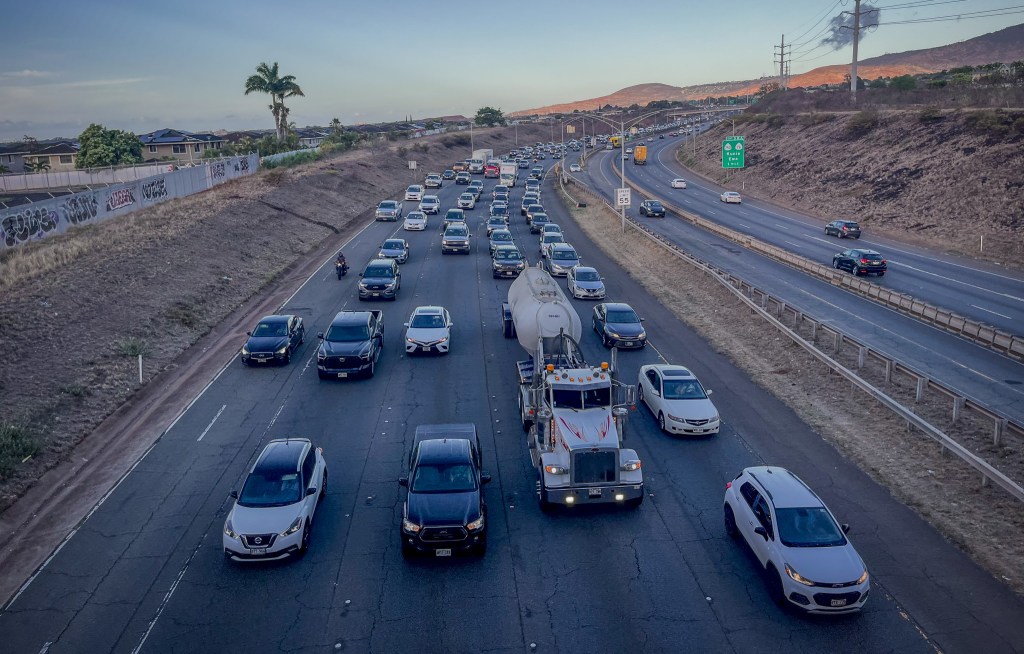
Yet another tax bill that is advancing this year is House Bill 2030, which would impose a new tax on sales of many gasoline- and diesel-powered vehicles to finance consumer rebates to encourage people to buy electric vehicles.
That measure would tax sales of gasoline vehicles according to a schedule that imposes higher fees for less efficient vehicles that travel fewer miles per gallon, and use money collected via that new tax to pay out rebates to consumers who buy or lease new electric vehicles and hybrids.
The rebates would be available only to families earning 300% or less of area median incomes, and could only be applied toward the purchase or lease of vehicles that cost $60,000 or less.
Supporters said the bill would be a major step toward implementing the 2024 settlement in the Nāwahīne v. Hawaiʻi Department of Transportation court case that calls for the state to achieve “net-negative emissions” in the local transportation system by 2045.
Earthjustice lawyer Isaac Moriwake told the House Transportation Committee last month that “the reliance on gas (for) driving for Hawaiʻi consumers is a huge affordability crisis.”
“It hits our rural and underserved communities the hardest,” he said. “We’re bleeding billions from our pocketbooks and our economy every year, but electrification is here, and already the cheaper choice. It’s the upfront costs that are still a barrier, and that’s why we need this bill.”
Critics of the bill including the Alliance for Automobile Innovation argued lower-income households are more likely to buy gas-powered vehicles because they are cheaper, which means the tax would effectively land on the families that can least afford it. The Hawaii Automobile Dealers Association also opposed the measure.
Moriwake countered the bill would make it possible for less affluent families to afford electric vehicles and enjoy the lower fuel and maintenance costs those vehicles offer. He said the bill is patterned after a similar California law.
A ‘Very Scary’ Stack Of Tax Bills
Lawmakers are even considering a measure this year to impose a new tax on tickets for some commercial performing arts events, with the proceeds to be used to help finance the performing arts.
House Bill 2604 would impose a fee of $1 per ticket on public, commercial events where the ticket price is $35 or more. Performances by public schools, the University of Hawaiʻi, and nonprofit organizations would be exempt.
Woo, with the Hawaiʻi Children’s Action Network, said the unusually large number of tax bills still in play at the Legislature this year has a lot to do with recent actions by the federal government.
“I think the biggest difference this session is the changes in the federal administration and the funding coming from Washington, D.C.,” she said. “We know that a lot of the programs that support our working families are threatened with cuts,” or the costs of those programs are being shifted to the state.
Lawmakers and the governor are looking for new revenue “because we don’t want to have these cuts to these programs that are so essential for families to be able to live here,” she said.
Tom Yamachika, president of the Tax Foundation of Hawaii, noted that many of the tax proposals that won preliminary approval in the House were never seriously considered in the Senate, so they may die in the Senate later in the session.
Still, Yamachika called the volume of tax proposals advancing this year “very scary.”
Yamachika considers any rollback of the income tax cuts that lawmakers approved in 2024 to be a “tax increase,” so he worries that “we’re going to get some kind of increase, we don’t know how much, we don’t know where it’s going to hit. It may be a combination of things, but at this point we just don’t know.”
Todd, who will play a major role as Finance Committee chair in the House-Senate negotiations over the tax bills, suggested some won’t make the final cut this legislative session.
“Some of them are going to be tough sells, for sure,” Todd said, “but in some cases I think there is some real value.”
Senate Ways and Means Chair Donovan Dela Cruz did not respond to a request for an interview on the Senate’s tax proposals this year.