

Hawaiʻi House Approves $10B State Budget That Prioritizes Essential Services
The budget now passes to the Senate which will continue fine-tuning the state’s spending priorities for the coming fiscal year.
With only nominal opposition by minority Republicans, the Hawaiʻi House of Representatives passed its draft of the state supplemental budget Wednesday.
The $10.7 billion spending plan for the fiscal year that begins July 1 prioritizes maintaining social safety net programs that received less federal funding under the Trump administration. That includes shifting $170 million in state general funds to support Medicaid and $200 million to ensure payment of the Supplemental Nutrition Assistance Program.
But the budget remains a work in progress, with the state Senate up next to tackle House Bill 1800. The final decision on appropriations and other expenditures will be made by Gov. Josh Green following an economic forecast report from the state Council on Revenues expected to be released May 21.
“We have a long way to go,” Rep. Chris Todd, the House Finance Committee chair, said during a floor speech Wednesday. “I know there’s still a lot of uncertainty on where we will land when we are here voting on a budget bill at the end of session. Still, I am confident that we will find a way forward that provides ongoing tax relief for those who need it most, maintains our essential services and balances our budget in a responsible and thoughtful way.”
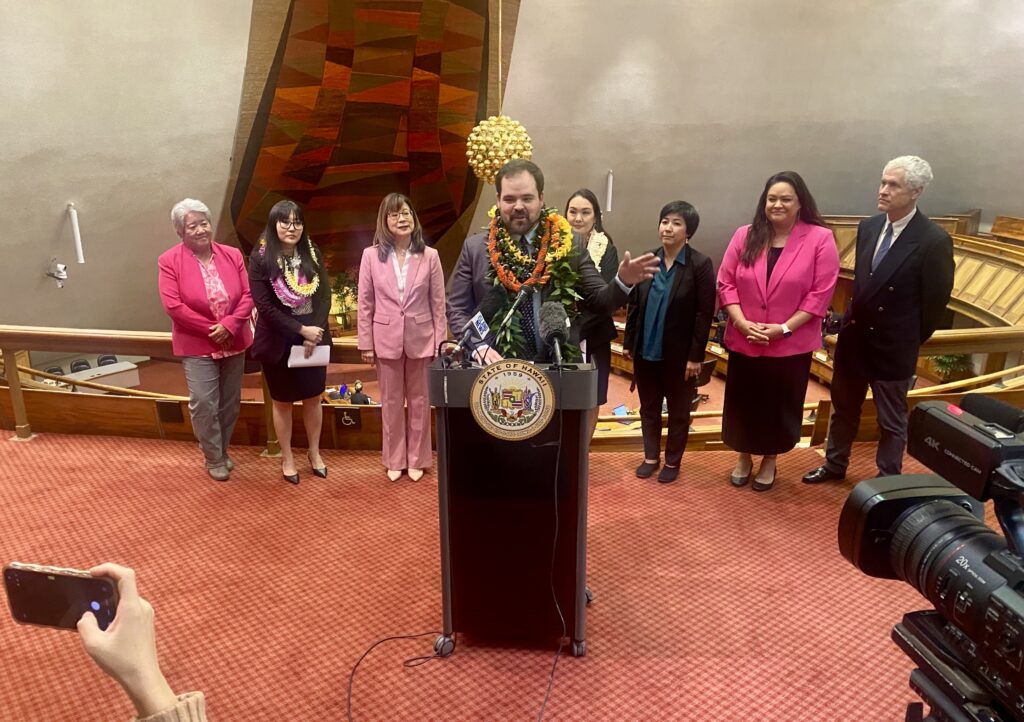
At press conference that followed, Todd expressed optimism that the House would largely find agreement with the Senate Ways and Means Committee to preserve as much as possible of the historic 2024 tax cuts, to find other revenue streams and to restructure existing programs.
“The devil is in the details,” he told reporters at a media briefing in the House visitor gallery.
Todd said he believed the state could also absorb any new expenses that come from the recent Kona low storm that drenched all the islands.
“Heading into conference, we’ll be anticipating communication from the administration, which should be aggregating some of these costs,” he said. “It’s very possible that, given existing fund balances from this prior budgeting process, that that can be accounted for already without any major figure being incorporated into the budget. But we’re going have to wait and see and go from there.”
It is the international situation that is far more difficult to factor into budget considerations. Jenna Takenouchi, the House Finance Committee vice chair, said more economic uncertainty is expected in the days to come because of the new war in the Middle East.
“Largely, this continuing uncertainty let us know that we needed to craft a budget that will let us remain flexible so that we can prepare to adapt as these conditions are continuously changing,” she told reporters.
In addition to covering federal cuts, priorities in the House budget also include affordable housing, higher and lower education and disaster preparedness.
For example, $130 million would go to financing programs for the state’s Rental Housing Revolving Fund, $234 million for improvements and repairs to K-12 school facilities statewide and $28.5 million for student housing improvements at the University of Hawaiʻi Mānoa campus, and $21 million would be distributed for insurance proceeds for the Lahaina wildfires.
All told, HB 1800 appropriates $1.4 billion in capital improvement project funding.
Only three Republicans, Reps. Diamond Garcia, Elijah Pierick and Chris Muraoka, voted against HB 1800.
Garcia, the minority floor leader, said in his floor remarks, “Overall, it does increase government spending. It does add hundreds of million dollars in increases to government spending, and it does take into account the will of this body to renege on the 2024 tax cut.”
But another GOP representative, Kanani Souza, defended the budget, saying that “at its core, the budget is about trade-offs.”
“Every dollar allocated reflects a decision about who and what we prioritize,” she said. “This is the document that determines whether our state can function, whether we fund our schools, maintain our infrastructure, care for our most vulnerable, and keep Hawaiʻi running in the face of very real and growing pressures. And those pressures are not abstract. We are staring down federal funding cuts that will continue to shift more burden onto the state, and what we are seeing in the news today only sharpens that reality.”
Other operating budget appropriations proposed by the House include:
- $6 million to the Department of Business, Economic Development and Tourism for geothermal, carbon sequestration and underground water resource;
- $5 million in green fee revenue to establish a Home Retrofit Program for hurricane risk;
- $6 million to the Department of Health for overtime costs at Hawaiʻi State Hospital;
- $2.2 to the Department of Law Enforcement for eight positions in the Office of State Fire Marshall.
Other capital improvement project funding includes:
- $651 million for the state highway system;
- $24 million for upgrades and improvements to National Guard facilities;
- $17.9 million to support agriculture park improvements;
- $3 million for Kauaʻi Veterans Memorial Hospital.
Click here for the full list of operating highlights of the budget as compiled by the House, and click here for the full list of CIP highlights.
The fiscal year 2027 budget is paid for through $10.7 billion in state general funds. When all means of financing are factored in, in particular federal funding, the 2027 budget totals $20.4 billion.

