

Competing Energy Proposals Debate Which Will Limit Costs For Consumers
HECO says the cost to upgrade the old power plant exceeds what state utility regulators have allowed.
The ability of liquefied natural gas to stem rising electricity costs for consumers has emerged as a key issue for Gov. Josh Green’s proposal to use the fuel in Hawaiʻi while the state transitions to 100% renewables by 2045.
Opponents of LNG have seized on a flawed 2025 State Energy Office study that touted its economic benefits, creating new headwinds for an initiative Green says would reduce carbon emissions and lower electricity costs for beleaguered residents who pay the nation’s highest rates – more than twice the national average.
At stake in the debate is the cost of electricity to ratepayers, Hawaiian Electric Co.’s dominant position as a producer of electricity from generators and the type of fuel that will be used.

JERA Co. Ltd. last week announced a proposal for a $2 billion, 500-megawatt, natural gas power plant that would establish the company as a major player in Hawaiʻi, competing with HECO as a power generator. The announcement came five months after Green announced a strategic partnership with JERA in October.
Hawaiʻi law requires all electricity sold in the state be produced by renewable resources by 2045, and generators using renewable fuels to provide steady power are expected to be part of the mix. JERA’s proposed project and a smaller, $847 million upgrade HECO is planning for its Waiau power plant both would be able to switch to 100% biodiesel or another renewable such as hydrogen by 2045.
In the meantime, HECO is expected to use a mix of oil and biodiesel at Waiau and 100% oil at its Kahe power plant in Waiʻanae, while JERA would use less costly natural gas. JERA says its fuel savings could be passed on to customers. But political opponents of natural gas point to the Hawaiʻi State Energy Office’s 2025 study to question whether the savings would be real.
JERA “can arm-wave all they want about how this is going to be cheaper … but let’s move beyond the arm-waving.”
Isaac Moriwake, Earthjustice Hawaiʻi
The crux of the energy office’s error was astounding: in effect, the office allegedly failed to account for the cost of natural gas itself in an assessment of various fuels that could be used in Hawaiʻi’s power plants while the state transitions to renewable energy by 2045. In a hearing before the Hawaiʻi House Energy and Environmental Protection Committee, Matthias Fripp, a former professor at the University of Hawaiʻi Mānoa, said data underlying the report contained an error that inflated the benefits of LNG by $1.2 billion.
Mark Glick, who directs the State Energy Office as Hawaiʻi’s chief energy officer, on Friday acknowledged an error in a data spreadsheet supporting the study but downplayed its significance.
Regardless, critics of Green’s LNG plan are using the error to leverage opposition to the LNG plan.
Opponents include political progressives in the state House, who sponsored a now-dead bill to ban liquefied natural gas from Hawaiʻi, and NGOs including the Sierra Club, Earthjustice and Life of the Land.
Joining the NGOs as an unlikely political ally, HECO has accused the State Energy Office of favoring JERA over the smaller Waiau power plant upgrade HECO has proposed, which is projected to cost typical residents an extra $4 to $5 per month on their electric bills when it comes on line in 2033. That would be in addition to the cost of biodiesel tacked onto bills as a fuel charge.
JERA says it could build a power plant twice the size of HECO’s at less cost to customers by using natural gas until 2045.
In a press release Monday, Rep. Nicole Lowen, chair of the House Energy and Environmental Protection Committee, castigated the energy office for its study errors.
“The Legislature, and the people of Hawai‘i, rely on the State Energy Office to provide accurate, competent, and objective analysis to inform policy directions and decisions,” Lowen said in the release. “They’ve failed in their mission here.”
While JERA says it has based its proposal, which also projects cost savings, on its own research, Isaac Moriwake, Eartjustice Hawaiʻi’s managing attorney, said the energy office’s error casts doubt on the whole endeavor.
JERA “can arm-wave all they want about how this is going to be cheaper and how this is going to be accurate this time, but let’s move beyond the arm-waving and advertising,” Moriwake said.
JERA Says LNG Will Save Money
In an interview with Civil Beat, JERA Americas vice president of development, Erik Montague, made the company’s case that it could reduce electricity costs on Oʻahu. JERA has done its own analysis that had nothing to do with the Hawaiʻi State Energy Office, Montague said. And any plan JERA proposes would have to be submitted to the PUC and vetted through a public process.
Central to JERA’s argument is that natural gas costs less than the oil now used by HECO’s Oʻahu generators and the biodiesel HECO would use when its Waiau power plant upgrade comes on line in 2033. Even with the war in Iran shutting down a key shipping route for oil and LNG, Montague said, LNG remains less expensive than oil, its price pegged to global oil prices or U.S. natural gas prices.
While global oil prices have skyrocketed, the U.S. natural gas price has remained remarkably stable during the crisis.
The result, Montague said, is that using natural gas to fuel generators would cost 23% less than oil. Compared with biodiesel, using LNG would produce a 50% savings for the cost of fuel.

“That first year ratepayers will save $170 million in a year,” Montague said. “So you divide that by households, and it comes into right below $500 a year per household. So that’s right around $40 a month.”
In addition to the cost of the fuel, there’s the cost of capital to build the facility. Partnering with local investors, JERA plans to invest $1 billion in equity and borrow another $1 billion. Montague said the company’s large equity investment and access to lower-interest loans will enable the company to keep its financing costs low.
Another factor working in JERA’s favor, Montague said, is that both Matson and Pasha Hawaiʻi use LNG as bunker fuel on inbound trips to Hawaiʻi. Establishing an LNG ship fuel business for outbound trips could help subsidize the costs of the Oʻahu power plant, he said.
“In the scenario we ran, here is another $25 million a year that would go back to ratepayers,” Montague said.
New Regulatory Framework Would Be Needed
JERA is pushing to complete its project in 2030, an extraordinarily fast timeline in a state where the PUC can take years to approve even a routine solar project as part of a longstanding procurement process.
JERA has extensive experience building LNG-burning power plants. It also has access to generator turbines that have become rare commodities as power-hungry data centers have sprung up globally with the growth of artificial intelligence.
But engineering skills and access to hardware alone could mean little in Hawaiʻi, where a notoriously difficult regulatory environment is known to slow down projects.
“2030 is a tall order in terms of delivering this infrastructure,” JERA’s Montague said. “However, we are also confident we can make significant progress to that and still have a shot at getting that done if we are able to move aggressively.”
Montague said moving aggressively would require more than pushing Hawaiʻi’s regulatory envelope. It would mean reinventing it — something the PUC has acknowledged needs to be done, at least for renewable projects, if the state is going to meet its 2045 deadline.
“The status quo is unsustainable,” the PUC said of its current regulatory framework in a 2024 white paper. “Given the compelling public need, critical energy infrastructure development should not take longer than three years.”
Montague agreed, and said it’s not just about LNG or JERA.
“Our view is that the state isn’t building renewables fast enough,” he said. “We think it needs accelerated by three or four times, and that has nothing to do with natural gas. Fundamentally, like this comes back to the process discussion we’re talking about: What is holding the state back on building renewables faster?”
As for JERA, Montague said, “If we try and follow this process, you will never get a transformational investment and change to your energy system.”
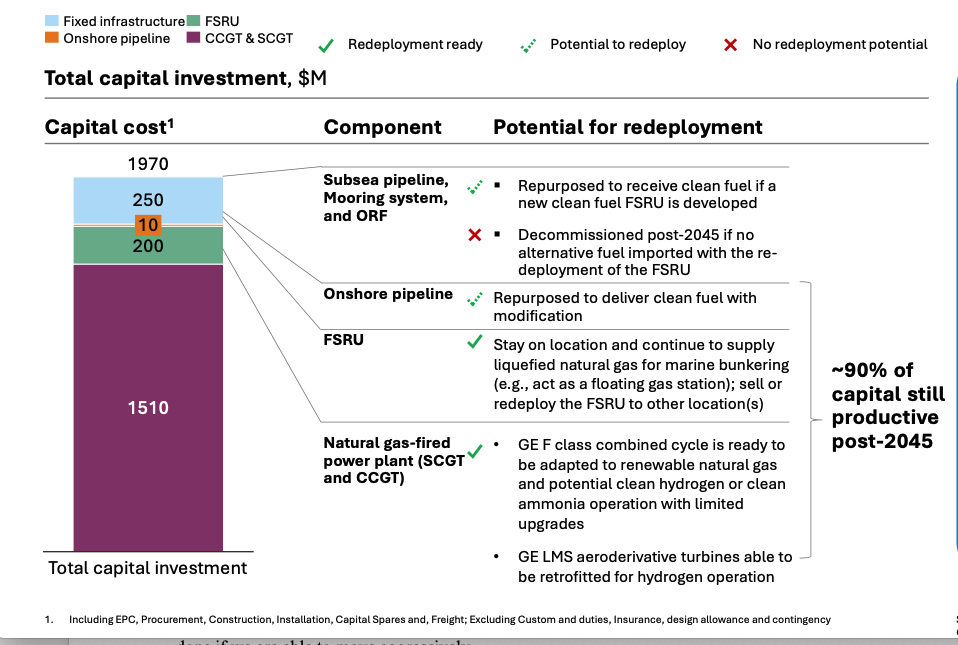
A major question surrounding JERA’s project is how the company could pay off a $2 billion investment in an LNG-burning power plant when state law prohibits the use of fossil fuels by 2045. Skeptics say JERA simply can’t meet the deadline, with the most suspicious critics saying the project is the first step toward extending Hawaiʻi’s renewables deadline past 2045.
Montague said its simply not true that JERA’s capital projects would become stranded assets after 2045 if JERA can’t use LNG.
Approximately $1.5 billion of JERA’s investment will go toward fuel-flexible generators similar to the ones HECO plans for its Waiau upgrade. And like HECO, JERA could use those generators past 2045.
“Get out a spreadsheet. Look at the cost of fuel, look at how much of a discount there is … and you can realize, this actually does pencil out.”
Erik Montague, JERA Americas
In 2045, JERA hopes to be able to switch to hydrogen fuel, which the Japanese government is developing as part of its plan to switch from LNG to renewables by 2025. If hydrogen isn’t feasible, JERA could use another renewable fuel such as the biodiesel HECO plans to use at Waiau.
Pipelines also could be repurposed for renewable fuels. And a floating, offshore LNG terminal could be deployed elsewhere or continue to be used as a shipping fuel hub for Matson, Pasha and others.
“Get out a spreadsheet,” Montague said. “Look at the cost of fuel, look at how much of a discount there is, look at how much fuel you use, and you can realize, this actually does pencil out pretty well. I think the detractors don’t want to admit that.”
Future Of HECO Power Plant Upgrade In Doubt
While JERA’s project faces headwinds, so does HECO’s Waiau upgrade.
The PUC on Monday gave HECO the green light to move forward. In doing so, the commission defied a request by Mark Glick, director of the Hawaiʻi State Energy Office, to delay making a decision until September.
Specifically, Glick wanted the commission to take time to see JERA’s proposal and to answer questions the energy office had about HECO’s request to increase project costs by 36%, to $1.15 billion, from HECO’s originally proposed $847 million.
HECO decried Glick’s 11th-hour request, accusing the energy office of playing favorites with the administration’s strategic partner, JERA. HECO was joined by renewable energy companies like AES and Hawaiʻi’s only oil refiner, PAR Hawaiʻi, which said Glick’s request threatened the integrity of the PUC’s established regulatory approval process.
Lowen pointed to the energy office’s flawed study and said it was troubling that the energy office “now seeks to influence an active Commission proceeding in a manner that would advantage a specific, non-competing entity.” Moriwake accused Hawai‘i’s energy chief and JERA of making a backroom deal.
While the commission rejected Glick’s request for a delay, the commission’s order greenlighting HECO’s project reined in the utility’s request for the 36% cost increase. Instead, the commission said HECO could go 10% above its original proposal or adjust costs for inflation, whichever was less.
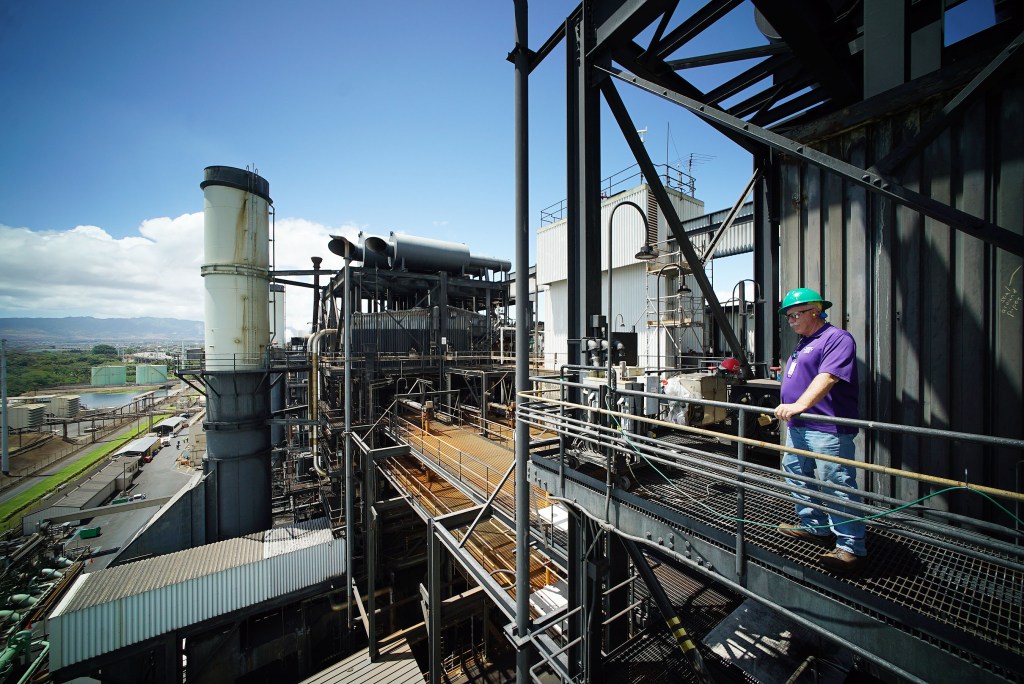
The commission also required HECO to speed up using biodiesel. While the company had anticipated using lower-cost oil until 2045 when it would be mandated to switch to more expensive biodiesel, the PUC said HECO would have to use at least 51% renewable fuel when the project comes online in 2033 and at least 75% by 2040.
HECO was less than enthusiastic about the order.
“We’re still looking at this because the amount approved is not the cost of the amount needed to build it,” said Jim Kelly, HECO’s vice president for government and community relations and corporate communications.
As for requiring HECO to switch to biodiesel sooner than it expected, Kelly said, “We have to use what we have been directed to use in that order.”
Moriwake, who frequently participates in PUC proceedings, said HECO’s next likely step would be to file a request for the PUC to reconsider its order. As a practical matter, that could give the Hawaiʻi State Energy Office what it wanted: time for JERA to submit a formal request to the PUC.
As for JERA, Monatague said its project would make the Waiau upgrades and HECO’s oil-burning Kahe power plant unnecessary.
“Our view is it’s much more cost effective for the state to build one bigger, newer, efficient, flexible generation project and retire all the oil sooner,” Montague said. “So both Waiau and Kahe get retired when this power plant comes on online.”
Civil Beat’s coverage of climate change and the environment is supported by The Healy Foundation, the Marisla Fund of the Hawaiʻi Community Foundation and the Frost Family Foundation.

