Frightening North Shore Floodwaters Forced Hundreds To Flee
Oʻahu rescuers used paddleboards and kayaks, Jet Skis and backhoes to evacuate residents around Waialua and Haleʻiwa
In the pitch black of Friday morning, as torrents of rain battered the island, floodwaters rose to levels many North Shore residents said they had never seen. Anxiety and fear became companions that prodded people into action, whether that was saving what they could or fleeing.
Racquel Achiu and her family had lost power and were in the dark at their Waialua farm. Emergency sirens were wailing, water was climbing across her property and when she waded out to save her livestock from drowning her pasture was “chest-high” in water.
“We are completely cut off,” she said in an early-morning text to Civil Beat. “Can’t see a damn thing … It’s so bad.”
The first evacuation notice hit Achiu’s phone at 3:42 a.m. in a Nixle alert from Honolulu’s Department of Emergency Management: “Catastrophic flash flooding in Waialua and Haleʻiwa. If you can evacuate safely, evacuate to higher ground now.”
The amount of flooding surprised even authorities who had warned of severe weather on the heels of the last Kona low, but were preparing for a lesser storm.
“The National Weather Service had forecast that there may be some potential for severe weather earlier in the week,” said Molly Pierce, spokesperson for the Department of Emergency Management, “but they did not have any understanding of what the severity of that would be.”
‘Never Seen It This Bad’
Across the sodden North Shore, as the Wahiawā Dam threatened to breach, hundreds of residents evacuated. That was far fewer than the 5,500 people officials said were living in evacuation zones. But many of those who did flee were driven by dire circumstances.
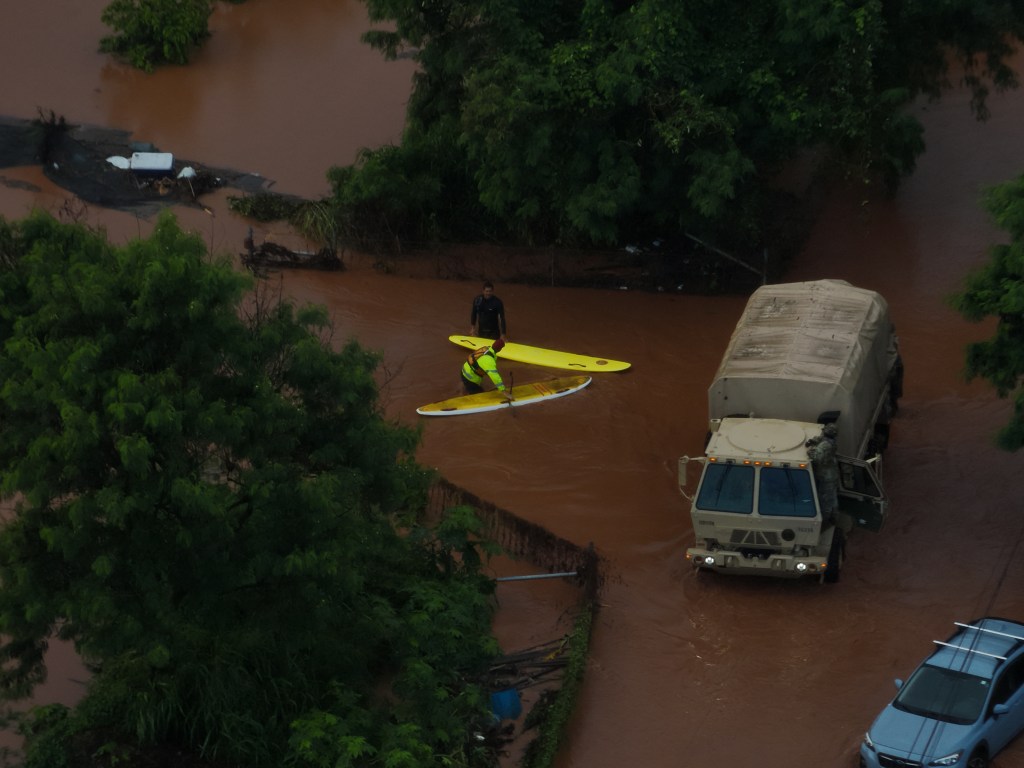
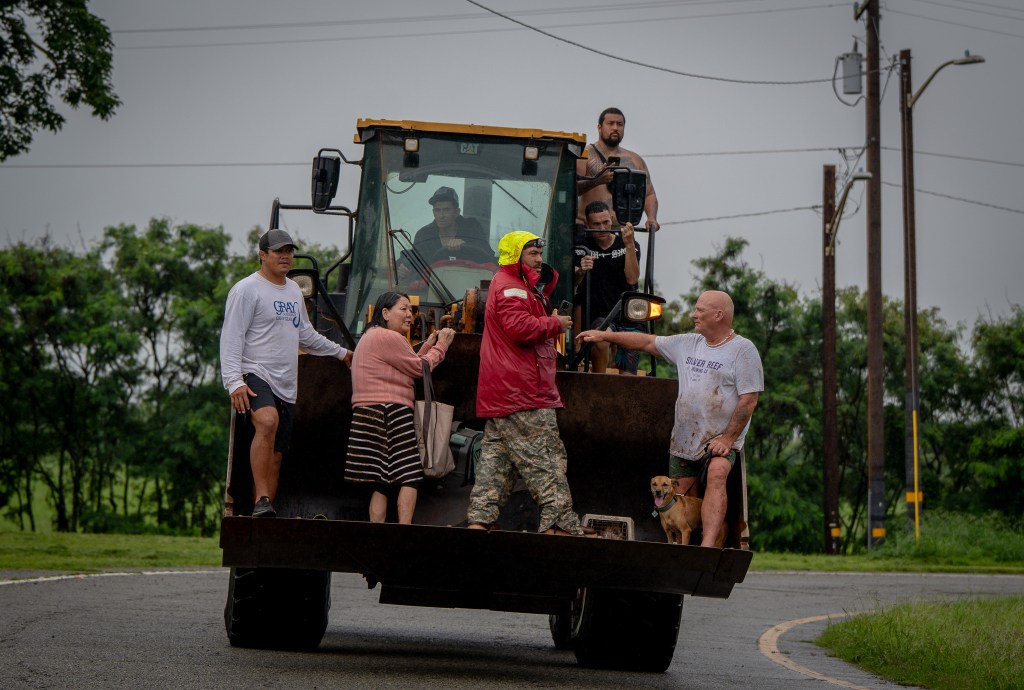
A visitor from Salt Lake City and her family rode surf boards down Haleʻiwa streets while others traveled in kayaks along farm roads. People were carried out in a bulldozer blade. Others in gravel trucks or buses. Some farmers were said to have swum through their fields. Firefighters and lifeguards came to the rescue on Jet Skis.

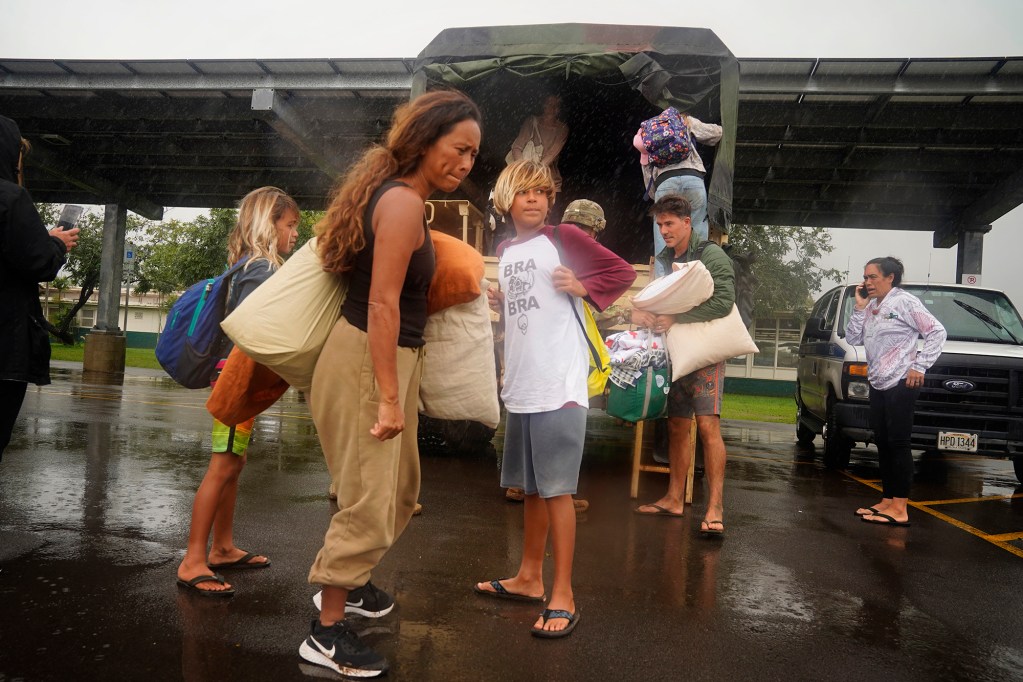
Military vehicles with high water clearance that usually transport troops were pressed into service. Through the morning, Jay Bal, Hawai’i National Guard Sgt. First Class said his truck made three trips evacuating civilians from Waialua to emergency shelters.
Police officers had started moving through Haleʻiwa from neighborhood to neighborhood at about 4 a.m., telling residents to leave and blocking off Waialua Beach Road, which was soon rushing with red clay water. A car was left overturned by the roadside.
Behind the Wahiawā Dam, owned by the Dole Food Co., water had risen within less than 3 inches of the 84-foot evacuation level by 4:30 a.m. It continued rising inch by inch, despite water pouring over its spillway at a pace of 1,500 gallons per second
“I have never seen flooding like this in all the years I’ve lived up here. I’ve never seen it this bad,” said Kathleen Pahinui, chairperson of the North Shore Neighborhood Board.
India Clark, a farmer at Kaʻena Farm Lots off Farrington Highway near Dillingham Airfield, said she saw a woman named Pule and her children trapped in her vehicle by rising floodwaters.
The woman was able to call police, who came to save her, Clark said.
“It’s either, stay in the truck, or do I get out in the water and try to make it”
North Shore farmer Sarah Ghio

Near Farrington Highway, midway between the airfield and Waialua town, farmer Sarah Ghio got trapped in her truck, too, and faced a choice. Water was coming over the hood. Firefighters said the waters were too deep to get to her, she said.
“It’s either, stay in the truck, or do I get out in the water and try to make it,” Ghio said.
She got out of her truck, made her way to Farrington Highway, then waded toward the high school. The current was so strong, she said it took her three tries to cross at the Mount Kaʻala Road intersection.
“I wasn’t sure I was gonna make it, just gonna suck me under, and then, you know, this kind of water will trap you and hold you under,” she said. “Thankfully, I made it out.”
Separated From Family
Christy Noriega, an Uber driver, had stayed late in town for work and had been trying since midnight to get back to her family in Waialua. But both bridges into the community were closed, stranding her.
“My family was in the house. I was with the car,” she said.
It took Noriega until 5:30 a.m. to get to her family. “I just kept trying different ways asking different people.”
Finally, someone told her they’d just gotten through the Farrington Highway bridge at the Otake Store two minutes earlier.
“I said, boom, I’m going,’” she said.
She drove by a house that had crashed into Kaukonahua Stream at the bridge near the Otake Camp store, partially blocking one lane of the road.
Zaz Dahlin, a farmer and Haleʻiwa resident, said her aunty and handicapped grandson lived in that house, but in a stroke of fortune they had been evacuated by police at about 2 a.m., even before the first evacuation alert.
“They had no time for grab” any belongings, Dahlin said.
They were taken to an emergency shelter set up at Waialua High and Intermediate School – which lost power until generators kicked in.
A Chilling Alert
At 8:34 a.m. came a chilling alert: the Wahiawā Dam was either failing or about to – putting 2,500 downstream lives at risk.
Dahlin heard the warning sirens but was trying to refresh the NOAA website to see the Wahiawā reservoir level. There had been mixed messages from the city, Dole and old farmers, she said, who believed it would fail at some point between 84 and 90 feet.
“This could wipe out the entire fucking town with billions of gallons in there,” Dahlin said, while loading her dogs and things into her pick up truck.
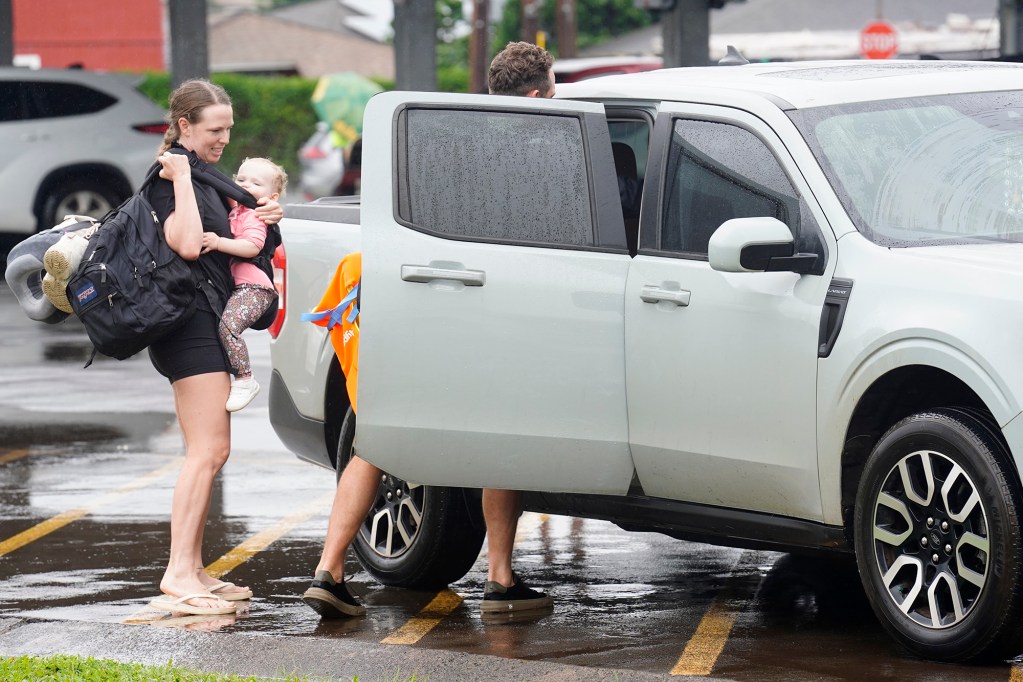
The warning was enough for Charlotte and Blake Hayward of Waialua. They got out with their 1-year-old daughter, Alana.
“They put the sirens on again. It was just like, ‘Okay, we’re stupid if we stay here this time, they gave us fair warning,” Blake Hayward said.
The Waialua High School shelter was itself evacuated by city bus. At least 186 people and 45 dogs were taken to higher ground at Wahiawā District Park and Leilehua High School, Mayor’s office spokesperson Ian Scheuring said.
“We were just settling in, getting everyone situated. And then the police came again and said, ‘Nope, you guys got to go up to Wahiawā,’” said John Salanoa of Wailua.
“Everyone ran, because they came in pretty strong, like there was seven or eight police officers … saying, everybody, please get up. You got to get out,” Salanoa said. “That dam’s breaching. It’s right now breaching.”
Twenty-six long minutes later came another alert: “Wahiawa dam has not failed but is at imminent risk of failure.” The evacuation order was still in effect, it said.
At the Leilehua High School shelter mid-Friday morning, Rafe Maldonado and his family were safe but still wrestling with unknowns.
“My daughter’s been throwing up all this morning,” Maldonado said, referring to his adult daughter, who lives on the same property as he does in Waialua. “She’s scared. She’s grateful, obviously, that we’re all alive, but she doesn’t know if she’s gonna have her house when she comes back.”
“As long as the dam didn’t break, we were safe.”
Rafe Maldonado, Waialua resident
The family had evacuated about 1:30 a.m. Friday, as floodwaters rose in their yard.
The Waialua High and Intermediate School shelter wasn’t open yet, Maldonado said, and they and other evacuees took refuge in the parking lot of a nearby shopping plaza for more than two hours.
“As long as the dam didn’t break, we were safe,” he said.
Several hours later, at the Waialua school shelter, they reunited with neighbors who had escaped from homes that were chest high in floodwater.
“They were moving the older people on the kayaks and on the set of paddle boards to get them out of the house, to get them to the cars, to be able to get out,” he said. “They all made it. Thankfully.”
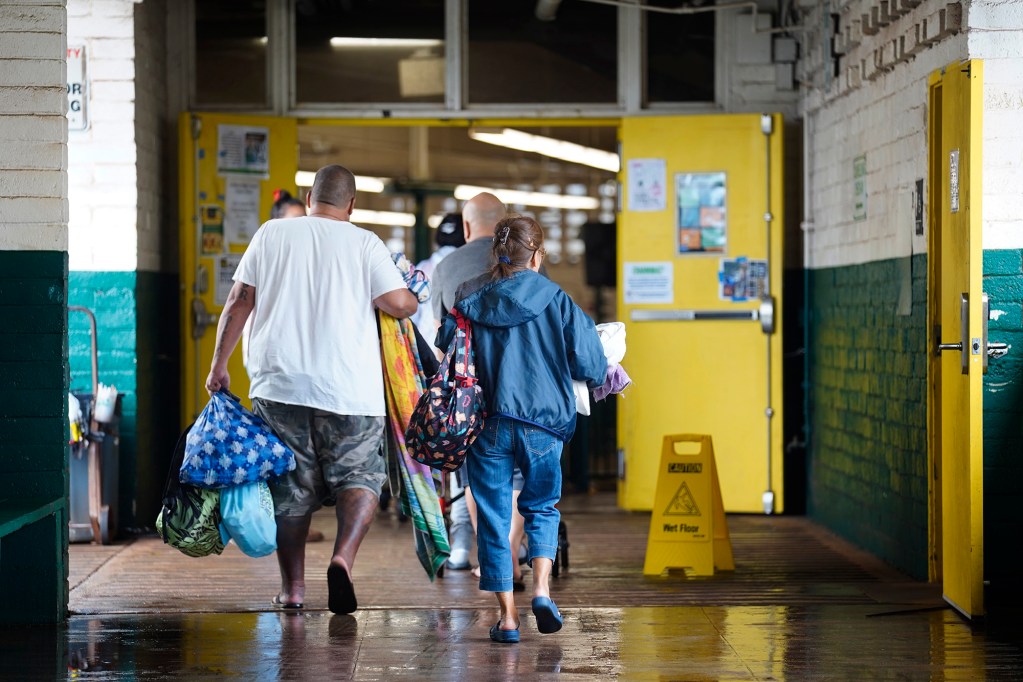
Resident Ricardo Taveira spent the morning helping families with young kids and elderly people evacuate their houses and wade through the water, which was moving fast enough to carry debris through the neighborhood. Taveira said he also evacuated a few dogs and cats.
Taveira, who owns the Hawaii Eco Divers shop in Haleʻiwa, said he has a Jet Ski to help people evacuate. He hasn’t needed to use it yet, he said, but he’s prepared to if the dam breaks.
By morning, in Waialua, Kukea Circle near Paukauila Stream was flooded, with brown water in people’s garages and partially submerging their washing machines, mailboxes and cars.
“All the safety equipment is ready to go,” he said.
At about 3 p.m., two National Guard trucks pulled up to the Leilehua High School shelter with six kūpuna rescued in the previous hour from a senior home in Waialua.
There were two in wheelchairs, one with a scooter and one using a shopping cart as a walker. When they were rescued, water in the home had been knee high in spots, said Hawaiʻi National Guard Sgt. First Class Atui Valu.
Staying Put
Some chose to ride out the storm.
Thomas Milcarek’s first floor apartment on Au Street in Waialua, in a neighborhood known as Cement City, falls on the edge of the evacuation zone. But the 75-year-old said he’s staying put for now with plans to join his friend on a higher floor of the apartment if the weather worsens or threats of flooding intensify.
“Right where I live, there’s not too much except a lot of good rain for my garden,” Milcarek said. “I’m not sure what’s gonna happen if the dam breaks, but I’ll just be ready to go up the third floor.”
Even if the roads were open, Milcarek said, he doesn’t have a car. If the weather gets worse, he said, he plans on riding his bicycle to the access road leading to the Peacock Flats campground — something he did during the tsunami warning last summer to get to higher ground.

In Haleʻiwa, Bill Andersen, who said he lives just inside the evacuation zone on the Anahulu Stream, which opens into Haleʻiwa Boat Harbor, was staying where he was, too.
Speaking moments after the first alert about the dam’s imminent failure, Andersen, who is also 75 and has lived in Haleʻiwa off and on for most of his life, said he had lost power but was confident the flooding wouldn’t reach him.
“I’d say it’s 50-50 at this point, depending on where the levee is that they say has been overrun,” Anderson said. “But I’m not worried about it at all.”
“…(W)e’ll have something to tell our kids and our grandkids if we survive.”
Bill Andersen, Haleʻiwa resident
The Anahulu Stream was flowing easily, he said, since a late February storm cleared out debris at the river’s mouth.
“It’s just been really, you know, very fast moving, but so far not flooding because nothing’s blocking it,” he said. “At some point it did start galloping, but then it leveled out because there’s nothing to stop it.”
His brother, who lives next door, is not leaving either, Andersen said.
“We just won’t leave,” he said. “I mean, it’s like, okay, if it comes up, we’ll worry about it. And we’ll have something to tell our kids and our grandkids if we survive.”