

Kauaʻi Wants To Get Tough On Beachfront Home Renovations As Tides Climb
As beaches shrink, the proposal would revise the county’s shoreline setback rules to ensure that coastal homes truly being rebuilt are relocated inland.
A nearly $4 million beachfront house on Wainiha Beach seems like a typical tropical vacation rental, with panoramic ocean views, a living area wrapped with floor-to-ceiling windows and five ensuite bedrooms.
But with climate change making beaches like this one on Kaua‘i’s North Shore retreat, the county hopes to get tougher on houses that want to do repairs and other improvements within the shoreline setback.
Bill 2984 would give the Kaua‘i Planning Department more authority to demand that such houses provide proof that the cost of their improvements fall under the county’s threshold for requiring that structures be moved outside of the shoreline setback area.

North Shore resident Caren Diamond, who helped the Planning Department draft the bill and has fought for better shoreline protections for decades, said it benefits everyone to have houses set back farther from the shoreline. Properties will be safer, the public access along the shoreline will be preserved and coastal hazards can be avoided.
“These beaches are so incredible that we need to do better,” she said. “We need to find a way to not have houses washing away.”
About a decade ago, the vacation rental on Wainiha Beach underwent a nearly $362,000 remodel that including replacing the exterior siding and drywall around new windows, creating a new closet and upgrading the flooring and fireplace.
The house was deemed exempt from a shoreline setback determination because the cost of its improvements amounted to 49.9% of the existing structure’s $725,500 market value.
If the improvements, plus any others completed in a 10-year period, had exceeded 50% of the structure’s market value – which the county would deem a substantial improvement — the house would have needed to be moved outside of the shoreline setback area. A formula is used to calculate the specific setback for each property, but the bare minimum is at least 60 feet. The house would also need to be further elevated to comply with the county’s flood rules.
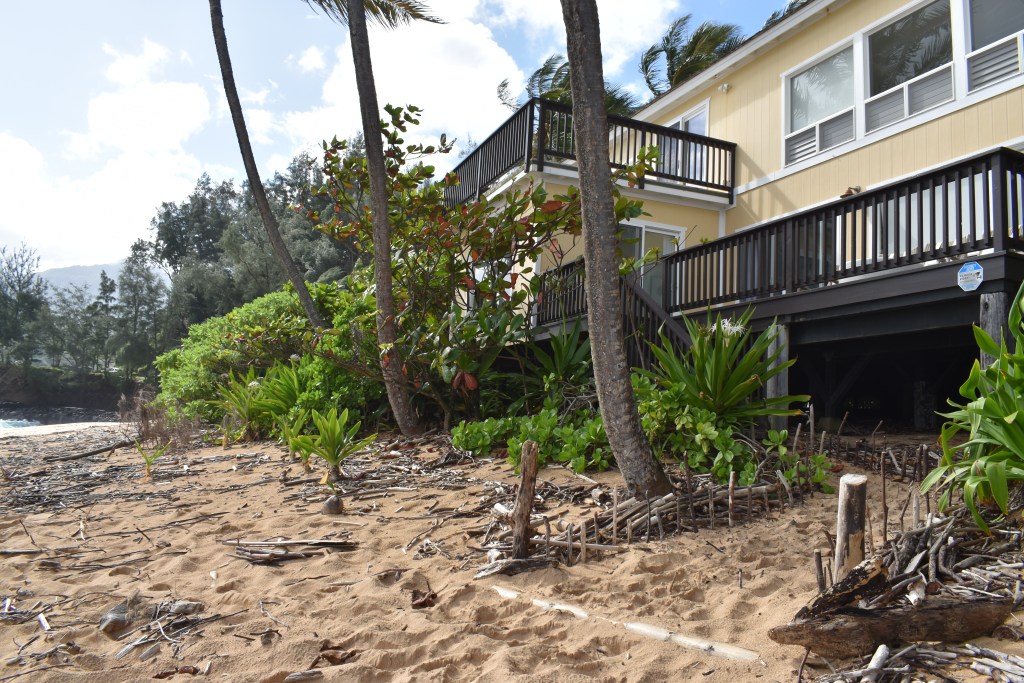
Frederick Kleinbub, who owned the house when the renovations were underway, told Civil Beat that he loved the house and wanted to remodel it. He hung up before answering further questions and did not respond to an email or voicemail following up.
‘What Is Happening Out There Is A Disaster’
On the North Shore, there are many obvious examples of houses doing major renovations or even rebuilds in Wainiha and Hā‘ena when they’re only permitted for repairs, according to Kaua‘i Planning Director Ka‘āina Hull. The area also has high volume of transient vacation rentals.
Over the last two years, the department has received seven complaints about coastal homes doing more construction work than allowed. He cautions that the complaint numbers don’t reflect the total quantity of violations because the department isn’t able to fully calculate whether the overall cost of repairs and improvements over 10 years exceed the 50% threshold.
“What is happening out there is a disaster,” Council Chair Mel Rapozo, one of the bill’s co-introducers, said when the council received the draft bill from the Planning Commission on Feb. 4. “There’s so much abuse going on out there, so much abuse. And it’s flagrant.”
He said the bill would help protect Kaua‘i’s people and lands, while also getting tough on vacation rentals that have taken over local neighborhoods where neighbors once knew one another.
“Our people are losing out on beaches, of the quality of their neighborhoods, where it used to be small little homes have turned into large homes and vacation rentals,” Rapozo told Civil Beat.
Bill 2984 would give the Planning Department the authority to request cost breakdowns of home improvements, plus receipts. The department could also do its own estimates if the homeowner failed to provide the receipts.
If the cost of improvements were found to exceed the 50% threshold, the department could require that the improvements be removed, or the structure be entirely relocated outside the setback.
“It gives us a lot more authority to implement and ensure that only repairs are occurring in the setback area and not the rebuilds,” Hull said.
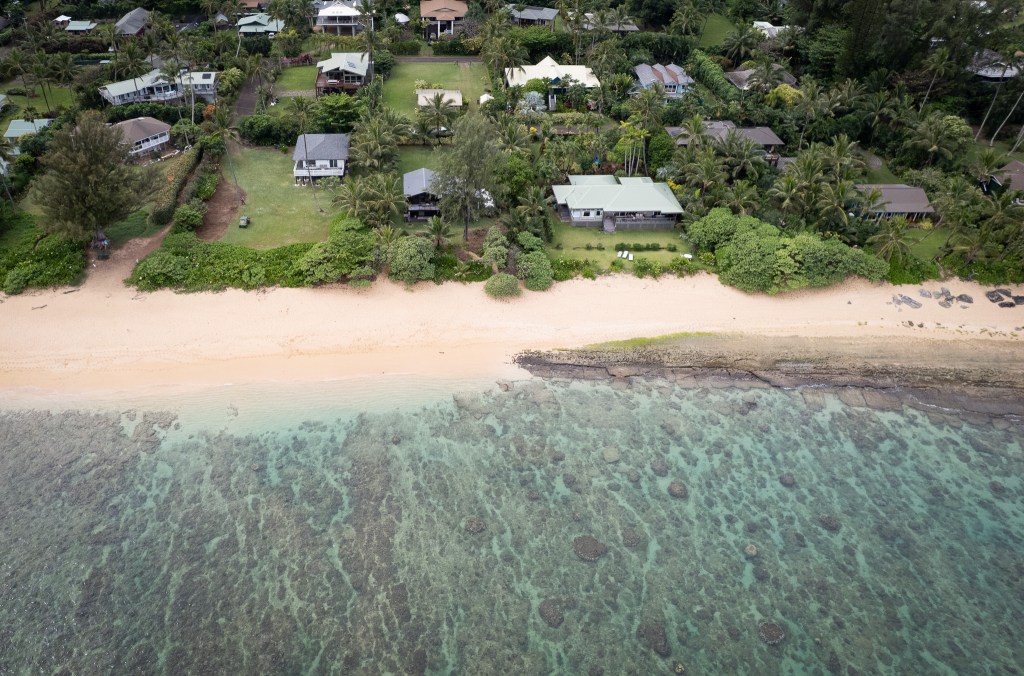
The bill includes provisions to increase community awareness of what’s occurring in coastal neighborhoods. Homeowners’ applications for a shoreline setback or exemption will be subject to a 30-day comment period, and they must post a sign on their properties when repairs are underway. That sign must include the shoreline setback determination number, Planning Commission acceptance date and building permit number, among other items.
Erosion Means Less Public Beach
Another major paradigm shift in Bill 2984 is a requirement for coastal homeowners to get a state-certified shoreline survey for any repairs exceeding $125,000.
“Across Hawai‘i, we just don’t really know where our actual certified shorelines are, and so we often see this rub between private property owners and people on the beach,” Hull said.
Diamond, who in 2006 won a landmark Hawai‘i Supreme Court case affirming that state law defines the shoreline as the highest wash of the waves outside of storms, said that without certified shorelines, homeowners have often instead used the edge of beachfront vegetation as their shoreline and then built back based on that. In some cases, homeowners have planted naupaka and other shrubs to artificially extend their property lines further makai.
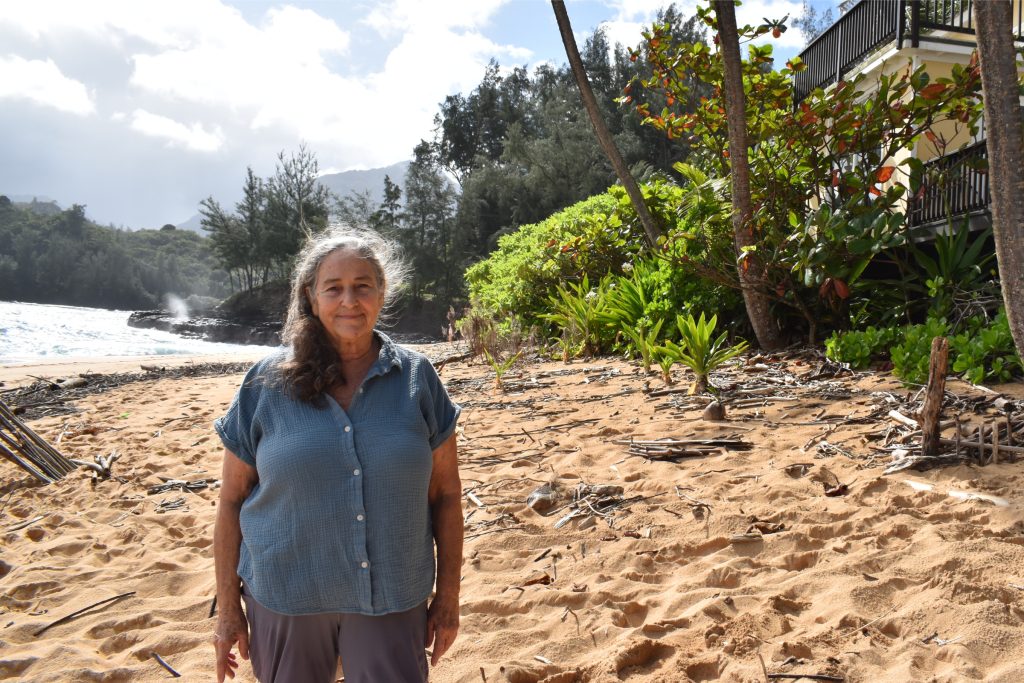
Diamond said that, combined with more coastal erosion, has meant less space for public beaches.
“It just keeps moving more and more seaward, and we keep losing more and more beaches,” she said. “And so even though the house is far back, the time of development is the time to restore your shorelines, and when the county skips that, this is a beach loss that should not be.”
Not all agree with the $125,000 repair threshold that would trigger that requirement. Andrew Pereira, director of public affairs for Pacific Resource Partnership, said having a hard, one-size-fits-all dollar cap doesn’t account for variations in property size, value or inflation and could disproportionately affect modest homes. PRP instead prefers a scaled, percentage-based threshold tied to the structures’ assessed replacement values.
PRP represents 6,000 unionized carpenters and 250 contractors, including about 300 journeyman-level carpenters and apprentices on Kauaʻi. The organization submitted written testimony on the bill, offering comments on certain provisions.
Rolling Back Shoreline Development
Chip Fletcher, dean of the School of Ocean and Earth Science and Technology at the University of Hawai‘i Mānoa, said the proposed rules are appropriate because they recognize the scientific reality that sea level rise is driving coastal erosion and will be with us for centuries.
About 73% of Kaua‘i’s sandy beaches are retreating inland and coastal erosion is expected to significantly worsen in the coming decades. Eventually, Kaua‘i and the other counties will have to move coastal roads and communities, said Fletcher.
“It’s very important that we prevent overdevelopment of our shoreline and that we use our rules and policies to roll back the existing development on the shoreline,” he said.
The proposed legislation would also require that owners of lots within the shoreline setback that are threatened by sea level rise or historic coastal erosion agree to retreat, remove or relocate their structures by the time the shoreline reaches them. This would only apply when the property owner is seeking to build an additional structure or make substantial improvements to an existing one.
Hull said that once the shoreline reaches a house, that house becomes state property and must be removed. In 2009, a beachfront Anahola house collapsed into the sea after years of crumbling away. The legislation aims to prevent that from happening again.
O‘ahu has already seen several homes collapse into the ocean in recent years, such as on the North Shore and in Kāhala but Kaua‘i is alone in having language explicitly requiring property owners to agree to retreat, remove or relocate their structures.
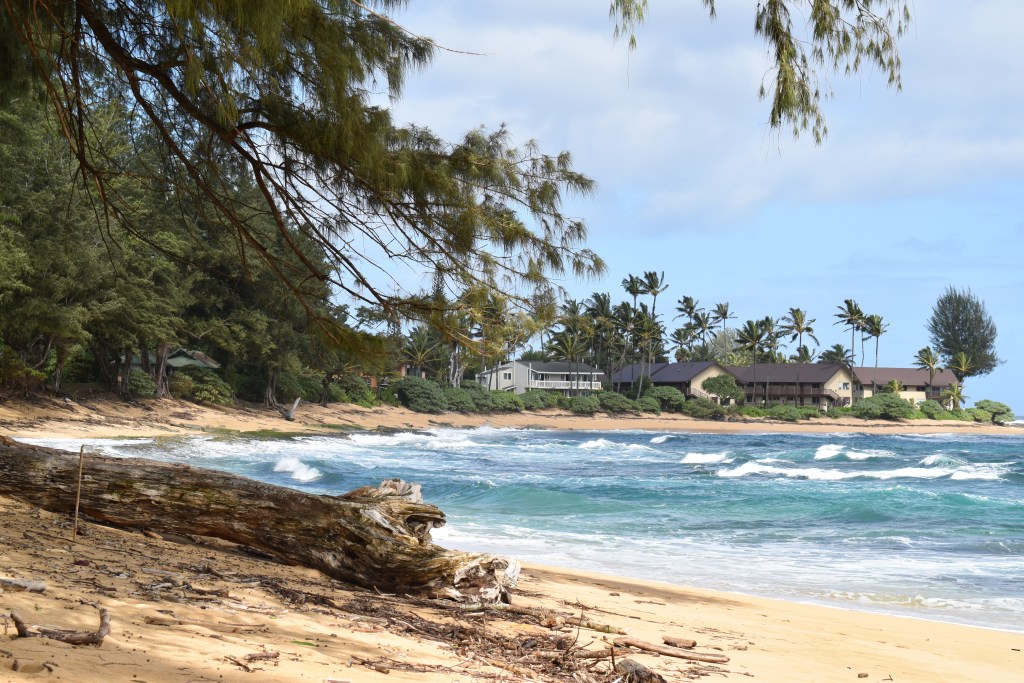
O‘ahu and Maui counties do have similar provisions allowing repairs and maintenance of existing shoreline houses generally as long as improvement costs over a 10-year period do not exceed 50% of the replacement cost. O‘ahu’s specific requirements vary based on whether part of the structure is located within 40 feet of the shoreline.
Council public hearing on shoreline setback bill
Where: Council Chambers, 4396 Rice Street, Suite 201, Līhu‘e
Agenda: https://www.kauai.gov/files/assets/public/v/1/county-council/documents/council-meetings/2026-03-11councilmeetingagendawithlinksdmc.pdf
Watch the livestream: https://www.kauai.gov/Government/Council/Webcast-Meetings
PRP argues that retreat and removal agreements should have objective and verifiable triggers, rather than relying on a vague standard.
“Whenever you’re talking about, you know, agreeing to retreat or relocate, or, you know, remove yourself from a property, that’s something that’s very emotional, and something that I think the council is going to have to treat very carefully,” Pereira said.
The County Council will hold a public hearing for Bill 2984 on Wednesday.
Civil Beat’s reporting on Kauaʻi is supported in part by a grant from the G. N. Wilcox Trust and its Civil Beat’s coverage of climate change and the environment is supported by The Healy Foundation, the Marisla Fund of the Hawai‘i Community Foundation and the Frost Family Foundation.
Read the bill below.

