On Top Of Everything Else Facing Storm-Ravaged Oʻahu … Potholes
After two intense Kona lows, calls to a city hotline to report potholes tripled. As drivers dodge divots, the city is just beginning to assess the damage.
As communities across Hawaiʻi assess serious damage from days of flooding, city data show the two Kona low weather systems quickly left their imprint on Honolulu’s streets and roadways.
A temporary break in the weather saw people taking to the roads over the weekend, and they found even streets not in flood zones pocked with potholes.
“Very, very deep pothole in front of the Hele gas station on Kapahalu,” one driver reported to the city’s HNL 311 service for non-emergency issues.
That was one of 455 reports of potholes between March 10 and midnight Monday, an average rate of 35 per day — three times the rate of reports between Feb. 21 and March 10 before the two Kona low weather events.
Many of those calls cite multiple potholes, not just from heavily affected parts of Oʻahu’s North Shore, but also wide swaths of urban Honolulu from ʻAiea to Waipahu.

And the actual number of potholes is certainly higher, as previous reports from the city Department of Facility Maintenance show that hotline calls represent only 20 to 30% of the number patched in any year.
Many of the potholes reported during the storms already existed and were targeted for maintenance, but have now grown dramatically.
Twin potholes along Kāneʻohe Bay Drive, directly outside a miniature golf course, appear almost nonexistent in Google Street View images from a year ago. By the time a resident submitted photos of them on Sunday, however, they looked more like rounded footprints of a large prehistoric creature, filled up with rain.
Ditto a pothole along Mōkapu Road, on the way to Marine Corps Base Hawaiʻi. Google Street View a year ago shows two smaller potholes and three patched sections of road in a line. By March 17, after the first of the two recent storms, a 311 user said the current giant oval-shaped pothole in that spot popped their left front tire.
“I was unable to see it due to the water inside of it making it hard to see the depth of it, as well as minimal lighting on that road,” the driver said in their report.

Three big potholes along a single lane of Waiʻanae Valley Road make it “nearly impossible for anyone to maneuver without damaging their vehicle,” according to another 311 reporter on Sunday. That user estimated one pothole is about 4 feet in diameter, the other two a little smaller.
Potholes Add To The Bill
More than half of Honolulu’s roads are considered in poor condition, and Honolulu drivers are accustomed to dodging potholes, which add an estimated $700 to $850 per year to the average vehicle maintenance bill, studies show.
The city has previously said it has a general policy to repair potholes within 48 hours of a report, but more than 30 of those reported in February remain.
Over 180 of the pothole reports made between March 10 and March 22 – 40% – have been fixed. It seems a bit like a game of whack-a-mole. In the recent deluge, 160 potholes were reported between March 20 and March 22 and so far those also indicate they remain open.
As widespread rain and flash flooding continued Monday, authorities will need to assess the pothole backlog in addition to the large-scale repairs required for major roads and bridges across Oʻahu.
In Honolulu the city’s Department of Facility Maintenance is in charge of filling in potholes on public roads. Private roads damaged before or during the storms are the responsibility of the property owner or owners.
For the upcoming fiscal year, the department has proposed budgeting $8 million for road resurfacing. That’s more than double the amount from four years ago but less than the $13.7 million spent for road resurfacing in fiscal year 2025.
Nobody from the Department of Facility Maintenance was available Monday for an interview, city spokesperson Ian Scheuring said.
“City crews with the Department of Facility Maintenance who would ordinarily answer questions about potholes have been deployed to communities along the North Shore — including Waialua and Haleʻiwa — to focus on emergency storm recovery efforts,” he said.
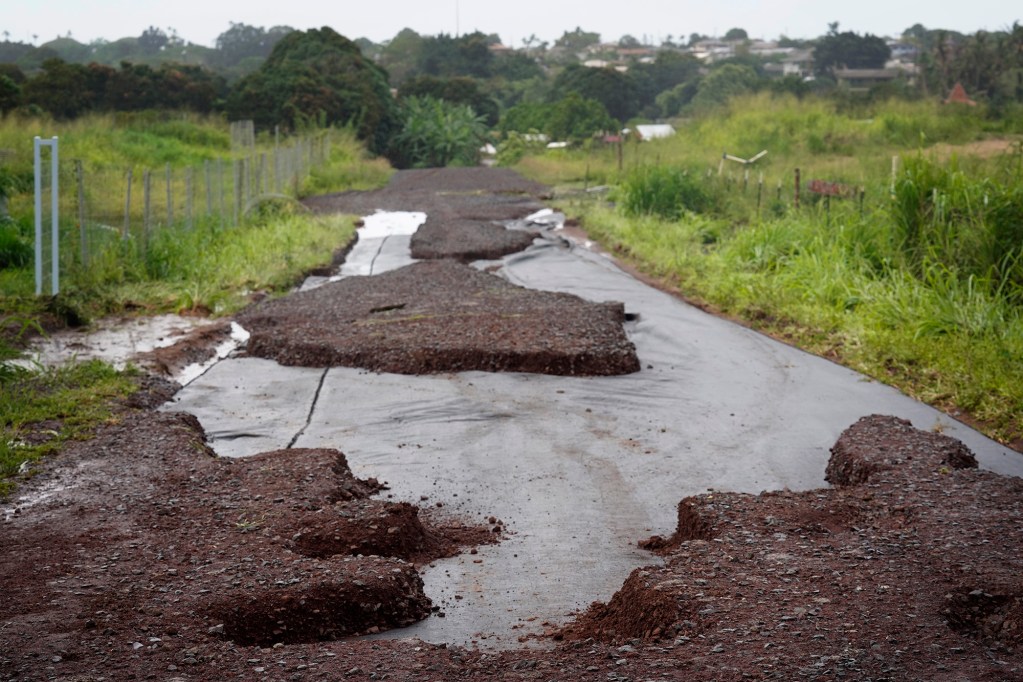
The state Department of Transportation deployed a dozen department crews and four contract crews to make repairs to state roads on Friday, Director Ed Sniffen said during an update. One of those crews was responding early Monday to a large pothole that closed the westbound H-1 onramp from Likelike Highway, a department release said.
Sniffen was unavailable for an interview Monday but DOT spokeswoman Shelly Kunishige said that since impacts were still being felt, it was too early to estimate the total toll recent storms took on state roads. The first Kona low system that hit the islands starting March 10 was expected to cost an estimated $24 million, according to a DOT estimate issued before the second Kona system hit.
Flooding and landslides that resulted from a Kona low in December 2021 caused over $2 million in damage on Waiʻōmaʻo Road in the Pālolo Valley, with 90% of the repair ultimately covered by a grant from the Federal Emergency Management Agency.
While potholes are a lower priority than the damage to flooded North Shore communities, they can nevertheless balloon, break maintenance budgets and trigger liability claims.
Civil Beat reported in 2017 that more than a quarter of all claims against the city annually are related to pothole damage. Less than a decade ago, the city made $2.5 million in payments to settle 490 claims and eight lawsuits related to pothole damage.
The Kona low weather events that have battered the islands for the past two weeks were particularly intense, officials have said. Gov. Josh Green estimated Friday that the worst flooding the state had faced in 20 years may cost a billion dollars.