

‘Pretty Unusual’: Big Changes Are Possible At The Kauaʻi County Council
With four open seats, this election presents a chance for better gender and geographic diversity.
Kauaʻi voters have a rare opportunity this election to fundamentally change the makeup of the county’s most powerful lawmaking body.
Four of the County Council’s seven seats are open as three members leave to run for mayor and another terms out. It’s only the second time in 30 years this many seats have been open at one time, and it comes as the island continues to experience a housing shortage and more impacts from climate change, invasive species and a worsening doctor shortage.
“I think it represents a tremendous opportunity to both potential candidates as well as to the county,” said Gary Hooser, a former state senator who served on the council for eight years. “People that want a more proactive council have a chance for a new majority, so to speak.”

Council Chair Mel Rapozo and council members Bernard Carvalho and Felicia Cowden are all running for mayor. Council Vice Chair KipuKai Kuali‘i, whose latest council tenure began in 2018, can not seek re-election due to term limits.
Colin Moore, a political analyst at the University of Hawai‘i Mānoa, said it’s a unique situation not just for Kauaʻi but anywhere in Hawaiʻi as incumbents generally stay in office and maintain control.
“I’m not sure when the last time something equivalent happened in another county, but it’s fair to say having this many open seats is pretty unusual,” he said.
So far, roughly two dozen candidates have shown interest in running for council this year. They have until June 2 to file, and the top 14 candidates will advance from the Aug. 8 primary to the Nov. 3 general election.
Name Recognition
Aside from making county laws, the council sets the county government’s budget and has the authority to revise property tax rates, enact zoning changes, guide future development and convey county property.
Voters determine who makes up the Kaua‘i County Council every two years. Kaua‘i is the only county to elect council members at-large rather than by districts, and the top seven finishers in the general election win seats.
Moore said having so many open seats in a top seven, at-large system can offer an opportunity to younger or less traditional candidates because voters are often more open to giving someone who is not a mainstream candidate a shot.
Most recently, that seems to have applied to Fern Holland, 40, and Addison Bulosan, 39, who hadn’t ever worked in county government and each won their seats on a second try.
On the other hand, Moore said a race where voters must choose so many candidates also can result in more established candidates being favored since they already have the name recognition and resources.
Anyone running an islandwide race needs money and a network of people who will help them wave signs, knock on doors and tell others to support them.
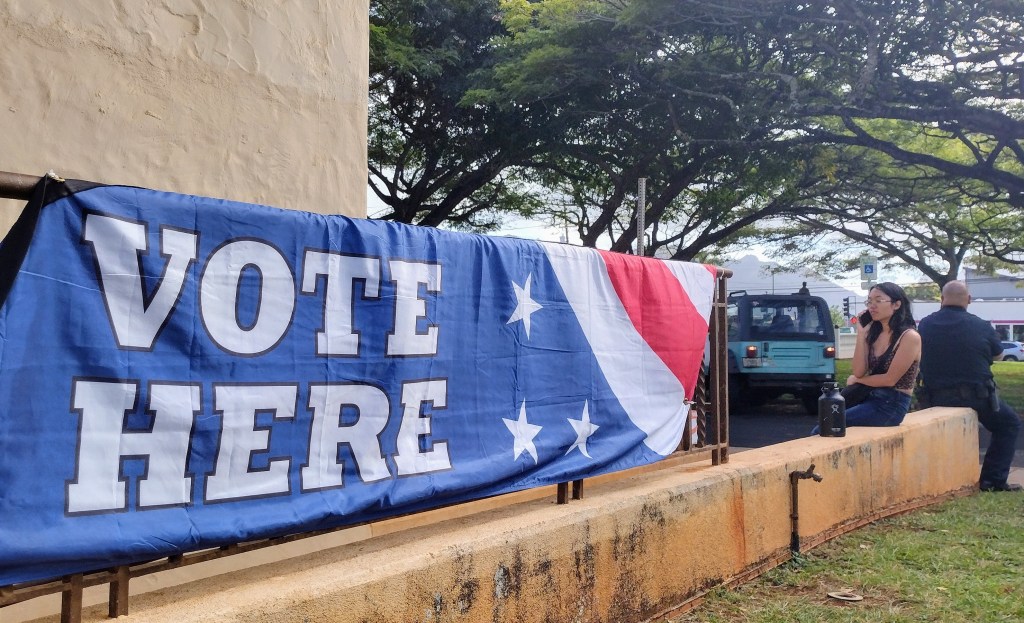
Former Kaua‘i Mayor Maryanne Kusaka said she still gets calls from council candidates seeking advice. She tells them to campaign island-wide, not just in their own communities. Throughout the decades, Kaua‘i voters have occasionally considered whether to have council districts, but the efforts have failed.
Newcomers are also challenged by the fact that incumbents, as well as former council members who served in past years, rarely lose.
“In my mind, once you get elected your name is out there and you have name recognition,” said Jimmy Tokioka, who served on the council in the 1990s and early 2000s. He’s now the director of the state Department of Business, Economic Development and Tourism.
If incumbents lose, it can mean they didn’t campaign enough or they upset voters during their term. Or voters just want change.
Senate President Ron Kouchi lost a council race in 2008, the year then-President Barack Obama was elected and ran a campaign centered on hope and change. Voters elected two first-time council members that year.
“I was one that they decided to change,” Kouchi said. He ultimately served on the council on and off for 22 years.
A Balanced Council?
Kaua‘i’s council has had some intense periods of ideological splits but hasn’t been very polarized in recent years, according to former council members and political analysts. The council has largely been made up of longstanding community members with a mix of business interests, government experience and concerns about growth.
“I think the people of Kaua‘i always want to try to find balance when they vote,” Tokioka said.
In addition to a pesticide disclosure bill, there were also divisions stemming from resort rezoning. In the late ‘70s, the rezoning of Nukoli‘i, a rocky beach in Hanamā‘ulu, from agricultural to resort use was hotly debated.
“Now they’re more aligned in wanting more housing, public safety for beaches, parks and recreation for our young people, working on the highways,” said Kouchi, whose first council term began in 1982. He added that council members are supposed to represent the entire county and not simply one interest over others.
Former Council Member JoAnn Yukimura said when she was first elected in the mid ’70s, she was often the sole vote against more development. In subsequent years, more grassroots activists were elected, so votes were more evenly split. She served on the council for 22 years over four decades.
She said it doesn’t matter if council members share the same opinions about every issue. It’s more important that they’re thoughtful, community-minded and willing to do the work.
“When you get that, you don’t necessarily know what the outcome will be on every vote, you just will know that the issues were well vetted and thought through and whatever legislation is coming through will tend to be good legislation,” she said.
Others argue that the council has become too complacent and simply accepts the status quo instead of being assertive and proactive about making Kaua‘i better.

“In recent history anyway, the trend has been a caretaker government,” Hooser said. “We don’t raise taxes, don’t make waves, don’t make too many changes, just keep the ship steady.”
Two years ago, the county reformed its property taxes to impose higher rates on vacation rental, hotel and non-owner-occupied properties. While Hooser applauds the effort, he wishes it had come sooner and was more assertive.
Chance For More Diversity
On Kaua‘i, women have never filled more than two council seats at a time. On the other county councils around the state, which all have nine members, women make up four, five or even six of the seats.
“It’s very painfully different,” said Lani Kawahara, who served as a Kaua‘i council member from 2008 to 2010. “Women are half the population and they’re not being represented in their local government.”
On Kaua‘i, the number of women who run pales in comparison to male candidates. In 2024, women made up five out of 17 candidates and in 2022, they made up six out of 19. Female candidates often have a greater hurdle to overcome with name recognition, and women tend to have more responsibilities raising children and caring for aging family members.
Kawahara added that with many women being overstretched as it is, they often never think about running until someone suggests it.
“I just want people — especially women — to consider themselves asked to run by their community,” she said.

This year’s election could also be a chance to see more geographic diversity. Most council members tend to be from the island’s population centers between Līhu‘e and Kapa‘a. In some recent elections, such as in 2018 and 2020, West Side residents made up roughly 20% of the candidates. In 2022 and 2024, South Shore residents made up 16% and 18%, respectively. It’s been much rarer to see candidates from the North Shore.
However, not all are confident that four open seats will mean a dramatic shift in the council. Candidates have two more months to get their names on the ballot, so there’s still a chance that past council members could throw their names in and win, reducing the number of fresh faces.
The last time there were four open seats was in 2002. Like this year, three council members — Bryan Baptiste, Randal Valenciano and Kouchi — ran for mayor. Hooser ran for state Senate. That paved the way for two first-time council members, including Rapozo. All other elected council members were incumbents or had served in past years.
“It’s always the same people run again,” Kawahara said. “So after they term out, they wait, and the next term they run again. So I don’t know how helpful and useful that is to getting fresh people to run.”
Voters are expected to begin receiving their mail-in ballots for the primary election on July 21.
Civil Beat’s reporting on Kauaʻi is supported in part by a grant from the G. N. Wilcox Trust.

