

Push To Feed Hawaiʻi Kids More Local Food Is ‘Structural Disaster’
The DOE has not taken the effort seriously and has no real plan for how to meet a legislative mandate to spend 30% of its food budget locally by 2030, according to a state audit.
Handwritten index cards to track food costs, missing information on what food items are produced locally, and mainland lettuce washed on Maui to possibly pass as local produce are just a few of the reasons the education department is failing to meet local food purchasing goals, according to a state audit released on Thursday.
The state Department of Education has been haphazard in its approach to increasing the amount of local food it purchases, the audit says, and the agency’s self-reported progress is iffy at best.
An example of how off base the DOE has been: department officials had believed milk purchases alone would allow the department to meet its initial benchmark of spending 10% of its budget on locally sourced food by 2025. It wasn’t until after the 2023-24 school year that the department realized its strategy wasn’t feasible, since local milk made up only 0.5% of schools’ meal budgets.
Building multimillion-dollar regional kitchens, which the department has pinned its hopes on, may not be the silver bullet it needs to reach its local food spending goals. The regional kitchen plans, according to the Office of the Auditor, lack details about how the department will work with local farmers to produce enough food to serve schools across the state.

Indeed, the agency’s long-term plans “seem more professions of faith than statements of fact,” the audit said, strongly questioning whether the agency has the ability to reach its mandate of spending 30% of its food budget by 2030, a goal set by the Legislature in 2021.
Although the report focused on local procurement efforts, it also identified key shortcomings in the day-to-day functions of the School Food Services Branch. For example, cafeteria managers don’t have a set budget or spending cap for their schools.
Last year, the department estimated it costs $9 to produce a school lunch. At the time, the department simply calculated its cost per lunch by dividing food and supply costs and staff wages by the total number of meals — and lacked the data for a more detailed breakdown of its expenses, the audit said, citing Civil Beat’s reporting on the issue.
The report also questions the validity of DOE’s data, since schools lack a centralized process for tracking and reporting how much they’re spending on local food.
The auditor’s findings are no surprise to farm-to-school advocates, who have for years lobbied the officials and asked for an overhaul of the food services branch.
“This report just crystallizes what we’ve known for a really long time,” said Daniela Spoto, deputy director at Hawaiʻi Appleseed Center for Law and Economic Justice.
Missing Numbers
The Department of Education has to submit annual progress reports on its local spending goals. But the agency’s data is dodgy, according to the report, because the agency lacks software to properly track its spending.
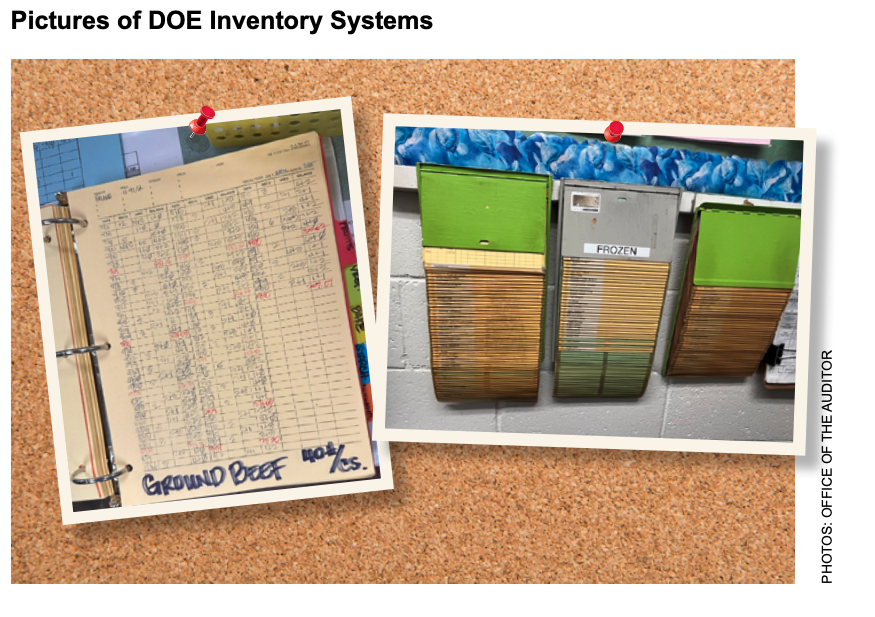
During the 2025 audit, school cafeteria managers were found to keep handwritten ledgers for their monthly food purchasing and stock taking, while the food services branch was only keeping track of schools’ total food costs — not accounting for local products.
Deciding what counts as local food was also a problem. One former school food administrator raised concerns that, in one instance, mainland-grown lettuce was being classified as a local product because it was washed on Maui. The department received pushback for including local bottled water in its 2025 progress report.
Cafeteria managers, who purchase food at the school level, aren’t given information about what products are locally sourced and don’t have a consistent way to report which purchases were local, the report said. As a result, the department must rely on information from its vendors to determine how much of school meals are locally sourced.
The poor data spoke to a lack of oversight and guidance from state-level leaders, the auditors said. The department’s school food branch was in a state of flux for years because of staff shortages and employee turnover. The head of the Office of Facilities and Operations — which oversaw the school food branch — was fired at the end of 2023. Randy Tanaka was criticized for failing to create or implement any plans for local purchasing, though he strongly supported centralizing food production.
The lack of consistent record-keeping also meant that DOE had varying estimates of how much it was spending on food costs. For example, DOE’s annual legislative reports said schools spent $64 million on food in 2023, but an internal office said the costs that year were more than $75 million, according to the audit.
Software to help with meal planning and allow cafeteria managers to track their local food purchases was poorly implemented, the audit said. Roughly 70 of the nearly 200 cafeteria managers did not use the software as intended, and the audit said the department also went through improper procurement processes to purchase the $2.3 million technology.
DOE discontinued the technology in spring 2025 and recently awarded the software contract to a new vendor, said School Food Program Administrator Anneliese Tanner, who joined the department less than a year ago. The department is creating a training plan for cafeteria managers, she said, but doesn’t have an exact date for when the software will be fully implemented. In the meantime, it had reverted to paper ledgers at the time of the auditor’s report.
One federally funded program — the Fresh Fruit and Vegetable Order/Receipt System — aims to provide schools with more locally grown produce. But during the 2023-24 academic year, schools left $1 million unspent, the report said, almost 20% of its allotment. The following year, the department failed to use almost as much: $913,000.
Cafeteria managers are supposed to prioritize purchasing produce through the federal program, school leaders said, but a lack of oversight meant schools weren’t consistently doing so. While some schools used all of their federal funding in 2024, one failed to spend any of its $16,000 appropriation. Another school didn’t receive any funding at all, according to the report.
The department is now tracking spending for the federal produce program on a monthly basis, Tanner said. The department is on track to spend the $5.3 million it received in federal funding this year, she said, and will also use some funds carried over from previous years.
‘Nothing More’ Than High Hopes
Hawaiʻi’s farm-to-school food movement has been underway for more than a decade in Hawaiʻi, but early hopes for a successful statewide program have waned in recent years, despite the state formalizing the agency’s local food spending goals, Spoto of Hawaiʻi Appleseed said.
The state is now focused on moving meal production to larger, yet-to-be-built centralized kitchens across the islands, breaking ground on the first facility in Whitmore Village on Oʻahu earlier this year. Construction is expected to cost $130 million and, once fully complete, serve up to 60,000 meals per day.
The Whitmore facility is one of seven planned centralized kitchens that the department says, altogether, will be able to convert local ingredients into up to 172,000 meals a day. Those kitchens would then provide enough demand for farmers and ranchers to increase local food production to meet the department’s needs. But the audit says the department’s centralized kitchen plans “seem to be nothing more than simple arithmetic unsupported by anything more than high hopes.”

Rep. Amy Perruso, who represents Central Oʻahu, said agency officials and lawmakers made broad assumptions about how the regional kitchens could be a panacea for the department’s issues and the state’s food productivity.
Both farmers and farm-to-school advocates have warned officials that a greater understanding was needed of what can, and is, being produced.
“What the report brings up to me is how we need to build our collaborative muscles between the agencies. We can’t afford to fail,” statewide food systems coordinator Amanda Shaw said. “And we can’t afford to do it in siloes.”
‘We’ve Also Dropped The Ball’
The auditor’s report serves as a good starting point for improvement, School Food Program Administrator Tanner said, adding that the department is currently in the process of implementing some of the 20 recommendations outlined at the end of the document.
For example, she said, the department is currently changing its approach to procuring produce for school meals to support more local farmers. While the department previously required vendors to produce a full supply of products for schools, she said, it’s now allowing farmers and local businesses to provide food in small quantities.
“If there’s availability of a product, we’re taking it in the amount that it’s available, and then scaling from there,” she said.
The department most recently launched a partnership with a local farm to supply microgreens to a single school in Kāneʻohe, she said. While the hope is some farmers can eventually scale their crops to support more schools, she said, the department is also willing to enter into more contracts with smaller suppliers to diversify its food sources.
Cafeteria managers will receive order guides that specify which products are locally produced, she said, allowing them to prioritize those foods over imported goods. Menus planned for next year, as well as when the regional kitchen is operational, have been developed based on what local food will be readily available, Tanner said.

“With the interagency partnership, we have a really good path forward for matching that supply and demand as best as we’re able,” Tanner said.
In his response to the auditor’s report, Superintendent Keith Hayashi said the department will complete all of the recommendations by 2028 or take action on an annual basis.
DOE also requested 13 positions to support farm-to-school initiatives and nearly $1.5 million to cover rising food costs in its budget request for the 2027 fiscal year. Both funding requests were denied in the governor’s budget.
Perruso said she’s hopeful the department can improve its food program and data collection under Tanner’s new leadership, but there’s only so much it can do by itself.
Farmers need support in scaling up their operations to meet DOE’s demand, she said. But the agriculture department — the state agency that could help farmers with this shift — lacks the funding and staffing it needs to do this work.
“This is so damning,” Perruso said. “Frankly, it’s an indictment not only of the DOE and maybe the Department of Ag, but the Legislature. We’ve also dropped the ball.”
Read the auditor’s report here:
Civil Beat’s education reporting is supported by a grant from Chamberlin Family Philanthropy. “Hawai‘i Grown” is funded in part by grants from the Stupski Foundation, Ulupono Fund at the Hawai‘i Community Foundation and the Frost Family Foundation.


