Climate Change Projects Key As Lawmakers Rush To Finish State Budget
The Legislature needs to make decisions on all tax and spending bills by Friday in order to conduct final votes next week.
House and Senate leaders finalized a list of more than $120 million in “green fee” environmental protection and other projects late Thursday evening as they hurried to meet a critical Friday deadline to move the state budget forward.
The Legislature is racing this week to complete its work on hundreds of bills and position them for final votes next week, including a new $20 billion budget they presented Thursday evening to finance state government next year. Lawmakers are scheduled to wrap up their work for the year on May 8.
Still hanging in the balance are proposals to dramatically increase the state conveyance tax on high-end properties to help fund the state Department of Hawaiian Home Lands, and another bill to ask voters if the state constitution should be amended to allow judges to remain on the bench until age 75. Currently Hawaiʻi judges must retire at age 70.
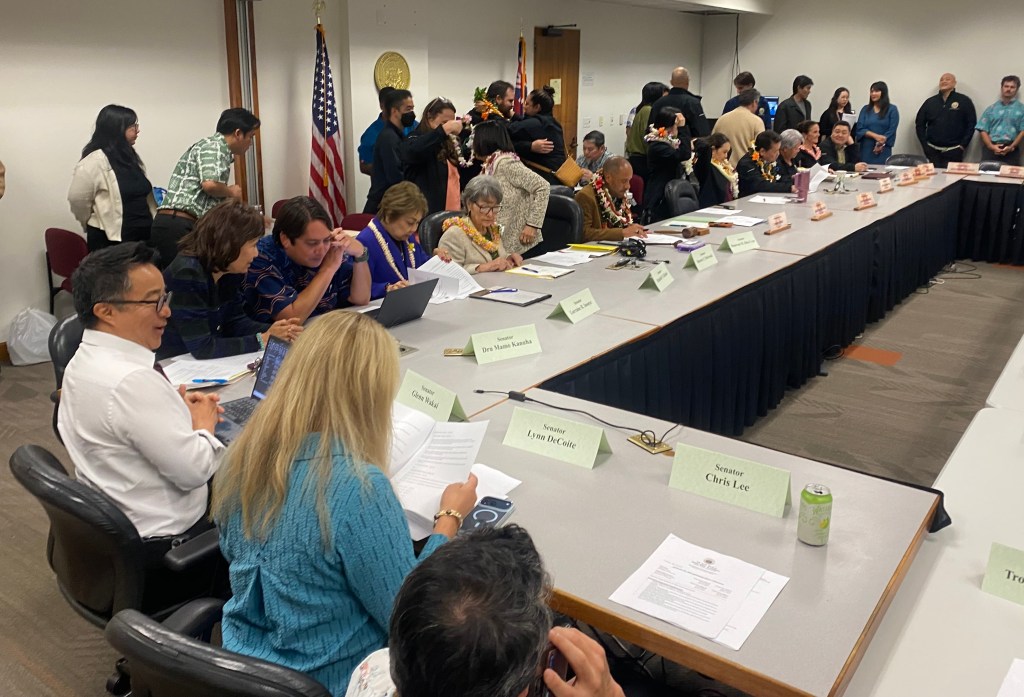
The new state budget, House Bill 1800, authorizes more than $4.5 billion in construction projects financed with state, federal and other sources of funding. Sen. Sharon Moriwaki said that includes $58 million for Wahiawā dam improvements, and Rep. Lisa Kitagawa announced lawmakers earmarked $446 million for repairs and upgrades to Hawaiʻi’s public schools.
Senate Ways and Means Chair Donovan Dela Cruz told staff and spectators gathered at a third-floor Capitol hearing room that “we’re proud to pass a budget that puts Hawaiʻi’s working families front and center.” He said the new budget features cost-saving measures that made it possible for the Legislature to preserve the bulk of the income tax reductions that were signed into law in 2024.
One of the most closely watched issues this year has been how lawmakers allocate money from the new green fee, which was created last year to finance projects to protect Hawaiʻi’s environment, prepare for impacts from climate change and promote sustainable tourism.
The green fee is financed mostly from an increase in the state hotel room tax, and is expected to raise more than $100 million a year. It is a major new pool of cash that appeared at a time when lawmakers struggled to balance the state budget. It’s become a tempting target.
The Green Fee Advisory Committee appointed by Gov. Josh Green vetted hundreds of proposals for green fee funding, proposing that lawmakers fund those that could be quickly executed with high impact, said Jeff Mikulina, chair of the committee.
But when the final list of green fee projects was released late Wednesday, it included some surprises such as $250,000 in funding for a cattle slaughterhouse and $1.2 million for a forage drying facility, which is used for dehydrating crops for livestock.
‘This Is The Legislative Process’
Some of the initiatives lawmakers added to the green fee list appear to fit well with its mission, such as a $2 million earmark for loans to finance closure of cesspools, and $4 million for wastewater improvements at Keaukaha in Hilo.
But other items on the final list seem to have more tenuous connection to the stated mission of the green fee, such as more than $7 million for a “Food and Product Innovation Network.”
That network has long been a pet project of Dela Cruz and the late James Nakatani, who for years was director of the Agribusiness Development Corp. The network concept is based on the New Zealand Food Innovation Network, which Dela Cruz and other lawmakers visited during one of several trips to the South Pacific nation.
As chair of the Senate Ways and Means Committee, Dela Cruz is in a position that gives him great influence over which items make it onto the green fee list and into the state budget.
The Hawaiʻi Food and Product Innovation Network was initiated by lawmakers last year to link both existing and yet-to-be-built food manufacturing facilities in an effort to boost Hawaiʻi’s agricultural economy. Now the green fee will dramatically increase funding to that project.
Another addition to the list by lawmakers is $10.8 million for a “water systems safety and preparedness” for West Kauaʻi. Senate President Ron Kouchi, who represents Kauaʻi, told Civil Beat that item began as an ordinary request for construction funding, and was added to the green fee list by Dela Cruz and others involved in the budget negotiations.

That money would be used to restore a reservoir and former sugar irrigation system, he said, potentially putting thousands of acres controlled by ADC back into agricultural production. Kouchi said putting fallow land back into active farming makes more sense than fire control strategies such as digging firebreaks.
Another item added to the green fee project list is $3.7 million for a University of Hawaiʻi biosecurity facility.
That project is called the Center on Biosecurity Research, Education and Extension, and would include biocontainment laboratories, greenhouses, a detector dog facility and office space for staff. It is expected to cost about $25 million to develop.
The center’s core focus would include early detection, according to UH Agriculture Dean Parwinder Grewal, with a focus on introducing more Hawaiʻi-specific pest control methods to the islands.
Overall, Mikulina said about 60% of the items that appear on the final green fee list came from the advisory committee recommendations, “which is encouraging.” Another 15% seem aligned with the intent of the green fee, he said.
As for the remainder, “One of our greatest fears was this green fee was going to pass, it was going to be a pot of money, and then folks were going to use this for their parochial sort of projects in various districts,” Mikulina said, “and unfortunately, some of it does feel like that.”
“We understand, this is the legislative process,” he said, “this happens, but it does erode in some way that original intent and goodwill behind adopting this really precedent-setting visitor impact fee.”
Still, he said, “this is a significant step forward,” and provides a major new funding source to help preserve Hawaiʻi’s environment and cope with climate change.
Dela Cruz’s New Budget Counterpart
Though he has had the job for nearly a year, this was the first time Rep. Chris Todd, the chair of the House Finance Committee, worked a budget through conference committee.
By many accounts from the fifth floor down to the chamber level, Todd held his own against the more experienced and assertive Dela Cruz. He spoke calmly and assuredly about the intricacies of budget policy. He was also accessible and made a point of talking and shaking hands with audience members before and after the WAM-FIN conference meetings.
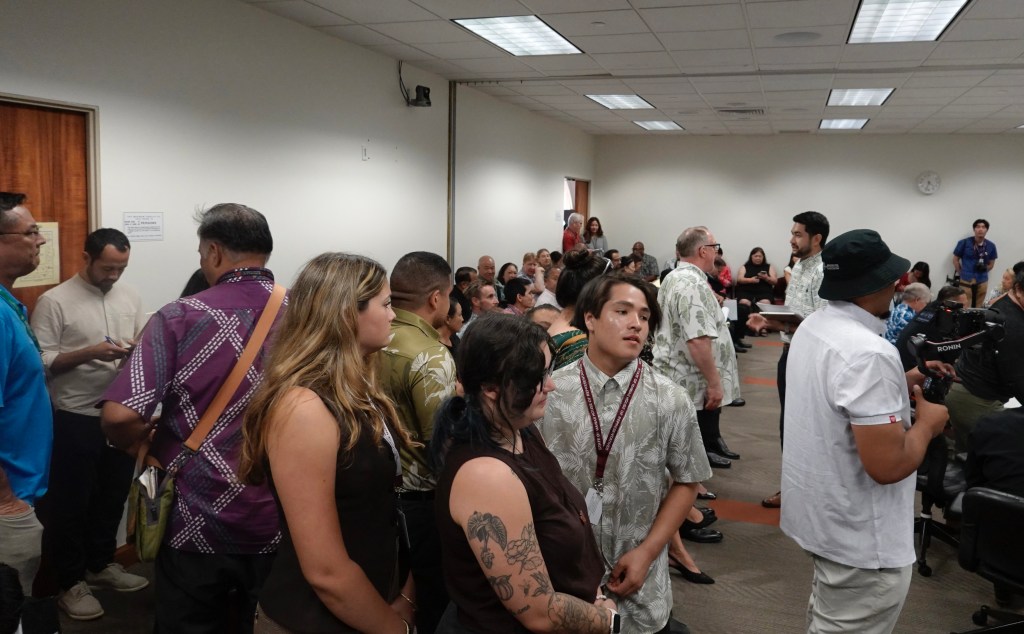
Still, it is rare for budget negotiators to wait until this late in the session to reach agreement on the state budget — in this case, one day before deadline. Missing that deadline would have made the need to extend session or come back in special session a real possibility.
Delaying the budget’s completion meant postponing conference committee voting on hundreds of other bills that face the same Friday 6 p.m. deadline. Most of them could not advance until receiving approval from Todd, Dela Cruz and House and Senate leadership. That means many bills are likely to die Friday.
And full details of the entire budget won’t be known until it is posted publicly in the days ahead. Green and his administration will then get a chance to analyze the voluminous document in June and early July.
The long budget negotiations also took another toll, this one human, with lots of reddened eyes, aching bodies and audible yawning. Dela Cruz at one point during the public portion of conference talks asked everyone to wait for a moment until he put on his eyeglasses so he could read off budget highlights.
And Wednesday’s talks went so late that Todd got only a few hours sleep — in his car in the Capitol parking garage.
Civil Beat reporter Thomas Heaton contributed to this story.
Read budget highlights:
Read the green fee project list: