

Hawaiʻi Drivers Say Uber AI is Shortchanging Them
Fed up with declining pay, drivers try and organize politically, seek lawmakers’ help.
A few years ago, being an Uber driver was a decent way to make a living, Joseph Awaa said. Driver pay had started to inch up after dropping during Covid, a trip from the airport to Waikīkī would pay him maybe $24, and he could make $800 or more a week pretty easily.
“It’s hard to make eight now, man,” said Awaa, who works seven days a week. These days, he said, he’s lucky if that trip from the airport to Waikīkī brings half what it used to.
On this Friday morning, Awaa was talking over the sound of car horns in the rideshare drivers parking lot on Rodgers Boulevard near the Honolulu airport. There, he and other drivers watch for the ping of a notification that someone needs a ride, then decide whether to pick up the fare.
It’s become a tougher and tougher decision over the past year, as the amount they can make for each ride has dropped.
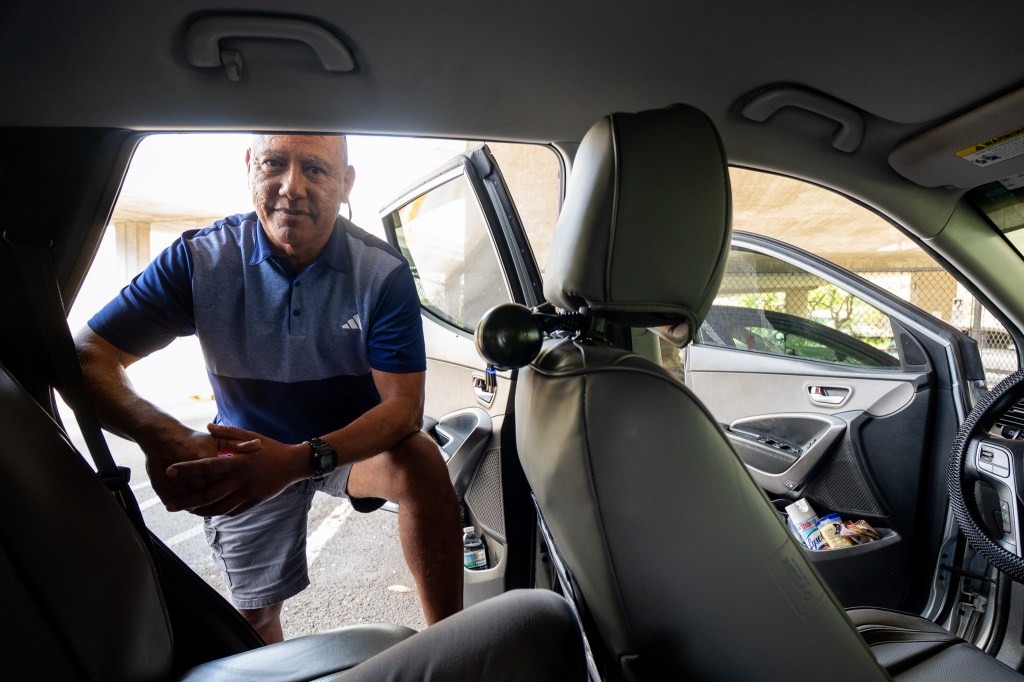
That has happened, they say, since Hawaiʻi became one of the last states to weather a change in Uber’s pay system for drivers. A new pricing algorithm bases what they make per ride on estimated traffic and demand. Drivers and Uber critics claim it also blends in how much a driver is willing to accept based on their past activity — although that’s something the company vehemently denies.
“The AI took over and everybody started seeing the huge drop,” said Felix Fernandez, who started driving for Uber in late 2023 after retiring from a law enforcement career.
At the beginning, Fernandez said, he made $800 to $1,000 a week, about the $30-an-hour Uber had said he would when he was signing up to be a driver. These days, he said he makes between $600 and $800 a week.
He and other Hawaiʻi rideshare drivers are joining their counterparts across the nation who say they find themselves weighing whether to pick up a rider against the cost of gas, insurance and payroll taxes — and of missing out on other fares while stuck in traffic.
Now some of them are pushing back, petitioning Hawaiʻi officials to follow the lead of places like New York City, Washington and Massachusetts that have set minimum pay standards and required Uber and Lyft to disclose more about how they calculate driver compensation.
“It’s not just about the money,” Fernandez said. “We want transparency.”
A New System
Previously, under a system termed market fares, Uber would offer a trip request through its app for drivers that would include a base driver fee, plus per-mile and per-minute compensation.
The app wouldn’t give the exact location where the passenger was to be picked up or dropped off until after a driver accepted the trip. Drivers could use the app after the trip to find out how much their passengers had paid.
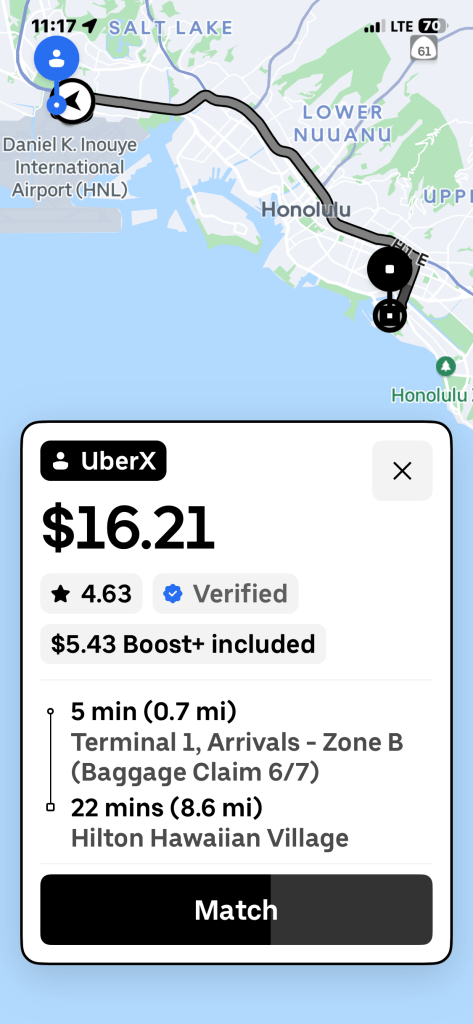
Uber rolled out its new system for drivers – called upfront fares – in 2021 but it didn’t arrive in Hawai‘i until last year. Lyft had rolled out its version in 2022 nationwide. Under the new system, drivers needed a computer to access information about how much passengers had paid for the trip; the app wouldn’t show that detail.
But drivers did get something they had lobbied for as part of the changes: The pickup and drop off locations were disclosed.
“I was, like, ‘Oh, great. This is nice. I don’t have to wonder where I’m going,’” said Peākalika Edwards, who started driving for Uber and Lyft in 2023 while a student at the University of Hawaiʻi Mānoa.
“Then everyone on the Uber Reddit was like, ‘Be prepared for your wages to drop at least 30% because this is a way for them to keep fares higher for passengers, but lower your pay.’”
It did, Edwards and other drivers said.
“Now, with the upfront fares, I am getting $8, $9, $10 offers to take people to the airport from town, which was never, ever a thing,” Edwards said in November, about six months after the changes took effect. “I got one yesterday for, like, $9 to take someone from Ala Moana area to the airport. I’m like, ‘Are you joking? This is crazy.’”
Rideshare companies have long used surge pricing that figures in demand to calculate customer fares. But Congress is currently investigating allegations that the companies also use customers’ historic use and other individual data to calculate the fares they charge, which Uber and Lyft deny.
And under Uber’s new algorithm, drivers say they are subject to the same calculation. They say they are being offered different fares for the same trip based on what fares they tend to accept; Uber, according to several studies, is taking a greater cut of each fare, while driver pay has slid.

An Uber spokesperson rejected those claims, saying Hawaiʻi drivers earn an average of $38 an hour for time spent on each trip, including while they are heading to pick up the rider. Uber doesn’t disclose how it weighs different factors to arrive at driver pay, but the spokesperson said it is based on the estimated time to the pickup point and from there to the destination, as well as on the current demand.
“Upfront Fares account for whether a particular trip is generally more or less likely to be fulfilled by drivers, based on aggregate patterns on similar trips,” said Zahid Arab, but not on what an individual driver has accepted in the past. “Individual driver behavior is not a factor.”
Arab acknowledged that “certain fares may be higher and certain fares may be lower, with the overall goal of making fares as a whole more consistently attractive to all drivers.”
Drivers argue in response that their pay doesn’t take into account the downtime of waiting for trips, or time spent returning from “deadheads” — destinations from which no rides are being requested — and barely adjust if navigating Honolulu traffic makes a trip take longer than originally expected.
It has left some longtime drivers like Kevin Collman, who has driven Uber for a decade, thinking about getting out of the business.
“I mean, you can barely make it,” he said. “I’m already at 41 hours, $655 bucks. That’s just ridiculous. I can’t do it anymore.”
Getting Organized
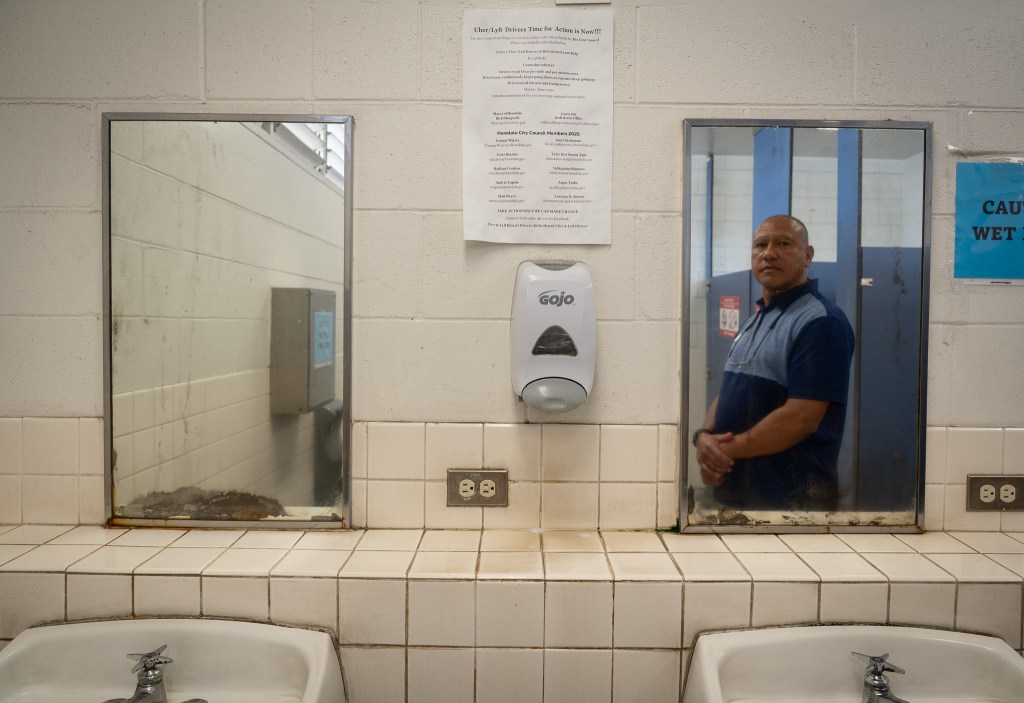
About three months ago, a sign appeared between the sinks in the driver washroom at the airport’s rideshare drivers parking lot and on the pillars that support the H1 offramp overhead.
It said: “Uber/Lyft Drivers Time For Action is Now!!!” and urged drivers to email elected officials and call for “clear per-mile and per-minute rates.”
Although he didn’t know who posted the sign — it’s still a mystery — in it Fernandez saw an opening.
“Drivers are just frustrated, but they don’t know what they can do to try to fix the system,” he said. “That’s when I decided, you know, I’ll start putting something together with everybody’s help.”
Fernandez created an Excel spreadsheet to track how much passengers were paying — drivers had to ask their customers for that detail — alongside what drivers and Uber earned per trip. Over 13 trips recorded between Feb. 2 and March 6, passengers paid $685; drivers earned $300; and Uber took a cut of $385.
Fernandez collected 50 drivers’ signatures on a petition and at the end of March sent it and the spreadsheet to Honolulu Council members, Mayor Rick Blangiardi, Gov. Josh Green – whose office responded by saying it would review the comments – and Attorney General Anne Lopez.
“I respectfully ask our local leaders to examine these issues carefully and consider policies that would require greater transparency in rideshare pay structures and fair compensation standards for drivers operating in Hawaiʻi,” said the petition, which also noted that Uber reported about $9.7 billion in net earnings through September 2025.
Rideshare driver protests have accompanied the rise of both Uber and Lyft, focusing at times on drivers’ contractor status, or on changes to their pay. Outrage over Uber’s new upfront fares algorithm has fueled more recent activism and the development of minimum pay standards in Massachusetts and Minnesota.
States that have put so-called wage floors into place for rideshare drivers — a minimum they must earn per hour of driving or per trip — use different mechanisms to enforce the rules. For example, Massachusetts requires the companies to submit data showing that they are topping off a driver’s pay if it doesn’t hit an average of $34.48-an-hour over a two-week period.
In Hawaiʻi, Uber and Lyft are lightly regulated. The state Department of Transportation requires rideshare companies to have a valid permit, which requires driver background and driving record checks. But the department does not get involved in pricing.
On Oʻahu, Honolulu’s Department of Customer Services regulates Uber and Lyft. Like the state, under an ordinance created in 2016, the department is primarily concerned with ensuring passenger safety through driver background checks and vehicle inspections.
The bottom line is that as independent contractors, the drivers are at a disadvantage when it comes to negotiating for pay and benefits, said Dion Dizon, director of the Center for Labor Education and Research at UH West Oʻahu.
“Inherently, the power dynamic is skewed in favor of the employer,” Dizon said.
Yet with its high cost of living, she noted, many in Hawaiʻi need to pick up gig work like rideshare driving to supplement their income. She urged them to consider collective action.
“They need to just stop work, all at one time, not by ones and twos, to gum up the system,” Dizon said. “When we impact their pocketbook, then they might pay attention. Until then, the process of legislation is a long one.”
“The whole system from top to bottom is very opaque.”
Honolulu Council member Tyler Dos Santos-Tam
Fernandez said he would like to take drivers’ concerns to that level. But it won’t be easy.
“If possible, my next step will be a one-day strike on the busiest day, Friday,” he said. “Getting organized is a challenge, though. A lot of drivers have given up because they see Uber as a big company and tell me, ‘What can I do?’”
Drivers do seem to have gotten the ear of at least one elected official, Honolulu Council member Tyler Dos Santos-Tam, who said he wants to learn more about their concerns and would like to see a hearing on the issue “in the near future.”
“Does this deserve a detailed look? Yes,” Dos Santos-Tam said. “The whole system from top to bottom is very opaque.”
Times have changed, Dos Santos-Tam said, as the rideshare industry has become a ubiquitous behemoth with tens of millions of drivers worldwide.
“It probably does need to be a combined city and state effort to examine what’s going on in the industry,” he said, “and how we can achieve the goals of consumer protection, labor protection, and also having a robust transportation network.”
Contributing: Civil Beat Reporter Ben Angarone
CORRECTION: This story has been updated to clarify how drivers access passenger. fare information.
“Hawaiʻi’s Changing Economy” is supported by a grant from the Hawaiʻi Community Foundation as part of its work to build equity for all through the CHANGE Framework; and its reporting on economic inequality is supported by the Hawaiʻi Community Foundation as part of its work to build equity for all through the CHANGE Framework; and by the Cooke Foundation.

