

How To Stop Your North Shore Farm From Flooding? Move, Developer Says
Waialua farmers were flooded again last weekend, the fifth time since February. A local developer says it’s time to look for new land, but for many that’s unfathomable.
Residents of Waialua’s chronically flooded farms should pull up stakes and move out of harm’s way, Oʻahu housing developer Peter Savio says.
He’s urging the disaster-stricken small farmers to lobby the state and local government for land swap deals so they can leave their soaked lots for drier tracts somewhere else on island.
“If you don’t seize this opportunity, I’ll be out here when I’m 89 years old, talking about the most recent flood,” the 77-year-old Savio told North Shore residents at a recent flood recovery meeting. “The floods are not going to stop.”

Heavy flooding has affected more than 150 farms on more than 600 acres between Waialua and Mokulēʻia since February, resulting in lost harvests, crops, vehicles and infrastructure. For the farmers, many whose family histories trace back to the plantation days a century ago, leaving is an almost impossible notion. It’s also not clear whether the city or state would even entertain such an offer, but that isn’t stopping Savio from putting it out there.
“It doesn’t make sense to me and I’ve spoken to others, and it doesn’t make sense to them,” Waialua Farmers Cooperative President Grace Kekahuna told Civil Beat. “When he suggested that we sell the land, I think it broke a lot of people’s hearts.”
But they agree something needs to be done to lessen the impact of future disasters in the floodplain.
Many are looking to the more than 2.5 miles of overgrown plantation-era irrigation ditches that surround and intersect their lands, along with the lack of storm drainage uphill from them. Some are searching for federal assistance. And others believe nature is running its course in the flood-prone area, including Savio.
That’s why he said it might be time for farmers to get out of the way, negotiate a land swap with the state or county, and have the area restored to a wetland like the Kawainui Marsh in Kailua, which is a state wildlife sanctuary.
But for many, that would mean deserting land they have spent decades cultivating.
“What it does highlight is agriculture, as a type of land use, in floodplains has a long, long history globally and locally,” said Hunter Heaivilin, Hawaiʻi Farmers Union advocacy director. “So the settlement patterns around waterways and agricultural development preceding us were designed with flooding in mind. But I think, as time has gone on, that has become less of the case.”
Who’s Paying?
Mill 6/10 is one of several projects Savio has formed in recent decades, aimed at preserving agricultural land and helping farmers live closer to their farms, often using fallow and former plantation land on Oʻahu.
Irrigation infrastructure was left as part of Dole’s legacy when Savio facilitated a purchase of the former plantation land in 2022. In the $6.4 million purchase, the longtime developer pooled farmers’ money and divided the land into 1- to 5-acre lots.
The lots are yet to be sectioned out and formalized legally, but Savio has no real say over the fate of the land. It’s up to the farmers.
“I don’t know where he thinks he’s going to put them,” said Racquel Achiu, vice chair of the North Shore Neighborhood Board.
Rep. Amy Perruso said it’s unlikely the state or county would be interested in purchasing land from the farmers or pursuing a land swap.
Various state agencies are actively, or have historically, purchased former plantation lands for conservation or agriculture. The state set up the Agribusiness Development Corp. especially to ensure the state’s agricultural economy survived after sugar and pineapple plantations folded.

The agency has banked thousands of acres of farmland, including 4,000 on Oʻahu, and could theoretically still help find land for the farmers. So could the Department of Agriculture and Biosecurity, which leases land to farmers around the state. The agency would consider “all options” to support affected farmers and ranchers, state agriculture director Sharon Hurd said.
A more likely candidate would be the state Department of Land and Natural Resources, perhaps in partnership with the city. DLNR spokesperson Andrew Laurence said DLNR would not discuss the concept.
Savio’s comments were new to the city, so it was wary of speaking to the concept, according to communications director Scott Humber. The city would continue working with the state, federal government and community organizations to work on immediate and longterm recovery, he said.
“Concepts like land swaps would require coordination across multiple agencies, landowners, and the farmers involved,” Humber said in an email. “At this point, our focus remains on ongoing recovery efforts and ensuring impacted farmers have access to the resources and support they need.”
Savio said he believes it could emulate Kawainui Marsh, which is co-owned and managed by the City and County of Honolulu and the state, as one of the nation’s Wetlands of International Importance.
The almost 1,000-acre area was originally managed by Native Hawaiians, with a prolific fishpond and taro ponds, and later used to grow rice. Before restoration efforts began, to return the land into its previous state as a fish pond, it had been drained for Kāneʻohe Ranch’s cattle to graze.
But instead of a land swap, Ann Casson of Kalili Farms on the North Shore suggests the state and county help farmers better manage the historic irrigation ditches that surround and intersect their lands. Otherwise, the small farmers could not afford the lengthy and expensive work.
The hurdles of finding alternative lands for the Waialua farmers and convincing them to restart their farms loom large over the idea.
“Everyone’s pushing local, fresh food — we want to feed our families and our communities,” Kekahuna said. “I would rather ask for a different solution, to focus on maybe drainage and infrastructure improvements, not displacing farmers.”
Watershed Emergency
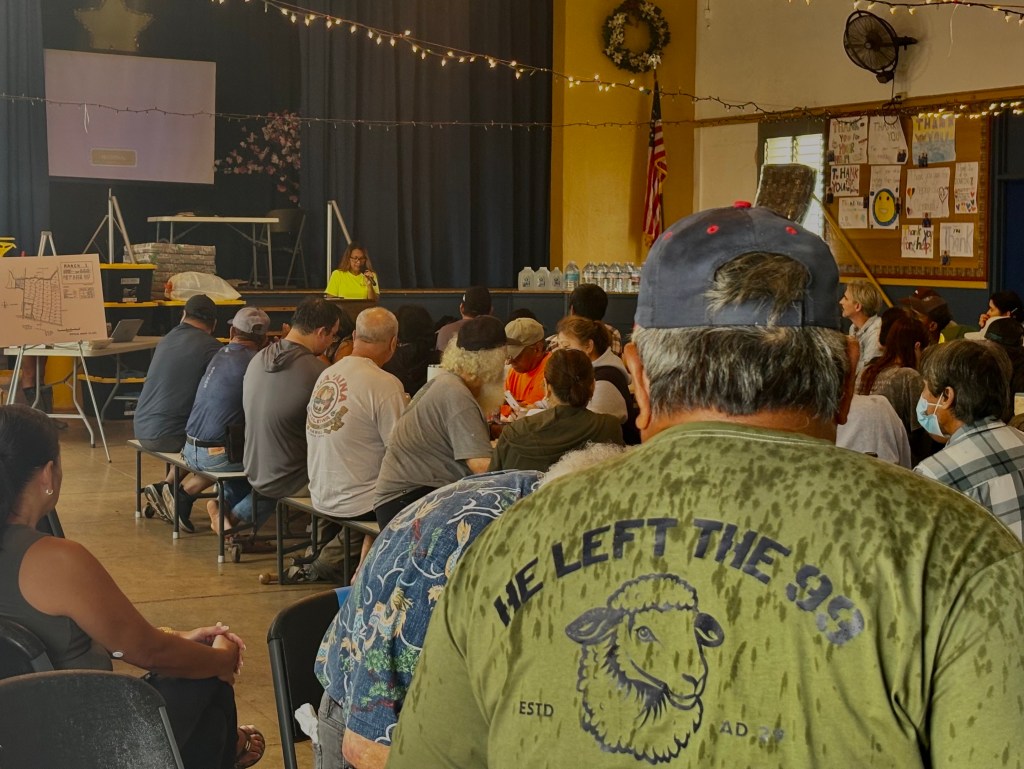
Roughly 100 farmers, agriculture advocates and government officials attended the flood recovery meeting Sunday at St. Michael Parish. For many, it was the first time they learned about the possible programs and relief they could get from state and federal governments.
They said it’s all needed. The farmers rely on Dole for well water, which hasn’t been restored yet.
Those programs often require previous knowledge or buy-in with various agencies, meaning farmers with lost crops, harvests and machinery may still be without relief. But one opportunity is the Emergency Watershed Program offered by the U.S. Department of Agriculture.
The program is specifically designed to help flood victims recover, generally by helping clear debris and conducting repair work. But within the program, there is a provision in the USDA Natural Resource Conservation Program to buy privately owned lands in a floodplain.
States such as Rhode Island and Kentucky have capitalized on the program. Texas recently received $4.4 million as part of recovery efforts following the historic Hill Country flooding in July, to buy at least 13 homes destroyed by flooding.
The federal program offers up to 90% of the fair market cost for land purchases, relocation and restoration.
“Hawai‘i Grown” is funded in part by grants from the Stupski Foundation, Ulupono Fund at the Hawai‘i Community Foundation and the Frost Family Foundation. Civil Beat’s coverage of climate change and the environment is supported by The Healy Foundation, the Marisla Fund of the Hawai‘i Community Foundation and the Frost Family Foundation.

