

Maui Fire Lawsuit Payouts Are Near. Few Survivors Will Break Even
Money could start flowing to victims by June, nearly two years after the settlement was finalized.
Leslie Clark isn’t counting on money from the Maui wildfire settlement to help rebuild her family home near Front Street in Lahaina.
Worrying about something out of her control “is not good for your health,” said Clark, 62, who lost her home in the August 2023 fire. “It’s not good for anything.”
As Maui fire victims like Clark inch toward finally receiving their share of a $4.03 billion settlement to compensate them for their losses, one thing has become painfully apparent: Few victims will be made whole, even many who, like Clark, had property insurance.
Settlement checks could start flowing as early as June, said Jake Lowenthal, a Maui lawyer who is one of four liaison lawyers leading the army of attorneys representing plaintiffs. How much money each victim will receive isn’t clear. A team of claims administrators is expected to dole out the money according to a complicated set of criteria that place the claims into 10 categories, including whether someone was injured or lost their home. How this shakes out remains to be seen.
The victims’ lawyers are asking for 25% of what they win for their clients, but that request still needs approval by Maui Circuit Court Judge Peter Cahill, who has expressed skepticism about the idea. Cahill has shown he’s inclined to set up a fund to help cover attorneys’ costs, which could mean lawyers getting less than 25% across the board, but the judge hasn’t issued an order on how that will work.
Still, some things are clear. Whatever victims receive won’t come all at once but in four payments over time, Lowenthal said. Insurance companies will get to claim 10% of the settlements of people like Clark, who lost their homes and were insured.
All this means that, however much money individuals receive from the settlement, for some victims as much as a third of it could go to lawyers and insurance companies. And there’s another issue looming: unless the U.S. Congress acts to resurrect an expired federal income tax exemption for wildfire settlement money, Uncle Sam could take as much as 37% from the survivors.
“None of them are going to be made whole by this.”
Sherry Peterson, Policyholders United
Sherry Peterson has been working with Maui fire survivors as a fellow with United Policyholders, an insurance consumer advocacy organization. As Peterson sees it, there’s simply not enough money to go around for victims, many of whom lacked adequate insurance to cover their losses.
Some 21,750 plaintiffs have sought to claim a portion of the settlement, resulting in a total of 94,816 unique claims across the 10 victim categories, Peterson said. The most frequent claims involved people who were displaced or had to escape the burn zone.
“My personal opinion, having sat with many victims of this disaster, is that none of them are going to be made whole by this,” Peterson said. “No matter how you dice the carrot, there’s just not enough carrot for the soup.”
How Much Will The Lawyers Get?
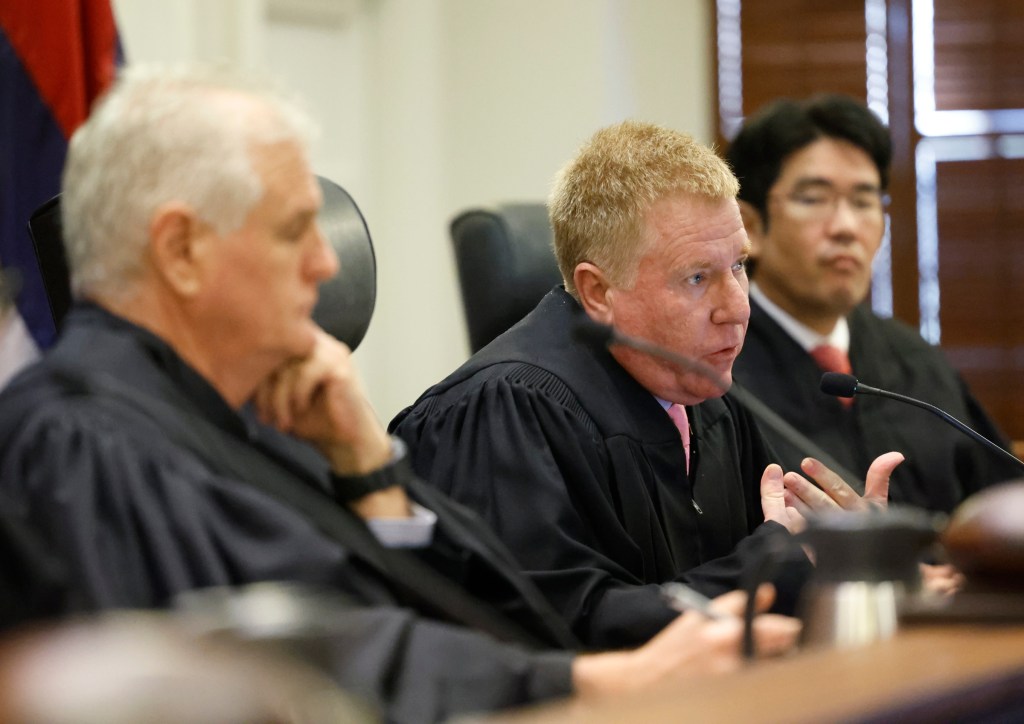
Maui Circuit Court Judge Peter Cahill has been on a warpath over legal fees.
As the judge has framed it, the issue is how to fairly compensate lawyers who paid for investigations, spent countless hours in mediation and argued before the Hawaiʻi Supreme Court without also unfairly enriching free-riding lawyers who in some cases merely signed up clients after the settlement had already been reached.
Cahill favors establishing something known in legal parlance as a common benefit fund into which all of the lawyers, including the free-riders, would contribute a portion of their fees. Those funds would then be redistributed to the lawyers who did the bulk of the work on the case. In essence, free-riders would no longer be riding for free.

But plaintiffs’ lawyers want 25% across the board — a proposal that hasn’t sat well with the plain-speaking judge generally known for humorous courtroom banter.
During a hearing in March, after sharing an anecdote about how cute his dog’s butt is when it wags, Cahill grilled Lowenthal about the lawyers’ request to take about $1 billion of the $4.03 billion settlement.
When Lowenthal said an across-the-board percentage was fairest for the lawyers, Cahill came back at him.
“How about if we propose everybody gets 2 1/2%?” the judge asked. “That would solve your problem very easily.”
Cahill also asked if the fire victims knew their lawyers were angling for a $1 billion payday.
“It might be helpful to hear from your clients to see what their positions are on your attorneys’ fees,” the judge said, “with the understanding that they have a voice in that, right?”
In another instance, when Lowenthal noted that the parties had worked hard to craft the settlement in record time, Cahill focused again on the victims.
“You know, Mr. Lowenthal,” Cahill said, “the settlement was done in record time … finalized on August 19th, 2024, and today’s March 27th, 2026, and no one’s seen a penny.”
Insurers Also Will Get A Cut
Property and medical insurers also are waiting to take a cut of the settlement money.
For medical insurers, the process is simple. They can simply file for liens on medical claims paid to treat fire victims, and the claims administrators will take that amount out of the victims’ settlement money, send it to the insurer and pay what’s left to the victim.
There’s no such system for property insurers who paid claims. For them, the Maui fires present a unique situation.
In other wildfires, such as the massive California fires that drove Pacific Gas and Electric Co. into bankruptcy in 2019, the insurers paid claims to policyholders and then sued PG&E — which pleaded guilty to 84 counts of involuntary manslaughter and one felony count of unlawfully causing the Camp Fire in Northern California — to recoup what the insurers had paid their policyholders.
In the bankruptcy proceeding, PG&E settled with the insurers for $11 billion, said Cathy Yanni, trustee for the PG&E Fire Victim Trust, who is also a special master overseeing the Maui Individual Settlement Fund. That was just over half of the $20 billion the insurers said they had paid out in claims.
Wildfire victims were given $13.5 billion, split equally between cash and PG&E stock; however, Yanni said victims recovered more, as the value of their PG&E shares increased. She declined to discuss the Maui case but said the PG&E settlement was substantially different from the Maui lawsuits.
“Bankruptcy changes everything,” Yanni said.
HECO was saved from bankruptcy through settlement negotiations that cut out the property insurers. Various parties cobbled together the $4.03 billion to pay the victims, with about $800 million from Hawaiʻi taxpayers, $1.99 billion from HECO and $807.5 million from Kamehameha Schools’ trust to benefit Native Hawaiian children. The rest came from Maui County, telecommunications companies that used HECO utility poles and companies affiliated with Maui landowner Peter Martin.
The Hawaiʻi Supreme Court determined the property insurers couldn’t sue Hawaiian Electric Co. and the other parties accused of contributing to the disaster but would instead have to file liens the way medical insurers do, essentially clawing back money paid to policyholders out of their settlement proceeds. Eventually, the insurers and plaintiffs’ lawyers agreed to a deal where the property insurers would simply get 10% of the claims paid to Maui policyholders from each settlement payment.
The insurers had paid out $3.03 billion in claims related to the fire as of December, according to the latest data from the Hawaiʻi Insurance Commission. Of that, insurers say $2.16 billion has gone to fire victims participating in the settlement. That puts the insurers in line for $216 million from the settlement payouts.
That doesn’t sit well with Clark. To get even some of the money she’s entitled to under her policy, Clark said, she had to hire a private insurance adjuster who helped her get $1.3 million to rebuild. Peterson has also been helping.
While $1.3 million might seem like a lot, Clark said, it’s not enough to rebuild the two-story home that housed 15 extended family members before the fire. Now the insurers will be getting some of the settlement money intended for her rebuild.
“It’s a disgrace,” she said. “To me it’s unbelievable.”
An Estimated 40% Of Homeowners Were Underinsured
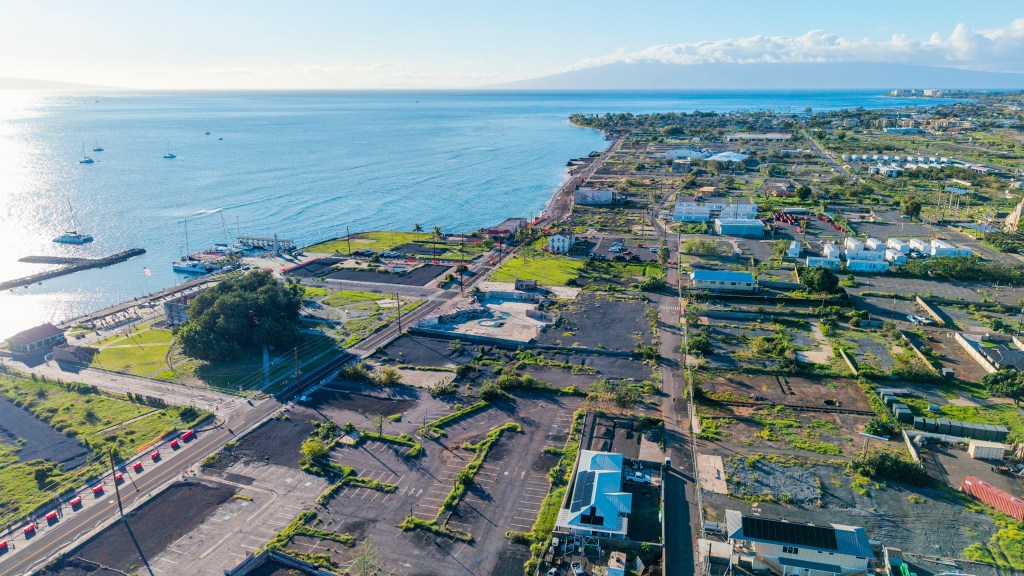
In some ways, Clark is fortunate. Maui County estimates that the fires destroyed 5,527 residential housing units on the island, including 1,256 owner-occupied units and 4,271 rentals. Of those, 28% of owner-occupied units were uninsured, leaving owners to foot the bill to rebuild out of their pockets or rely on a federal program or various community and charitable initiatives.
It’s hard, Peterson said, for many of the uninsured people who lost homes to find their way, especially for those still dealing with the effects of trauma or generally reluctant to accept charity.
“There’s a lot more people needing help than there are people to help,” Peterson said.
It’s not just uninsured owners facing challenges. The county reckons 72% of owner-occupied homes and 78% of rental properties had at least some insurance but that around 40% of them were underinsured, with the typical policy falling about $400,000 short of covering the cost to rebuild.
“Everybody I’ve dealt with has had a shortfall,” Peterson said.
One of the Maui homeowners Peterson worked with received $336,000 from an insurance policy but found the cost to rebuild would be $545,000 — a situation she described as fairly typical. She knows of multiple people who face $500,000 shortfalls.
For those victims, Peterson said, it’s troubling that insurers are going to take 10% from the settlements — especially fire survivors who had to fight to get insurers to pay what they were entitled to.
“It’s insult to injury,” she said.
In addition, Peterson noted, some victims still haven’t been fully paid by their insurers. While the insurers had paid out $3.03 billion as of December, estimated insurance losses totaled $3.54 billion.
The bottom line, Peterson said, is that many people simply don’t know how much they’re going to receive from the settlement — and whether that will be enough to cover their shortfall.
“People need to see what they’re going to get from the lawsuit before they rebuild,” she said. “If they don’t know what that’s going to look like, how do they plan?”

