‘Renovation Aloha’ Sued For Filming Native Hawaiian Bones
HGTV is releasing a re-edited version of the episode “Bones On The Big Island” after a Hawaiʻi judge ordered the original taken down.
In the latest episode of HGTV’s “Renovation Aloha,” husband and wife home flippers Tristyn and Kamohai Kalama happen upon an unexpected discovery on Hawaiʻi island: human bones.
With cameras rolling in a lava tube on their property, Kamohai registers his surprise.
“Holy crap,” Kamohai says, while shining a flashlight on the skeletal remains. “There’s bones back here.”
Now, the production is in legal trouble.
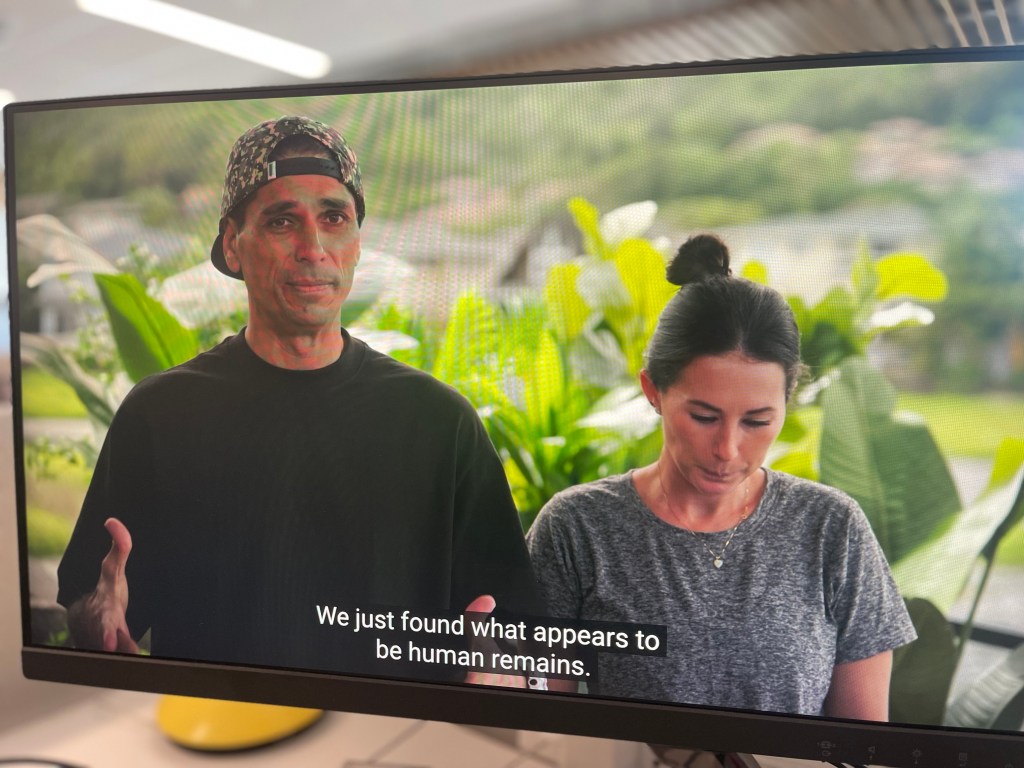
Filming Native Hawaiian ancestral remains is culturally taboo and considered deeply disrespectful to the islands’ Indigenous ancestors. Photographing these remains, called iwi kūpuna, is also illegal under Hawaiʻi law without permission from a state burial council.
The Kalamas did not get permission, according to the state.
Previews for the episode shown on social media so alarmed Hawaiʻi officials this week that they made a last-minute effort on Tuesday to block its dissemination. The Hawaiʻi Attorney General’s Office sought – and won – a restraining order from a state judge to get the content taken down. The order did not keep HGTV from airing the episode and legal experts say the court’s action may have been a violation of the First Amendment.
On Friday, HGTV issued an apology and said it would issue a re-edited version of the episode for “all future network airings and platforms.”
“We take the concerns raised by the Native Hawaiian community very seriously and are committed to ensuring our programming is respectful and appropriate,” reads the statement from Lynne Davis Adeyemi, vice president of communications for Warner Bros. Discovery.
“We apologize to anyone who found any part of the episode offensive, as that was not HGTV’s intention.”
Leimana Abenes, who represents Kohala on the Hawaiʻi Island Burial Council, said the Kalamas were out of line.
“That’s just the way in our culture. We don’t take pictures and videos of our deceased loved ones,” she said. “That’s the dignity, the Aloha and the respect and honor and loyalty to the person that passed away. We don’t do such things. That’s law and that’s cultural protocol.”
Civil Beat contacted the Kalamas, their production partner and a public relations firm the couple worked with in the past, but did not receive a response. None of the parties have filed any responses in court.
The lawsuit is the latest controversy for the Kalamas who were under scrutiny in 2024 after Civil Beat revealed they routinely did their Oʻahu home renovations without proper permits. Some of those projects were subsequently slapped with violation notices from the Honolulu permitting department.
‘Unlawful Broadcast’
As the Kalamas promoted the episode “Bones On The Big Island” on social media last week, the state of Hawaiʻi noticed.
Multiple Hawaiʻi agencies issued a written directive to the Kalamas on Monday to immediately remove all content depicting the remains from social media, cease and desist from making new similar posts and preserve all their files related to the matter, according to the AG’s office complaint.
The couple was told to confirm compliance in writing within 24 hours of getting that message, the AG’s complaint said, but they did not.

So on Tuesday, court records show the attorney general sued the couple and their producers in state court to halt the broadcast of the episode, which was scheduled to premiere that same day.
“The broadcast of footage depicting iwi kūpuna on national television causes profound and irreparable harm to the Native Hawaiian community, to the State’s interest in protecting its cultural resources, and to the dignity and sanctity of the ancestors whose remains were depicted,” Deputy Attorney General Miranda Steed wrote in a court complaint filed Tuesday.
On Tuesday afternoon, hours before the episode was set to air in Central Time, Third Circuit Judge Henry Nakamoto ordered the production to refrain from “broadcasting, airing, streaming, or otherwise disseminating any video, photographic, or digital content depicting human skeletal remains.”
The temporary restraining order was approved before the defendants could even weigh in, an unusual move. The judge said doing so was necessary in this case because the state of Hawaiʻi would be “irreparably harmed if the motion is not granted.”
According to the judge’s order, the unauthorized broadcast would:
- (1) violate the sacred cultural and spiritual rights of the Native Hawaiian community with respect to their ancestors;
- (2) cause immediate and ongoing reputational, cultural, and emotional harm that no court can adequately remedy in law;
- (3) permanently destroy the confidentiality and restricted nature of the remains that Hawaiʻi law is specifically designed to protect; and
- (4) set a precedent that commercial media interests may override Hawaiʻi’s historic preservation laws.
Promotional social media videos were taken down, but the show aired on Tuesday and remained available on streaming platforms as of Friday.
On Thursday, the AG’s office threatened additional legal action.
“The Department of the Attorney General took immediate legal action to prevent the unlawful broadcast of images depicting ancient burial remains and successfully obtained a temporary restraining order prior to the program’s airing,” AG spokeswoman Toni Schwartz said in a statement.

“We are aware that the segment aired notwithstanding the court’s order, and we take this matter very seriously. The Department will pursue additional action as necessary. Because this is an active matter, we cannot provide further comment at this time.”
After discovering the bones, the Kalamas contacted police and involved an archaeologist who confirmed the remains were “ancient,” and the iwi kūpuna were left in place, according to the show. The couple said on the show the land near where it was discovered would not be developed.
“As depicted in the episode, local authorities were contacted upon the discovery of the remains,” HGTV said in its statement. “Out of respect, the Kalamas made the decision not to develop the lot, and the site was later blessed by a community elder.”
Nevertheless, the AG says the Kalamas’ conduct constitutes a violation of the state’s burial rules and they may be subject to “enforcement action and civil penalties.” The state’s administrative rules on burials state violators can be prosecuted or face fines up to $10,000 per offense.
“Defendants’ unauthorized photography, social media publication, and national television broadcast of images depicting the human skeletal remains constitutes an unauthorized disturbance and desecration of burial site remains,” Steed, the deputy AG, wrote.
‘It’s Desecration’
Stacey Alapai, a Hawaiian community advocate on Maui, is a longtime fan of “Renovation Aloha.”
But when she watched Kamohai and the cameras get closer to the iwi kūpuna, she said she was “from a spiritual perspective, shocked that people who are so connected to our culture here would make that decision.” Kalama, too, is Hawaiian.
The episode could have been a good way to start a conversation about the protection of iwi kūpuna, and the Kalamas did the right thing calling the police and choosing not to develop on the land, Alapai said. But broadcasting the remains wasn’t right.

“If they had not shown those images, I wouldn’t be criticizing them at all. I’d actually be praising them,” she said.
“There’s a lot of creative ways you can tell that story without crossing that line of broadcasting images of iwi kūpuna to the world.”
Sharing the images with a national audience sensationalizes the issue, Alapai said.
“I think it sets a precedent and normalizes a practice. It essentially tells people that it’s okay to do that when it’s not. It’s not just illegal, it’s just hewa” — wrong — “and it’s desecration,” she said.
Burial council member Abenes said when iwi kūpuna are disturbed, trespassers can awaken them. And their mana, or power, can spread to the person finding them, or vice versa.
“Mana it transmits, it travels, it attaches to people,” she said. “When people deal with burials, especially in this particular situation, they’ve got to be very careful, because they don’t know what type of individual that person was.”
As a Hawaiian, Kamohai should have known better, Abenes said. She says his actions, especially the commercial nature of them, were disloyal and dishonorable to his kūpuna and Hawaiians.
“What is their driving force? Fame and fortune,” she said. “They push us back in time a long way. It just makes the struggling and the fight even worse than what it should be.”
No Photography Rule May Violate First Amendment
Given HGTV’s apology and efforts to remedy the situation, it appears unlikely the Kalamas or HGTV will challenge the restraining order in court. However, there could be grounds for them to do so, according to legal experts specializing in the First Amendment.
Eugene Volokh, a law professor and Stanford University fellow, said the Hawaiʻi court’s order is “pretty clearly unconstitutional.”
He pointed to the landmark U.S. Supreme Court case Snyder v. Phelps, in which justices said homophobic speech against a dead Marine at his funeral was protected under the First Amendment. He said the Supreme Court also allowed news outlets to publish the Pentagon Papers despite the Nixon administration’s claim that national security was at risk.
“It seems especially clear then that you can’t punish publication because it may cause emotional harm to some community,” Volokh said.

Volokh also criticized the court’s quick injunction preventing further publication of the footage without first reaching out to the production team for a response.
“On top of the fact that this just substantively violates the First Amendment,” Volokh said, “I think it’s also procedurally unsound.”
Paul Alston, a local attorney with experience in First Amendment matters, said it’s a stretch for the state to claim that the Kalamas violated the law by broadcasting footage from the lava tube. Assuming that the hosts genuinely stumbled upon the bones by accident, he said, it’s fair game to broadcast that day’s content.
“That’s where you run into a real First Amendment problem,” he said.
Alston said the state’s claim would be stronger if it comes out that the Kalamas entered the lava tube planning to record footage of the bones.
“If they went into the cave knowing the bones were there and then pretending to discover them … creating a phony story about it,” he said, “that’s a problem for them.”
Even in those circumstances, in Volokh’s opinion, the show’s content would be protected speech under the U.S. Constitution.
While it’s good the Kalamas called the authorities, Alston said, they probably should have stopped recording once it became clear the bones might be iwi kūpuna.
Even though Volokh thinks Hawaiʻi’s rule against photographing burial grounds is unconstitutional, he said removing it would require somebody challenging it. Since Hawaiʻi’s small population has a lot of cultural reverence towards iwi kūpuna, it’s possible no one will push back on it.
“There’s often a lot of public pressure against people challenging various laws,” he said, “and those laws may therefore stay on the book.”