Salary Increases Approved For Honolulu Politicians
Salary commissioners say the pay bumps are necessary to keep pace with public sector union raises and to ensure salaries are on par with officials’ job duties.
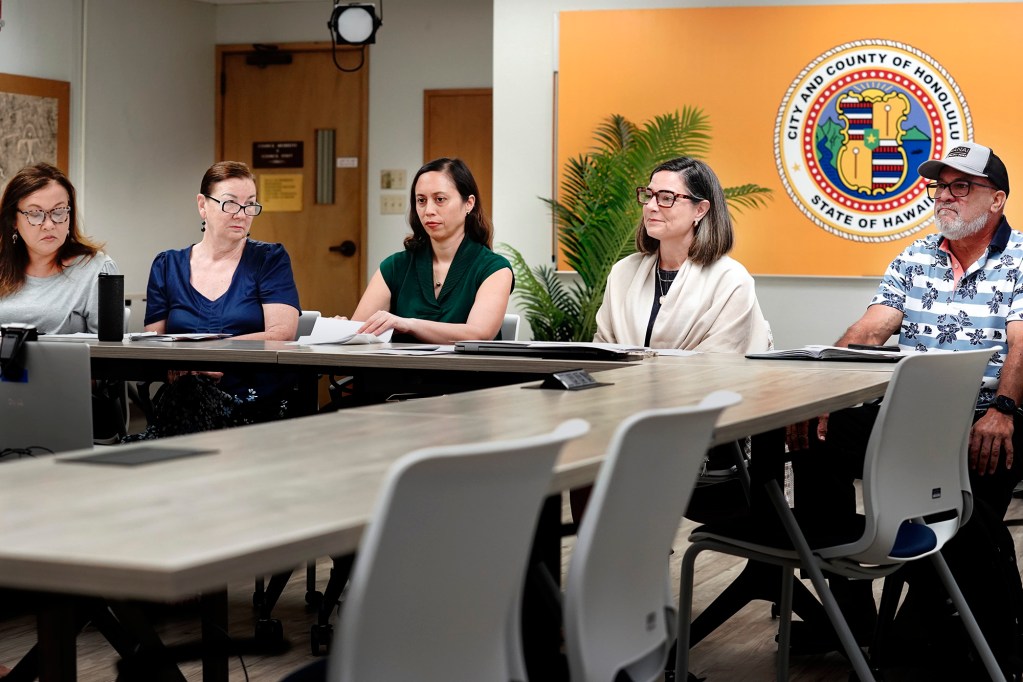
The Honolulu Salary Commission unanimously approved a 4.7% salary raise for Honolulu Mayor Rick Blangiardi, City Council members and other executive employees on Wednesday morning.
The move comes three years after big pay raises for city officials, including a 64% pay raise for council members.
Natalie Iwasa, a Hawaiʻi Kai resident and frequent testifier at the City Council, testified that she opposes the increase, saying it’s higher than the rate of inflation and the raises public union workers are receiving.
Only a few residents submitted testimony for the commission’s April 6 meeting earlier this month and all of them criticized the proposed raises as being too high.
“At 70 I had to go back to work to make $21.00 per hour just to make ends meet,” ʻEwa Beach resident Renee Kuʻuleinani said in written testimony. She felt the council’s proposed pay raises for city officials were a slap in the face to people like her who struggle against inflation.
“How do those officials live with themselves knowing the people they are NOT serving properly are poverty stricken!?” she wrote.
Salaries for council members would increase from approximately $122,000 to $128,000, while Council Chair Tommy Waters’ salary would remain $10,000 higher than that of the other members.
Blangiardi’s salary would increase from $226,000 to $237,000. Department heads — besides police, fire, the medical examiner, corporation counsel and the city prosecutor — would see their salaries rise from $202,000 to $211,000 while their deputies would go from $192,000 to $201,000.
If council members do nothing, the raises will take effect automatically. The raises will be rejected only if three-fourths or more of council members vote against them within 60 calendar days of their adoption.
“As in the past, deferring the acceptance of salaries only compounds over time and draws more criticism from residents when large increases are necessary to make up for deferred increases,” city spokesperson Ian Scheuring said in a written statement. He said to his knowledge, the mayor has no plan to decline the raise.
“We believe that the recommendation of the Salary Commission is a prescribed Charter process which reflects a commitment to pay city leadership a fair value for their service to the public.”
Who’s Declining To Take The Pay Raise?
Council members used to be able to decline the commission’s proposed pay raises for the legislative branch. That changed after voters approved a charter amendment during the 2024 General Election that capped council pay raises at no more than 5% each year and prohibited council members from voting on their own pay raises. Now those raises automatically take effect with the new fiscal year.
However, council members can turn down the pay raise on an individual basis, and some have already stated their intention to do so.
Council member Esther Kiaʻāina told Civil Beat she would decline the salary increase. Kiaʻāina had shown up to the commission’s meeting Wednesday morning to testify that salary increases for council members don’t need to happen annually.
She said the 64% raise that she and other council members received in 2023 was meant to catch up with cost-of-living increases after years of salary stagnation that had left their salaries a little under $69,000.
“Now that we are up to par, I think that you can be more prudent moving forward,” Kiaʻāina said.
In an interview after the meeting, she said perhaps it would be more appropriate if raises were given out once every three or four years. She said if council members were to receive a raise close to 4.7% every year, their salaries would be more than $160,000 by 2030.
“Of course people are going to talk about the timeframe and everything,” she said, “but for me, it is more of a matter of what is sustainable.”
Council member Radiant Cordero said she is also declining to take this year’s increase, and she agreed with Kiaʻāina’s point that their salaries do not need to be raised this year.
“I feel like that we were caught up already,” she said, referencing the massive 64% raise she and her colleagues received in 2023 in the name of correcting years of lagging salaries.
Council member Augie Tulba told Civil Beat in March that he would donate future raises to scholarships and local nonprofits. He did not respond to a request for comment on Wednesday.
Council member Matt Weyer said he hasn’t had the chance to look at the Salary Commission’s approved raises yet and did not have an answer.
“I’ve been on the ground for the past month dealing with real crises,” he said, referencing catastrophic flooding in the district he represents on Oʻahu’s North Shore.
In a written statement, Council Chair Tommy Waters said he would not take the raise, citing this year’s tight budget and recent flooding.
Council members Andria Tupola, Val Okimoto, Tyler Dos Santos-Tam and Scott Nishimoto did not respond to requests for comment.
Tupola, Tulba and Cordero had declined the 64% pay raise at the height of its controversy almost three years ago. All eventually took it after winning reelection.
An Imperfect Process
Some community members are frustrated with the process of determining public officials’ salaries at the city level.
Iwasa, the frequent council testifier, flagged an issue with Salary Commission testimony, saying she and other members of the public had submitted early testimony for the commission’s April 6 meeting but that it wasn’t received in time.
“Something fell through the cracks,” she said.
Volunteer Salary Commission members acknowledged during their meeting Wednesday morning that people may not agree with their proposed increases, especially given the mayor has said this will be a tight budget year. The increases also come at a time when the Hawaii Fire Fighters Association says the pay package their government employers are offering its members is too low.
But commission members said they are just following their job description as per the City Charter.

“Our mandate isn’t to determine whether or not there’s funding available for these increases,” commissioner ʻAuliʻi Dudoit said at Wednesday’s meeting. “It’s to objectively look at the metrics of the data and whether or not people are being adequately paid for the work that they do.”
Commission Chair Sarah Guay said the commission’s job is to ensure officials get adequate pay and that a structure is maintained where supervisors make more than their employees.
“The folks that these people are supervising, their salaries are increasing,” Guay said. “And as a result, one of the things that this group is charged with is maintaining adequate structure. And because this group is charged with that, these salaries need to keep pace with that structure.”