

Supreme Court Chief Justice Nominee Faces Tough Questions From Senators
Besides his work for a powerful Hawaiʻi super PAC, lawmakers raised concerns about Vladimir Devens’ attendance at a controversial Honolulu cop’s retirement party.
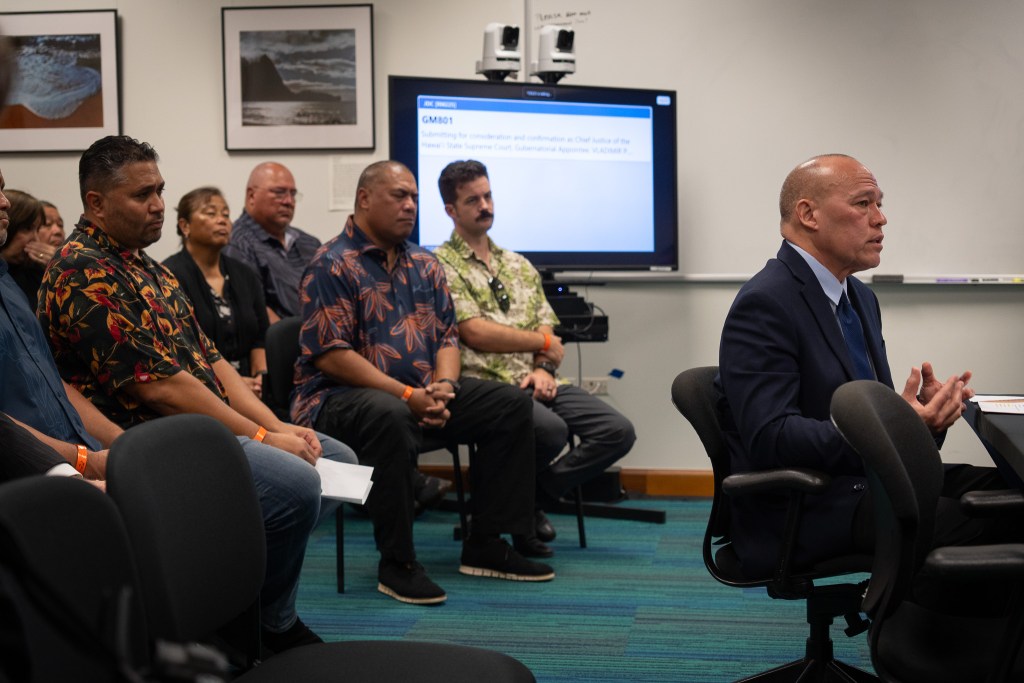
Sitting in a conference room full of his supporters in the legal and labor communities, a Hawaiʻi Supreme Court justice spent two uncomfortable hours Wednesday defending his ethics and integrity before the Senate Judiciary Committee.
Among other things, senators questioned Vladimir Devens, Gov. Josh Green’s nominee to be the next chief justice, about why he hadn’t disclosed his past work for a political action committee. Such information, they said, was vital in order to judge his ability to lead the state Judiciary.
Devens not only did not list the information in his application for associate justice in 2022, he also omitted it from his current application for chief justice.
“I don’t understand how that piece of information was not relevant,” Judiciary Chair Karl Rhoads told Devens at his confirmation hearing at the State Capitol. “Whenever I find out something about a nominee through the press, and especially if it’s negative, I feel like probably it should have been just sitting up front at some point in the process.”

For four years, Devens was on the board of Be Change Now, a super PAC operated by Pacific Resource Partnership, a consortium made up of the 6,000-member Hawaiʻi carpenters union and more than 250 contractors statewide who employ them. It’s funded by the Hawaiʻi Carpenters Market Recovery Program Fund.
Rhoads’ committee unanimously approved that November 2023 appointment, also made by Green.
Now that he wants to be the state’s top jurist, the work with the super PAC has gained new scrutiny from the Senate.
“So what were your rationale for not saying anything about it during 2023?” Rhoads asked Devens Wednesday.
“Well, because of my background of the work that I was doing, it was just part of the everyday work that I do,” Devens replied. “And so there was nothing that stood out for me, my perception and my work and understanding of (my position) as a private attorney.”
He added: “And I don’t think there was any question asked of me at the time.”
But Rhoads and another Judiciary Committee member, Sen. Joy San Buenaventura, described Devens work for Be Change Now as significant because PRP’s prominent political advertising has been controversial in several major elections over the past 15 years.
In 2012, Ben Cayetano, a former governor, ran against Kirk Caldwell for Honolulu mayor. PRP’s negative advertising prompted Cayetano to file a libel and slander lawsuit against PRP that was settled in 2014. PRP was required to apologize and give $100,000 to the University of Hawaiʻi and $25,000 to the Hawaiian Humane Society in Cayetano’s name.
Devens stressed that his work for Be Change Now was of a limited advisory capacity. He equated it with work he has done for several other unions over the years, something he did disclose at length on his Judicial Selection Commission applications.
But Devens acknowledged that he now understands the concerns about the political work.
“I did not view that as a negative in and of itself, or a negative reflection on me, and that was my perception,” he said. “However, in talking with several members of this committee and hearing the sentiments that are conveyed and how political committees may have opposed the candidate (with) extended resources, I certainly understand and appreciate that perception and the expectation to disclose — it wasn’t my intention at all. And I’m very sorry and regret that it came across that way.”
Rhoads also pressed Devens about why, as a sitting Supreme Court justice, he had attended the retirement party in August of Darren Cachola, an officer with the Honolulu Police Department accused of assaulting women and who was fired after a video showed him hitting his girlfriend in a restaurant. Cachola was later reinstated.

A flier for the party, Rhoads pointed out, featured a photo from a police protest with Cachola’s face alongside that of Derek Chauvin, the officer convicted of killing George Floyd in 2020 in Minnesota, and George Zimmerman, a Florida watch volunteer who shot and killed Trayvon Martin in 2012.
“How did you find out about that party?” Rhoads asked.
“Somebody had told me about it,” Devens replied.
“If he wasn’t a personal friend, why did you feel you needed to go?” Rhoads then asked.
Devens responded by saying that Cachola was a former client.
Another senator, Les Ihara, was invited by Rhoads to question Devens as well. Ihara said he was concerned about maintaining the public trust that is expected of the Judiciary, a branch that Devens would lead.
While Ihara said he did not question Devens’ legal experience and performance as an associate justice and that he appreciated “his candor and honesty,” Ihara still said a promotion to chief justice would come with an entirely new level of responsibility and expectation as compared to an associate justice.
Ihara said the Senate’s process of vetting a high court nominee is to determine “whether you have the discernment to be a chief justice” and the “discretion and responsibility and accountability” that comes with the job.
Devens replied, “Public trust is everything, Senator, and so is my integrity. That’s everything to me.”
If confirmed, Devens said he would do “everything I possibly could to reassure that I take my job very seriously.”
Rhoads deferred decision making on the Devens nomination until Friday.
Union And Legal Backing
The confirmation hearing was held in a conference room packed with members of labor groups and the legal community, most of whom were there to support Devens.
Written testimony in support of Devens came from Honolulu Prosecuting Attorney Steve Alm, Honolulu Managing Director Mike Formby, former Hawaiʻi Chief Justice Mark Recktenwald, lobbying firm Imanaka Asato, the Hawaiʻi Filipino Lawyers Association, the United Public Workers, Unite Here Local 5, the University of Hawaiʻi Professional Assembly, the Hawaiʻi State Teachers Association and the Hawaiʻi Government Employees Association.
“His confirmation presents a historic opportunity to have an advocate for organized labor and working families for the first time in our state’s history,” wrote HGEA Executive Director Randy Perreira who, like Alm, attended the hearing. “At a time when the challenges facing working families are too often overlooked, we are confident that Justice Devens will continue to represent the views and values of local citizens, as he has throughout his service as an Associate Justice of the Hawaii Supreme Court.”
The Hawaiʻi State Bar Association board of directors testified that Devens was qualified to be chief justice.
Only a handful of people submitted testimony in opposition to Devens. They included Chuck Freedman, who has worked for various nonprofits and in the administration of former Gov. John Waiheʻe.
“My objections stem from the concentration of power by the Hawaiʻi State Carpenters Union in all three branches of our government, with the appointment of Devens to Chief Justice being either a capstone or another notch in the gun for a single union, depending on your point of view,” wrote Freedman. “Absolute power corrupts absolutely. We have watched this happen with the Carpenters Union, mostly in silence. It is time for the sirens to go off.”
During the hearing, Devens said he never intended to become a judge or justice, saying he was satisfied with his work as a trial lawyer. He changed his mind after a former Hawaiʻi justice encouraged him to apply. He also said he believed he had administrative experience working with the Honolulu Police Department which he noted has a bigger budget and more employees than the Judiciary.
Devens initially applied for a seat on the Intermediate Court of Appeals in 2022 but later withdrew. That November he applied to be an associate justice.
The timing of the applications and when exactly he stepped down from the board of Be Change Now was raised by Rhoads several times. Business registration records with the Department of Commerce and Consumer Affairs show Devens as having served in the Be Change Now board as early as 2019 until April 2023.

Devens said he submitted his notice to resign from Be Change Now in June 2022 to be effective that July. Rhoads asked if Devens could provide his committee with paperwork to back that up, and Devens indicated he would.
Devens was also asked whether he had been involved in Be Change Now decisions to expend funds to support or oppose candidates. Devens didn’t answer directly and suggested that it was “not appropriate” to discuss internal business. “I don’t remember those kinds of details,” he said.
Deven did say he was aware of PRP ads attacking candidates for Hawaiʻi office like U.S. Rep. Jill Tokuda and Lt. Gov. Sylvia Luke but said he did not recall the specifics.
“I have my personal opinions about politics in general,” he said. “I’ll leave it at that.”

