Murder Charges, Then Freedom: Teens’ Pretrial Release Questioned
The cases raise questions about leniency shown to young arrestees and the effectiveness of ankle monitors.
Shae’Dan-Styles McEnroe-Keaulii had just gotten into a fight and was holding a ghost gun, police said, when he was arrested outside a nightclub last month.
But he had something else unusual on him as well: an ankle monitor.
The 19-year-old was on supervised release after being charged with murder two years ago, accused of shooting a woman at a Māʻili cockfight.
Normally, such a serious charge would land someone behind bars until their trial. But McEnroe-Keaulii was enjoying an unusual freedom, thanks in part to his age, the fact that his mother was there to sponsor him during his pretrial release hearing and the state’s expansion of ankle monitoring as an alternative to incarceration.
It’s not the first time a young man accused of killing someone when they were a minor was released into the community, only to be arrested again.
Branston Medeiros, who was charged with murder at 16 for killing another teen at Mākaha Beach in 2023, was also released to his mother’s home in July 2024 on an ankle monitor while awaiting trial.
He was re-arrested last year after cutting off his ankle monitor and fleeing from his mother’s house. His whereabouts were unknown for more than five weeks. Prosecutors say he also tried to hire a hitman, a fellow gang member, to kill his girlfriend’s new boyfriend around the time he was re-arrested, court records show, but Medeiros hasn’t been charged for that.
The incidents involving young defendants granted pretrial release have raised questions about whether the courts treated the men too leniently and the adequacy of the state’s electronic monitoring system.
“What message is that sending to the public?” said Kaukaohu Wahilani, a member of the Waiʻanae Coast Neighborhood Board who has had two nephews die in shootings on the Westside. “To me, they took a life and they should stay in until court.”
McEnroe-Keaulii’s case is still pending. He has pleaded not guilty and a trial is scheduled for June 15.
Murder Suspects Not Usually Released
Honolulu Prosecutor Steve Alm said it’s concerning to see defendants charged with murder out on supervised release. Court records show prosecutors in both the Medeiros and McEnroe-Keaulii cases opposed their release on the grounds that both men posed a danger to the community and were at risk of fleeing before trial. Medeiros ultimately pleaded guilty to manslaughter.
Most defendants charged with violent crimes are not given supervised release, Alm said. Most are held without bail or given a high bail of $1 million or more. In the case of juvenile defendants, the fact that they’re young and may lack a significant criminal history shouldn’t be a factor given the seriousness of the crime for which they’re charged, the prosecutor said.

“The judge has to look at the facts and circumstances,” he said, commenting generally and not speaking about specific cases. “But since my primary number one job is to keep people as safe as possible, it would be a rare case that we would not be objecting to supervised release for somebody charged with murder.”
But Haley Cheng, Hawaiʻi’s first deputy public defender, said defendants are presumed innocent until proven guilty and should not have to spend time in jail while they wait to receive justice. Incarceration for young defendants can be particularly traumatic, she said.
Though she noted it’s uncommon for any defendant charged with murder to be given supervised release, she said it’s up to the discretion of the judge. Factors such as the age of the defendant, their criminal history and the availability of a stable sponsor to help supervise them can all go into the decision to release someone.
“With juveniles, I think the parental support that they have or the family support is different from somebody who may be in their 30s or 40s,” she said. “They often have a home, a verified address, things like that, which a lot of other criminal defendants may not have.”
It’s difficult to get a full picture of juvenile offenders out on bail because the Hawaiʻi Family Court’s juvenile cases are closed to the general public, and records are kept confidential. Cases only become public when they are waived out of Family Court, and the juvenile is tried as an adult, which is rare. Only 10 juvenile cases have been waived out of Family Court since 2021, according to the state Judiciary.
There are currently no juvenile offenders out on ankle monitors, according to the state’s Department of Corrections and Rehabilitation.
How Could These Cases Have Happened?
It’s difficult to say exactly why the judges in Medeiros’s and McEnroe-Keaulii’s cases decided to release them. Pretrial bail reports, including a risk assessment completed by the Department of Corrections and Rehabilitation’s Intake Services Center, are confidential.
In both cases, though, the defendants were released to their mothers, who were deemed by the court to be sponsors capable of supervising them and helping ensure good behavior pretrial. When reached by phone, both McEnroe-Keaulii’s mother and Medeiros’ adopted mother declined to comment for this story.
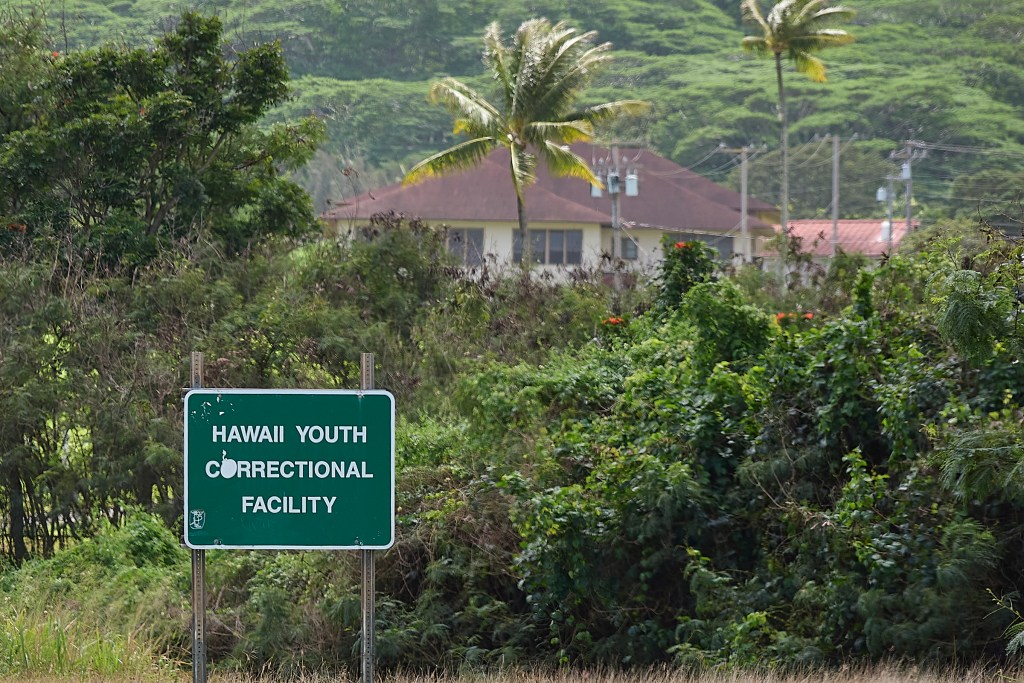
In McEnroe-Keaulii’s case, First Circuit Court Judge James Kawashima waived a $2 million bail and released him to house arrest on March 7, 2025, despite objections from the state. He had already spent about two years in the juvenile detention facility and was nearing his 18th birthday, at which point he would have transferred to O‘ahu Community Correctional Center.

In Medeiros’ case, First Circuit Court Judge Catherine Remigio reduced his bail from $750,000 to $500,000 and released him to home confinement. He posted bail on July 23, 2024, despite the fact that he had assaulted a correctional worker at the Hawaiʻi Youth Correctional Facility a week prior, according to court records.
It’s clear from court records that having sponsors in the community was part of what led judges to release these two young men, who were 18 by the time they were released on ankle monitors.
In contrast, Jasper Solberg, a 17-year-old who was charged with murder last May in a gang-related shooting, has been held without bail. He was transferred from the youth correctional facility to OCCC on Aug. 13, 2025, the day before his 18th birthday.
In October, First Circuit Court Judge Clarissa Malinao denied a motion for supervised release due to the violent nature of the crime with which he was charged, his alleged gang affiliations and the potential danger he posed to the community.
Medeiros and Solberg were associated with the same gang, the Shark Boys, according to court records.
Two people who offered to be Solberg’s sponsors were also deemed inadequate by the court. One failed to submit a lease agreement, leading to doubts that Solberg could legitimately stay at her residence. Another lived at a house where all residents worked or went to school during the day, which would have left Solberg unsupervised.
“This court was not presented with any evidence which would support any condition or combination of conditions which would reasonably assure the appearance of Defendant Solberg and/or the safety of the complaining witnesses and/or the community,” says an order denying Solberg’s bail.
Solberg’s attorney, Pedric Arrisgado, declined to comment because of his client’s ongoing case.
McEnroe-Keaulii’s attorney, Doris Lum, did not respond to calls seeking comment.
Cheng, the state’s first deputy public defender, said generally speaking, public defenders almost always advocate for their clients to be released pretrial given the fact that they have not yet been convicted of a crime.
There are, though, additional factors a judge may take into consideration when dealing with a juvenile offender. For example, juveniles who are held in the Hawaiʻi Youth Correctional Facility are often transferred to OCCC when they turn 18. When that happens, they’re often held in isolation to keep them away from the older adults, and the solitude can be extremely traumatic, she said.
“Does it shock me that the courts are considering release for juveniles that are charged with very serious offenses? No,” Cheng said. “I think the courts do a good job of assessing each case, you know, on a case-by-case basis, and the same for adults.”

But Alm said the fact that young defendants don’t have a criminal record shouldn’t be given much weight if they’re charged with a crime as serious as murder.
The fact that they have sponsors in the community should also be taken with a grain of salt, said retired First Circuit Court judge Randal Lee. Their sponsors clearly weren’t supervising them at the time of their original offense.
“You cannot overlook the seriousness of the offense just because they’re 16 or 18 years old.”
Kimora, a professor of corrections at John Jay College of Criminal Justice in New York City who goes by one name, said juveniles can benefit from being released pretrial if they have community support from parents, teachers or other figures.
“The more that we can have them stay in the community, be monitored, is great,” Kimora said. “And then if we can do counseling, maybe they’ll settle down more. They’ll realize, no, this is not the way to go.”
How juveniles are treated by the justice system varies broadly state by state and ultimately comes down to the discretion of the judge in each case. But, Kimora said, there is a growing recognition in the criminal justice world that young brains are still developing through the age of 25 and therefore young people could benefit more from being rehabilitated in the community, rather than incarcerated.
“You cannot overlook the seriousness of the offense just because they’re 16 or 18 years old.”
Retired First Circuit Court judge Randal Lee
Mark Patterson, chair of the Hawai‘i Correctional Oversight Commission and administrator of the Hawai‘i Youth Correctional Facility, said he doesn’t know the specifics of Medeiros and McEnroe-Keaulii’s cases, but he knows that in order to be released, a judge would have to determine a defendant was not a threat to the community.
The judges probably thought the young defendants would benefit from being out in the community with their families, Patterson speculated. But in light of the murder charges in both cases, he said it’s hard not to question the decision to release them.
“Everybody right now is looking at the whole case and trying to figure out,” he said, “where did they go wrong in the decision making?”

Violence on the Westside has become a focus for Alm’s office, which in December launched its Safe and Sound initiative in the area.
Katie Kaahanui, who runs the program for the prosecutor’s office, said she is working with schools and community organizations to learn about residents’ public safety concerns and setting up a Youth Advisory Council to get input from young people and provide them with leadership training.
Through the Safe and Sound initiative, prosecutors also give priority to prosecuting crimes committed on the Westside, between Kahe Point and Kaʻena Point, and advocate for higher bail for violent offenders, Kaahanui said. This means cases will be pushed through the courts faster and defendants will be sentenced more quickly than cases that originate on other parts of the island.
“We want to make sure that the threats are treated right away,” Kaahanui said. “And we really want to get that zero tolerance mindset just kind of known by people that, ‘Hey, if you’re out there doing things that are harming yourself or harming others, that’s not going to be accepted here.’”
Murder Suspect Was MIA For Weeks
In each case, having an ankle monitor wasn’t enough to keep Medeiros or McEnroe-Keaulii from violating the terms of their supervised release.
About six months into Medeiros’s release, on Jan. 26, 2025, he cut off his ankle monitor and fled his mother’s home. For five weeks, the state was in the dark about the then-murder suspect’s whereabouts.
After receiving an alert that Medeiros had absconded, his pretrial officer, Sandee Suzuki, called him and left a message telling him to report immediately to the state corrections department’s Intake Services Center. He didn’t.

Suzuki then reported the violation to the court, and a judge issued a bench warrant. Honolulu Police Department spokesman Lance Aquino said officers attempted to find Medeiros to serve the warrant but didn’t say how many attempts they made.
Medeiros spent the next five weeks in hiding, without his ankle monitor.
His lawyer, Neal Kugiya, said Medeiros left his home for good reason. He’d seen suspicious figures wearing hoodies in his mother’s backyard one night, peering into the windows of her Waiʻanae home.
The night before he decided to run, four members of the Māʻili 200 gang showed up at the house and beat him severely when he answered the door, Kugiya wrote in a letter he submitted to the court. The teenager Medeiros eventually pleaded guilty to killing was associated with that gang.
Kugiya told Civil Beat he advised his client to attend a court hearing so he could explain himself to a judge. But the hearing wasn’t scheduled until more than a month after Medeiros cut his ankle monitor — during which time, the defendant had no contact with his pretrial officer or the court.
“Don’t put a violent offender on an ankle monitor and expect he’s going to behave.”
Tim Dees, retired police officer and writer about police technology for Police1.com
When Medeiros showed up for the hearing, he was arrested on the courthouse steps — a move the judge in the case, Kevin Souza, called inappropriate because Medeiros had a right to appear before the judge on his lawyer’s motion to recall the bench warrant, according to court minutes. Other officials involved in the case, including Suzuki, had taken time out of their day to attend the hearing, which would have to be rescheduled because of the arrest.
“That does not sit well with the Court,” the minutes say.
Souza rescheduled Medeiros’s hearing for the following day, at which point he revoked his supervised release and ordered him held without bail.
Medeiros ultimately pled guilty to manslaughter and two firearms charges last August and was sentenced to 20 years in prison.
In an interview last week, Kugiya said Medeiros had been doing well on supervised release before he went on the run. He was even in the process of getting permission from the court to work at a poke shack.
“He was doing what he was supposed to be doing,” he said.
In McEnroe-Keaulii’s case, he had no violations noted by the court in the year he was on supervised release — until just before 3 a.m. on April 12 when he was caught fighting with other people outside a nightclub on Kapiʻolani Boulevard and arrested.
In an emailed statement, Tommy Johnson, director of the state Department of Corrections and Rehabilitation, said staff at OCCC’s Intake Services Center, which is responsible for supervising defendants on ankle monitors, get alerted about ankle monitor violations via email, but because McEnroe-Keaulii’s violation happened overnight, they didn’t follow up on the violation until the following Monday morning — April 13.
His supervised release was revoked the next day. He was taken to OCCC and Judge James Kawashima set his bail at $2 million.
Electronic monitoring increased in Hawaiʻi over the last decade, from 29 people in 2015 to 85 people in 2023. That includes people on pre-trial release, probation and those participating in programs through specialty courts, like drug court.
A 2018 report from the Judiciary to the Legislature recommended expanding electronic monitoring as an alternative to pretrial detention for defendants who can’t afford bail. It recommended that defendants deemed as having a “moderate risk” of failing to appear or being re-arrested could be let out on supervised release to the care of a sponsor, but those deemed “high risk” should be held pretrial.
Tim Dees, a retired police officer and writer about police technology for Police1.com, said ankle monitors shouldn’t be seen as tools that will prevent defendants from reoffending but rather as devices that can enhance the supervision of defendants who are already likely to follow the terms of their pretrial release.
“You just have to use proper discretion,” he said. “Don’t put a violent offender on an ankle monitor and expect he’s going to behave.”