

Kaua‘i Looks To Triple Homeless Funding On Heels Of Lower Count
The County Council also increased funding for invasive species mitigation and mental health programs as part of its ongoing review of next year’s budget.
The Garden Isle’s homeless grant-in-aid program is likely to receive more than triple the amount of funding next fiscal year due to a recent budget amendment by the Kaua‘i County Council.
The boost was made after council members heard roughly an hour of testimony from 14 people — many of whom have experience with homelessness — imploring them to increase funding for the $500,000 program.
“You need to cough up the money,” Rowena Contrades Pangan, executive director of Ho‘omana Thrift Store, told the council Thursday. The Wailua nonprofit hosts weekly outreach events for the island’s homeless community. “$500,000 isn’t enough.”

The funding is part of the county’s proposed $504 million budget for fiscal year 2027, which begins July 1. The overall spending plan includes nearly $364 million for operations and $140 million for capital improvement projects. The figures come from the county’s supplemental budget, which incorporate changes by both the mayor’s administration and council.
In addition to more funding for homeless programs, the proposed budget also includes increased allocations for invasive species, early childhood development, bus passes for low-income households, and mental health and substance abuse programs.
The council will further discuss the county spending plan for next fiscal year at its May 27 finance committee meeting before making its final vote June 3.
‘People Are Falling Through’
The $1.5 million for the homeless program grant was proposed days after the release of the neighbor island Point-in-Time Count, a one-night snapshot conducted by Bridging the Gap.
The latest data showed 516 people are experiencing homelessness on the Garden Island — a slight decrease since the 2024 count. Over three-quarters of Kaua‘i’s homeless population is unsheltered.
The Point-in-Time Count doesn’t include what some call the “hidden homeless,” people who lack stable and permanent housing and instead couch-surf or camp on loved one’s properties. Contrades Pangan said the true number of individuals experiencing homelessness is likely much higher than what’s included in the latest count.
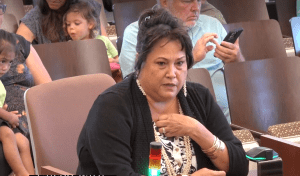
Laura Lindsey, Catholic Charities Hawai‘i’s community director for Kaua‘i, told the council that much of the burden for taking care of the island’s homeless population has fallen to the county when it should have been taken care of at the federal level. Lindsey is also a mayoral candidate.
“We, the nonprofits, are sitting here with torn nets and people are falling through,” she said.
The county launched its homeless grant-in-aid after recognizing that federal funding to address homelessness would be declining and that state funding was inadequate, wrote Housing Director Adam Roversi in an email. In 2025, the county received requests for $685,000 and awarded $500,000 to Family Life Center, Project Vision Hawai‘i, Malama Pono Health Services and U.S. Vets for various outreach, shelter and rapid rehousing projects. This year’s grant recipients included Family Life Center, Project Vision Hawai‘i and Hale ‘Ōpio. The county received $1.7 million in total requests.
Those aren’t the only funds the county has dedicated to addressing homelessness. Reiko Matsuyama, the county’s managing director, told council members that the county has also invested over $15 million in its Kealaula supportive housing projects at Pua Loke and at Lima Ola. A second phase of Kealaula at Pua Loke, with 24 units, is 95% complete and expected to open this summer, Roversi said.
Several of the testifiers at the Thursday meeting shared their experiences with homelessness, with several commenting on how they’ve seen that service providers are already stretched thin with staffing and resources.
Chad Kia‘aina said he wanted to see more funding for outreach and to help transition individuals off the streets. His partner, Kino Shigekane, is part of a group that’s trying to create a safe zone where individuals experiencing homelessness can get food, use a clean bathroom and access support services. Of the $1.5 million for homelessness, $500,000 is specifically for safe zones.
Shigekane told Civil Beat that she envisions a safe zone where individuals can stay longer term without having to worry about being swept or cited.
“They can just be left alone so that they can actually heal themselves and figure out what they’re going to do with their life. And you can’t do any of that if all you’re trying to do is look for some place you can sleep for more than four hours without getting harassed,” she said.

Hawai‘i island created a safe zone, called Camp Kikaha, in Kona in 2017 before closing it the following year due to safety concerns. Safe zones were also a major topic during the 2018 legislative session.
During the meeting, council member Felicia Cowden, who is also running for mayor, said that she’s looked at safe zones for eight years. Her colleague, council member Fern Holland, asked the county if there was county-owned land that could be used for such a program, but Matsuyama said the county hasn’t identified any. She added that the homeless program grant could be used to do safe zones, but the county hasn’t received any proposals.
A Growing Need
The increased funding was part of a comprehensive community services budget amendment introduced by Council Vice Chair KipuKai Kuali‘i and Holland.
“A lot of this testimony kind of broke my heart, and it doesn’t seem right,” Kuali‘i said at the meeting. “I really know we’re doing some, but it’s nowhere close.”
The county gives about $1.3 million a year to the Kaua‘i Humane Society, for instance, through various line items, Holland said.
“Funding people at an equivalent rate as funding stray cats and dogs doesn’t seem like a stretch,” she said. “The need is 100% growing.”
The council also added $500,000 to the Office of the Prosecuting Attorney’s Life’s Choices Adult and Adolescent Mental Health and Substance Abuse Grant Program, bringing its total to $1.5 million.
The amount of funding for the Department of Parks and Recreation to deal with invasive species, like the coconut rhinoceros beetle, was doubled to $400,000.
Funding was also increased for the Kaua‘i Bus Pass Outreach Program to $220,000 from $170,000. The program is administered by nonprofits and helps low-income households get bus passes.
Education, Housing, Capital Improvements
Another major change to the budget since Mayor Derek Kawakami proposed it in March was adding $300,000 to support early childhood development as part of a grant-in-aid under the mayor’s office.
Matsuyama said the money would help Tūtū and Me — a traveling preschool that supports keiki caregivers — until federal funding secured by U.S. Sen. Brian Schatz kicks in. The program was anticipating closing 17 sites around the state at the end of August after federal funding for Native Hawaiian education was set to run out.
The county budget also set aside $1.5 million in capital improvement projects for a workforce housing preservation program that will purchase deed restrictions on new and existing homes to preserve housing stock for local residents. Maui County earlier this month launched its own pilot program for Moloka‘i.

Another $5.2 million was set aside for the county to purchase a 5.5-acre industrial parcel in Puhi from Kauai Veterans Express Co., where its auto shop will relocate. Matsuyama told the council that the auto shop is currently cramped and in need of more space. The acquisition will also create more space for the Division of Wastewater Management to expand the Līhu‘e Wastewater Treatment Plant.
Overall, the total capital improvement project budget was upped by $1 million since the March submittal and the operating budget was reduced by $1.1 million. The mayor’s administration also decreased the estimated revenue for the Transient Accommodations Tax by $1 million and the General Excise Tax by $500,000 due to uncertainties in the global economy.
Civil Beat’s reporting on Kauaʻi is supported in part by a grant from the G. N. Wilcox Trust; reporting on economic inequality is supported by the Hawaiʻi Community Foundation as part of its work to build equity for all through the CHANGE Framework; and by the Cooke Foundation; education reporting is supported by a grant from Chamberlin Family Philanthropy.

