

State Homeless Housing Contractor Failed To Report Insider Payments
HomeAid Hawaiʻi did not fully disclose payments made to the CEO’s spouse in federal tax returns.
Chris Dotson had a landscaping business with two dozen clients when the nonprofit run by his husband saw an explosion of growth.
HomeAid Hawaiʻi, which has been awarded the bulk of the no-bid state contracts to build tiny houses for the homeless under an emergency proclamation from the governor, went from having $235,338 in revenue in 2022 to nearly $142 million in 2024.
As HomeAid’s work on the kauhale initiative increased, so did Dotson’s work for the nonprofit run by his husband, Kimo Carvalho.
By the time Dotson and Carvalho filed for divorce earlier this year, HomeAid was Dotson’s only client. In a court document, Carvalho said HomeAid was “a major income source” for Dotson — a fact that contradicts previous statements by the nonprofit developer about Dotson’s role, which it said involved merely “volunteering his time and offering discount labor.”
Dotson’s lawyer, Jared Washkowitz, did not respond to requests for comment.

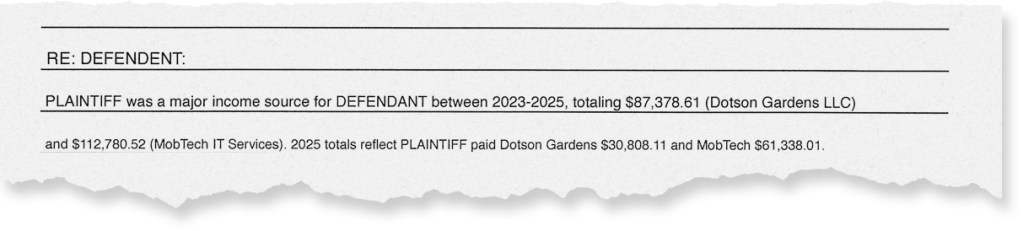
HomeAid now says it paid Dotson $87,379 for landscaping services between 2023 and 2025. Dotson also received substantial money from HomeAid through MOB TechNet Solutions, a Washington state-based IT company owned by his brother. Those payments totaled $112,000 during those same years.
HomeAid failed to disclose some of the payments in tax returns, as required by the IRS.
HomeAid said the failure to report some of the payments to Dotson was the result of a form being “missing from the electronic record” of an IRS filing. In any case, HomeAid said, no state funds were used to pay Dotson companies and the transactions were approved by then-board president Harry Saunders, also the former chief executive of Castle & Cooke Hawaiʻi, who died last year.
Hugh Jones, a former supervising deputy attorney general overseeing Hawaiʻi nonprofits, said the transactions between HomeAid and the Dotson companies raise numerous questions — regardless of whether the money came from state taxpayers or private donors.
“Those are assets of the nonprofit,” he said. “They’re charitable assets.”
HomeAid’s failure to report some of its insider deals is part of an unspooling saga over the state government’s performance in managing its sole-source contracts with HomeAid.
The Hawai‘i State Auditor has raised alarms about management of the kauhale initiative, one of Gov. Josh Green’s signature programs, designed to help some of the state’s most vulnerable residents.

Unlike past state efforts, which provided a patchwork of services, Green’s kauhale program involves an integrated approach: building communities of simple, affordable one-room dwellings with common kitchens and bathrooms and on-site social and medical services.
HomeAid is spearheading the initiative under contracts with the State Office of Homelessness and Housing Solutions, which were awarded without bidding under Green’s 2023 emergency proclamation on homelessness.
There’s no question that the program is getting people off the streets, as documented in a steady flow of television advertisements for HomeAid. The question is how the state and HomeAid are managing the money.
Green’s office did not respond to requests for comment for this article.
The Legislature last year approved a total of $88.2 million of additional funding for the initiative, but also required an audit of the program following an investigation by Civil Beat that found the homelessness office lacked records to show how millions of dollars paid to HomeAid to build hundreds of housing units were actually spent.
State Auditor Les Kondo hasn’t released his final audit. But in an urgent memo to lawmakers last month, Kondo said his office had found serious deficiencies in the state’s oversight and management of its contracts with HomeAid.
Kondo wrote that he wanted to give legislators a heads-up before the final audit because “waiting until the issuance of a final audit report will likely result in continued exposure of public funds to unsupported or inappropriate costs.”
The auditor had found so many questionable transactions so far, Kondo wrote, that “It may not be feasible for us to quantify all questioned or potentially improper costs within the scope of this audit.”
Green in response accused Kondo of having a vendetta against him and of being overly aggressive while conducting interviews related to the audit.
Information obtained by Civil Beat through court filings and HomeAid’s tax returns is consistent with Kondo’s overarching concerns about financial oversight of the kauhale initiative.
Failure To Report Is Serious Issue
Although there can be legitimate reasons for nonprofit leaders to hire family members, the risk of nepotism and unfair dealing is significant enough for the IRS to require such transactions to be reported in a nonprofit’s annual tax return.
In an income and expense statement filed in his divorce case, Carvalho said he paid more than $87,000 to Dotson for landscaping and another $112,780 for IT work between 2023 and 2025. In an email to Civil Beat, HomeAid said that Carvalho later amended that statement because HomeAid was the source of those funds — not Carvalho himself. But HomeAid failed to report some of those payments to the IRS.
A nonprofit failing to report payments to insiders is a significant oversight, said Jones, a recognized expert on nonprofit laws. Such disclosures are material parts of nonprofit tax returns, Jones said.
“There are donor monies flowing through the organization,” he said. And those funds are “supposed to benefit those programs, rather than insiders or family members.”
The IRS requires charities to report any compensation to family members of any nonprofit official “in a position to exercise substantial influence over the affairs of the organization.” The IRS calls these transactions with “disqualified persons” or “interested persons.”
The purpose of the federal law, Jones said, is to ensure that insiders of public charities aren’t unreasonably benefiting from the organization. That includes making sure nonprofit leaders aren’t effectively getting compensation beyond what’s reported to the IRS by steering contracts to family members.

Even if the payment to the family member was made through an intermediary, such as a third-party company employing a disqualified or interested person, the payment can trigger IRS reporting requirements.
Nonprofits also are supposed to have policies in place to make sure that the organization — and by extension its donors — are getting a good deal from the insiders. As long as the organization fully discloses the transaction and the board does due diligence and determines the deal with the disqualified or interested person is fair and reasonable, it can be allowed.
State law requires insider deals to be disclosed to the board, which must make the determination that the transaction is fair and reasonable, Jones said.
“Fair and reasonable” doesn’t simply mean that the organization got a fair price on the good or service from a qualified vendor, Jones said. The price charged to build a golf course, for example, might be fair, he said. But it might not be reasonable for the organization to build a golf course at all.
Due diligence by the board is key, Jones said.
“The nonprofit law is looking at governance of the board,” he said. “Are all of the material facts being disclosed to the board. Is it fair and reasonable? Did unconflicted members of the board approve it?”
“How is the board running the show? Is it entering into conflict transactions without knowing the facts?”
Hugh Jones, former supervising deputy attorney general, Hawaiʻi AG’s charities division
The IRS and state laws have slightly different goals, Jones said. But both are broadly meant “to make sure assets are being properly expended.”
“How is the board running the show?” he said. “Is it entering into conflict transactions without knowing the facts?”
In an email responding to questions raised by Civil Beat, HomeAid said it followed its conflict-of-interest policy before entering deals with the Dotson companies.
“The contracts were found to be fair, reasonable and in the best interest of HomeAid Hawaii, providing goods and services at below market rates, and in certain instances, for cost without any compensation to the principals of such contracting entities,” the organization said.
Transactions Approved By Board President?
HomeAid also said the Dotson transactions were approved by Saunders, the now-deceased HomeAid board president. HomeAid provided a check to Dotson Gardens signed by Saunders to support its statement.
But some who were close to Saunders express skepticism that he would have approved the transactions if their extent and insider nature had been fully disclosed to him.
Frances Sakai was Saunders’ secretary for a decade. In that role, Sakai says, almost everything submitted for Saunders’ approval came over her desk. In addition, by 2024, she said she definitely would have known: Diagnosed with terminal cancer, his health failing, Saunders began working from home, and Sakai says she would take all documents to his home in Kailua for him to sign.
Sakai doesn’t remember Saunders approving $200,000 in payments to MOB TechNet and Dotson Gardens.
Sakai said she was willing to go on the record because, as she put it, “Harry’s not here to defend himself.”
“For people to do this after he’s dead: Shame on them.”
Susie Saunders, widow of former HomeAid board president Harry Saunders
Saunders’ widow, Susie, also doubted Harry Saunders would have approved the insider transactions.
“Bullshit,” she said. “That’s absolute bullshit.”
She specifically questioned whether Saunders, who she said was adamant about hiring Hawaiʻi contractors, would have approved a deal with MOB TechNet, which was based in Vancouver, Washington.
“Harry would never hire a contractor out of state — not when we have IT people here,” she said.
Like Sakai, Susie Saunders took issue with HomeAid pinning the approval of the deals on her deceased husband when he could not respond.
“For people to do this after he’s dead: shame on them,” she said.
HomeAid said it could not provide documentation showing that Saunders had approved the deal with Dotson Gardens because it was “inadvertently not recorded.”
However, HomeAid said, “such confirmation is evident from the execution of payment checks by certain board members, including the late Harry Saunders, as the prior President of the Board of Directors of HomeAid Hawaii.”
To support the assertion, HomeAid provided a check from HomeAid to Dotson for $5,218 signed by Saunders.
Concerning the MOB TechNet transactions, HomeAid said the organization wasn’t required to consider the deal under its conflict-of-interest policy “because siblings of an officer’s spouse (i.e. an officer’s brother-in-law) are excluded from the definition of family member by the IRS.”
Regardless, before HomeAid approved the transactions, “Mr. Carvalho disclosed that MOB TechNet Solutions was owned by his brother-in-law, and it was determined that the transactions were made in good faith, and were reasonable and in the best interest of HomeAid Hawaii (being at or below market value).”
Even if Saunders had approved the transactions under HomeAid’s policy, it would defy the general principle that boards, not an individual, are supposed to provide oversight, said Jones, the expert on nonprofits law.
“Nonprofits are governed collectively by the board and not by a single director,” he said.
IRS Reporting Requirements Are Strict
There is little wiggle room when it comes to requirements to report deals with relatives of nonprofit leaders. It doesn’t matter whether the deal with a disqualified or interested person was fair and reasonable; the nonprofit must report it to the IRS in the organization’s tax return, known as a Form 990.
“Payments to executives and disqualified and interested persons are material parts of the 990 form, and there should be full disclosure,” Jones said. Penalties for submitting false information in a 990 include fines of up to $100,000 and three years imprisonment for the person who signed the return, under penalty of perjury.
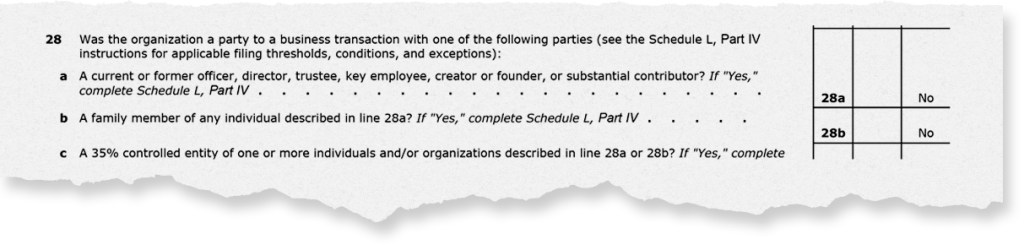
A section of the 990 asks whether a key employee engaged in a transaction with a family member. If so, the IRS requires the nonprofit to submit an additional “Schedule L” form detailing the transaction.
HomeAid blamed the failure to report the Dotson Gardens transactions on a technical glitch — a missing form. But in its 2023 990 signed by Carvalho, HomeAid reported there were no such transactions to report.
“After review of the Form 990 (2023) on file with the Internal Revenue Service, it appears that Schedule L is missing from the electronic record,” HomeAid’s statement said. “HomeAid Hawaii is looking into the matter and will take appropriate action to correct any filing error, as permitted under applicable law.”
HomeAid didn’t say why it told the IRS that there had been no insider deals, even though one such deal involved the spouse of the CEO who signed the document.
However, the bulk of the $200,000 paid to Dotson companies went not to Dotson’s landscaping business, but to MOB TechNet Solutions, the IT firm that HomeAid said it understands was owned by Dotson’s brother. Those payments totaled $112,781, HomeAid said.
HomeAid said it did not report the payments to MOB Tech because the IRS “excludes the siblings of an officer’s spouse from the definition of family member.”
There are instances when the IRS does require nonprofits to report payments to a third-party intermediary if the money goes from the intermediary to an insider’s family member. Jones, the former deputy attorney general overseeing charities, couldn’t say whether HomeAid’s payments should have triggered those requirements.
Still, he said, making six-figure payments to an insider’s brother-in-law reeks of nepotism.
“What you have is a charitable organization’s assets being paid to a third party, and then being funneled to the CEO’s husband,” Jones said. “I don’t think anyone reading your story would say that’s a proper use.”
Frances Miller, a professor emerita at Boston University Law School, said that in general, board directors and trustees have fiduciary duties to “provide much more than token oversight” to safeguard against improper nepotism, favoritism and self-dealing.
“They have the obligation to be a real oversight agent,” said Miller, who has taught trusts and estates law at the University of Hawaiʻi. “In this particular case, since it’s a public charity, they have a heightened duty.”
Documents Support Whistleblower Allegation
Jeffery Ben was a licensed contractor employed as a construction manager on kauhale projects in May 2025 when he wrote to Green about conflicts of interest and other issues he claimed to have seen on the job.
Ben told Civil Beat last year that he thought it was a serious conflict of interest when he saw HomeAid steering gardening contracts to the spouse of the organization’s chief executive for a project called Alana Ola Pono in Iwilei.

HomeAid at the time rebutted Ben’s allegations, saying that Dotson Gardens’ costs were reasonable and that Dotson “volunteering his time and offering discount labor to assist with landscaping at Alana Ola Pono, is consistent with HomeAid Hawaii’s charitable model and internal governance, and therefore required no specific board approval.”
The organization added: “Mr. Carvalho conferred with board members and obtained guidance prior to authorizing his husband to perform landscaping work at Alana Ola Pono.”
Ben’s lawyer, Bosko Petricevic, declined to comment when asked if the court documents vindicated his client. Green’s office did not respond when asked if anyone had spoken to Ben about his concerns.

