

Beginner Farmers Need Look No Further Than West Kauaʻi
Few instructional opportunities exist for Kaua‘i residents to get into commercial farming, and this program connects participants to a ready market.
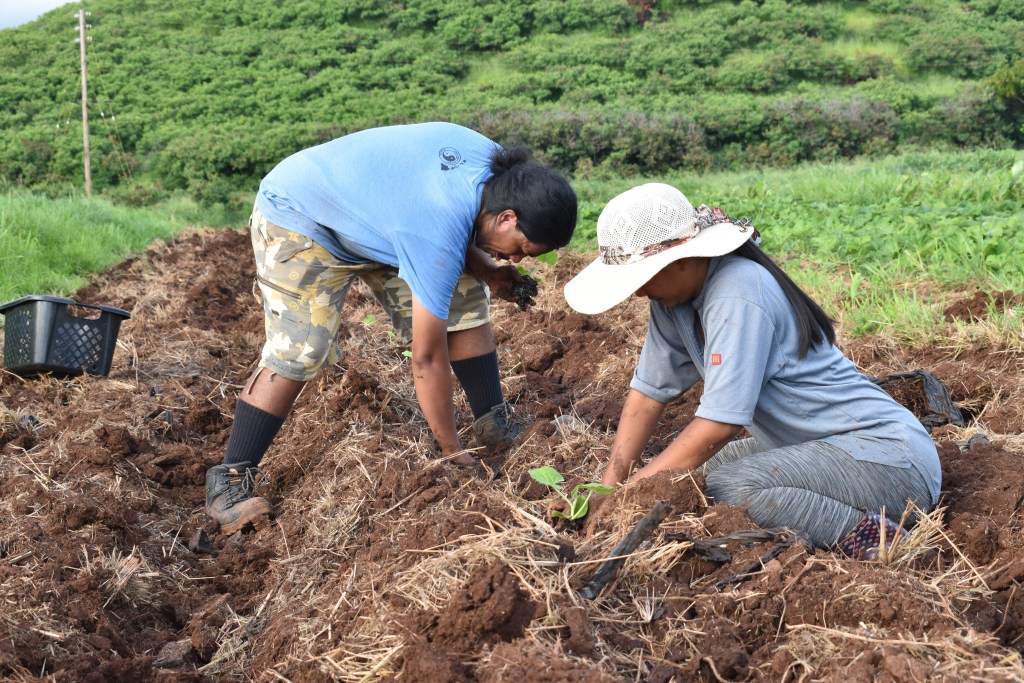
As the day starts to cool down on Kaua‘i’s West Side, Liesel Rudolfo and Jayce Foster carefully loosen the soil around young kalo stalks smaller than their palms before gently planting them.
It was the second roughly 400-foot-long row of taro they had planted over the last two months, joining their two rows of pala‘ai, or pumpkin.
Before February, the Kekaha couple didn’t know much about farming, but that’s slowly changing through their participation in a new beginner farmer program called Farm Learn Earn, run by ResiRoots Cafe. The small business produces kalo flour, kalo croutons and other products.
Nearly all the crops the participants grow are committed to the Hawai‘i ‘Ulu Cooperative, of which ResiRoots is a member and serves as its Kaua‘i processing partner. Some of the kalo may also go to ResiRoots for its own production.
Kaua‘i’s commercial farmer training program, GoFarm, recently closed its Kaua‘i Community College site, leaving the Farm Learn Earn program likely the only program of its kind on the island. The Farm Learn Earn program is also different in that its participants’ harvests are already committed to buyers, said Emilio Ruiz-Romero, a farmer and co-owner of ResiRoots Cafe.
“I have the space, and I believe that by having more farmers, it’s going to help to feed everybody,” he said.
West Kaua‘i’s agricultural lands have long been dominated by large-scale operations. Thousands of acres were in sugar production for 120 years. For the last couple of decades, the area’s agricultural lands were largely controlled by seed and genetically modified crop companies.
While Ruiz-Romero acknowledges the importance of having some large-scale farms to help feed the region, he said there’s also a need to support smaller farmers who can one day grow into using lands those operations no longer need or leave behind. Several thousand acres owned by the state Agribusiness Development Corp. are up for lease.
Intro To Commercial Farming
About 10 Kekaha and Waimea residents across six groups are participating in the Farm Learn Earn program. Some of them farm together or bring their partners or children to help. For many, it’s something they do outside of other jobs.
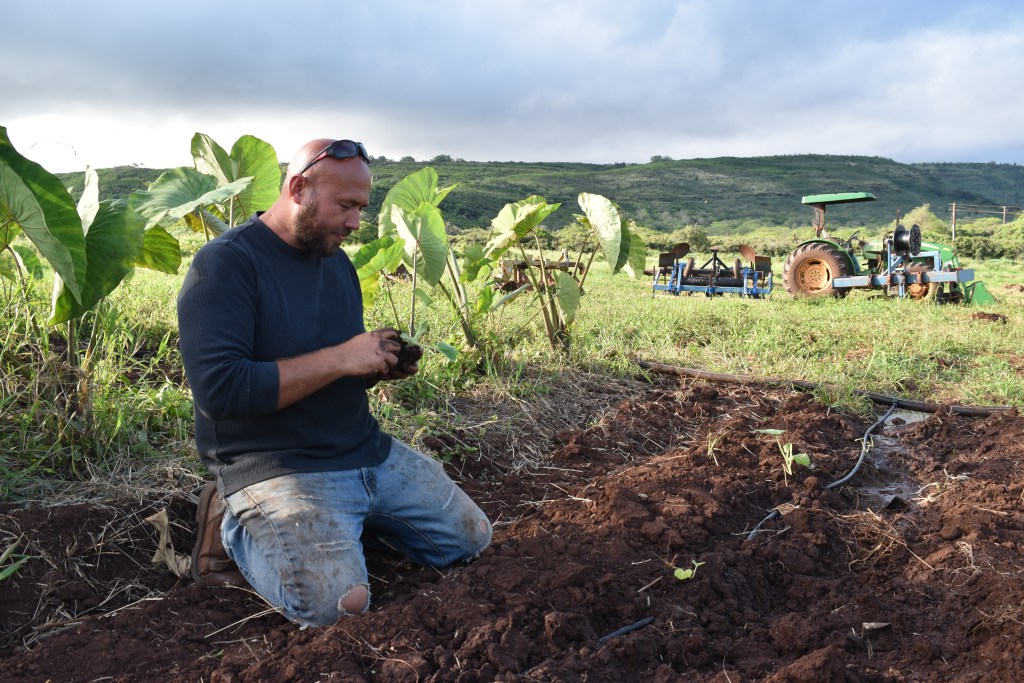
The first thing they learn is how to germinate pala‘ai seeds at home. Ruiz-Romero then prepares their rows, mowing away the weeds and using a tractor to disk the soil and lay drip tape for irrigation. He shows them how to plant their seedlings and how to connect and repair the drip tape.
Participants are responsible for continually weeding their rows, removing plastic left behind by companies that once occupied the fields and watering their crops. They also must adhere to a germination, planting and fertilization schedule set by Ruiz-Romero.
Each group has about 1.5 acres, and they’re expected to plant a row of pala‘ai and kalo each month so they’ll have regular income and so the co-op will have regular production. Pala‘ai grows quickly, in about 120 days, while kalo takes about 10 to 12 months.
Participants are expected to commit to the rows they grow, but if one decides they don’t want to return, their rows will be given to other participants or taken over by ResiRoots.
The land they’re using is part of roughly 20 acres in Kekaha that Ruiz-Romero subleases from Corteva, which sets aside that field to help incubate new and small farmers. He has been farming on that land since 2021.
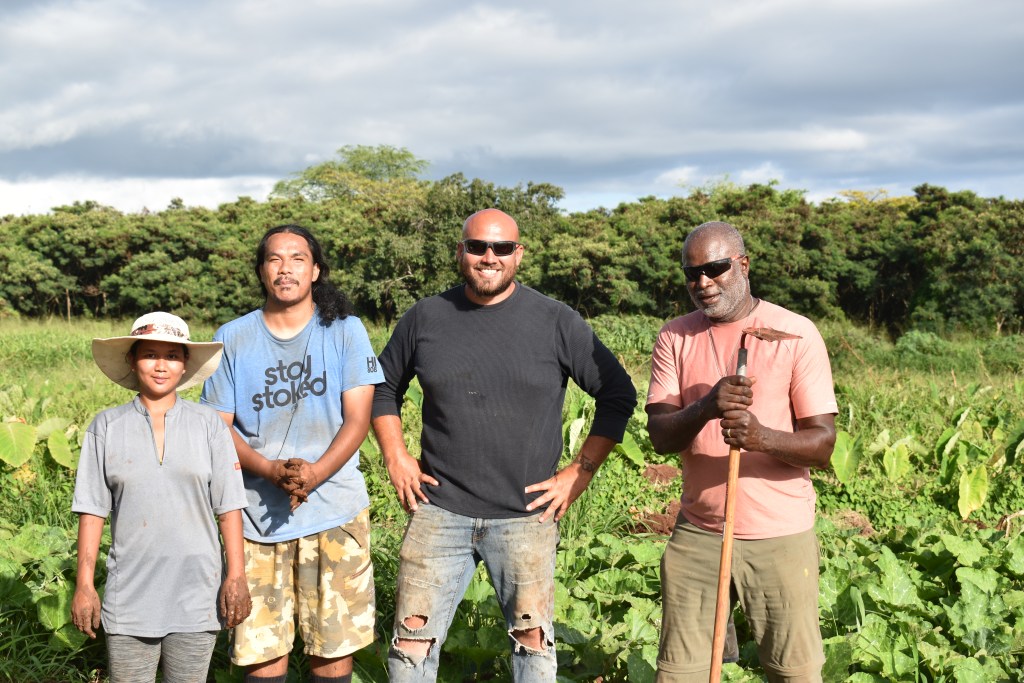
Rudolfo and Foster come out to the farm generally one day a week, spending anywhere from an hour to all day checking the water, fertilizing and weeding. Rudolfo said it’s been rewarding to see their crops’ progress and how the participants have formed a small community to help each other on the farm and elsewhere.
Wil Dargan, who works for the Pacific Missile Range Facility nearby in Mānā and does beekeeping, joined the program to make extra money but quickly fell in love with farming. He’s out in the field every day for an hour or two and said it’s been helpful to have someone show him what to do. He sees the program as a way to help Hawai‘i reduce its reliance on imported food.
In addition to his existing pala‘ai and kalo, Dargan is getting ready to plant watermelons, which he plans to give away to the West Side community over the summer.
“We’re looking for ways to bring people in, help out the community,” he said.
A Template For New Farmers
The program launched in February and stems from Ruiz-Romero’s need for more crops to process at the Hawai‘i ‘Ulu Cooperative’s Hanamā‘ulu processing center. The ‘ulu, or breadfruit, harvest season tends to peak between July and December. The co-op also processes pala‘ai, ‘uala (sweet potato) and kalo.
When Rudolfo and Foster approached Ruiz-Romero looking for work, he decided to instead create a program so they could learn to farm commercially and earn income from everything they grow, rather than simply working for him and taking a cut of his earnings.
“Another company would have said I’m going to pay people to come out here and pocket all that, but I don’t see it that way,” Ruiz-Romero said.
A 400-foot row of pala‘ai is expected to produce roughly 1,500 pounds. The co-op pays $1.15 for each pound, so participants are expected to earn around $1,700 for each row. Each row of kalo is expected to produce a similar yield.

The goal is that participants will understand farming practices, as well as how to generate consistent and predictable income from their harvests, Ruiz-Romero said.
“If you give a farmer a little plot of land and let them do whatever he wants, he might not be successful,” he said. “But if you guide him and you say you have to grow these and they understand the numbers, they understand the process, they can actually expand to figure it out themselves.”
Dana Shapiro, CEO of the Hawai‘i ‘Ulu Cooperative, which has roughly 200 members statewide, said she’s excited about the Farm Learn Earn program because it removes some of the risk of farming by linking participants with ready markets. That helps take the guesswork out of what new farmers should plant, where they’re going to sell their harvests and how much they charge.
“We’re kind of giving them a template that they can fit right into and, in that way, they can really focus on just learning how to be a farmer,” she said.
It’s different from GoFarm’s model, which encourages participants to grow diversified crops at small scales, said Ruiz-Romero. For now, participants will sell to the co-op under Ruiz-Romero’s membership, but he hopes that they’ll eventually get their own memberships and grow to have additional, direct buyers and, one day, their own ADC land licenses.
More Crops To Grow
The first pala‘ai harvests are still roughly two months away. In the meantime, some participants will soon be planting papaya and green bananas. Ruiz-Romero said the bananas will be for ResiRoot’s banana flour and other mixes.
The program also just received money to purchase a tent from the West Kaua‘i Rotary. That tent will be for the program’s nursery so seeds can be germinated on site instead of at participants’ homes.
Josh Uyehara, president of the Kekaha Agriculture Association, said this type of program is needed, especially with GoFarm closing its Kaua‘i site. The farmer’s cooperative is made up of ADC tenants and maintains the area’s agricultural infrastructure.
“We have to care about the whole pipeline for farmers,” he said.
As the sun dips lower, Ruiz-Romero looks over to Foster and Dargan working independently in their respective rows.
“They’re finding themselves in there,” he said, pointing out Jayce looking at his plant. “That moment right there, he’s learning something. He’s running some numbers through his head. Look at Wil right now, with irrigation, he’s doing it on his own.”
Civil Beat’s reporting on Kauaʻi is supported in part by a grant from the G. N. Wilcox Trust. “Hawai‘i Grown” is funded in part by grants from the Stupski Foundation, Ulupono Fund at the Hawai‘i Community Foundation and the Frost Family Foundation.

