

‘Culture Of Corruption’? Records Link Arrested Lawmaker To Lobbyist
We examined the legislative record of Hawaiʻi Rep. Ryan Yamane, suspected of bribery, and his ties to a well-connected lobbyist. Here’s what we found.
Rep. Ryan Yamane had paused the House’s floor session to recognize a notable organ donor advocate, Tobi Solidum.
A lobbyist, Solidum had been instrumental in pushing forward a state-funded program to manage chronic kidney disease. During a floor speech to support that bill — which also directed $300,000 to the National Kidney Foundation of Hawaii — Yamane wanted to commend “many of the unsung heroes” like Solidum “who never let this issue rest.”
Later that same session, 14 years ago, Solidum donated $500 to help reelect Yamane, who as chairman of the health committee was also integral in moving the bill forward. That donation brought the total level of Solidum’s support to $1,200 for that election cycle.
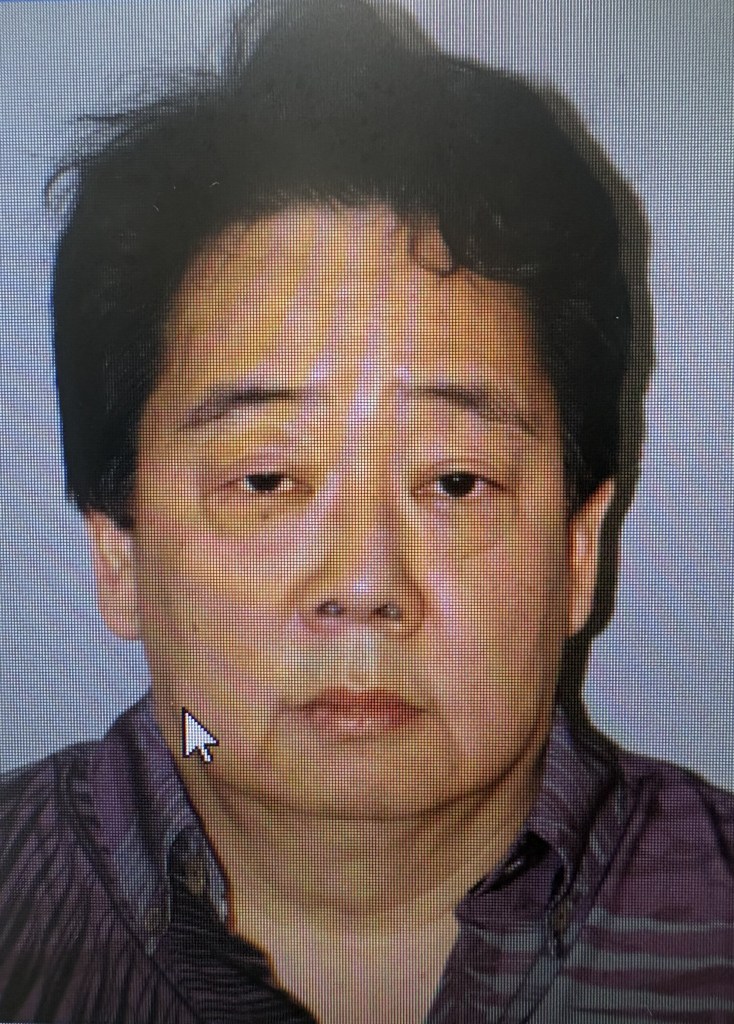
Now the two men are joined again as co-defendants. Prosecutors allege that Solidum paid Yamane in a series of cash and check installments between 2020 and 2022 to take official actions culminating in a scheme, prosecutors allege, to direct emergency funds to a pricey Covid-testing program run by the kidney foundation. Solidum made millions of dollars from the testing program, according to court documents.
A Civil Beat review of Yamane’s legislative record during that timeframe shows he moved dozens of measures as a committee chairman, a position that would have allowed him to easily influence the outcome of bills affecting Solidum and his clients.
Out on bail after his arrest on bribery charges and reached by phone Monday afternoon, Yamane declined to be interviewed for this story.
He is now the third member of the House to be accused of bribery in recent years. The others are Lt. Gov. Sylvia Luke, Yamane’s co-defendant who was a state representative in 2022; and former Rep. Ty Cullen, who turned on fellow lawmakers and reported them to federal authorities before pleading guilty to bribery charges four years ago.
Cullen and Yamane, along with former state lawmaker Henry Aquino, were once part of a faction that called themselves the Three Amigos, often introducing measures and voting together.
Former House members and staff who served alongside Yamane declined to be interviewed on Monday. One legislator only said “it’s a sad state of affairs,” before rushing off the phone.
In a written statement, House Speaker Nadine Nakamura called the indictments a serious matter.
“The public has waited a long time. The priority now is that this process be allowed to proceed fully and fairly, so that a clear and complete picture of the facts can emerge,” Nakamura said.
Nakamura didn’t address questions from Civil Beat regarding how the House would respond to the news that two of its former members have been charged with bribery related to actions they took as lawmakers or if there would be a review of Yamane’s votes as a legislator.
But prosecutors did not mince words. Yamane, they said, is the “most culpable individual” among the recent bribery case defendants.
‘Thanks For All Your Efforts’
As a committee chairman, Yamane had the power to single-handedly advance or halt legislation because of longstanding, unwritten rules in the Legislature that require rank-and-file lawmakers to go along with a chairman’s recommendations.
During the bribery era framed in the indictment, Solidum’s client, Liberty Dialysis, had been weighing in on measures in the Legislature to regulate the opening of new dialysis centers.
Early in the 2020 session, company representatives testified on a bill that would have given existing facilities like theirs the right of first refusal in areas where they were already operating. That bill was not introduced by Yamane nor did it move through his committee. It was eventually changed drastically to put the state health director in charge of screening passengers during the Covid pandemic. The bill died.
The following year brought a more direct connection between Solidum, Yamane and action the legislator took on a bill. That year, Yamane introduced House Bill 224, which would deregulate new dialysis centers and open the market.
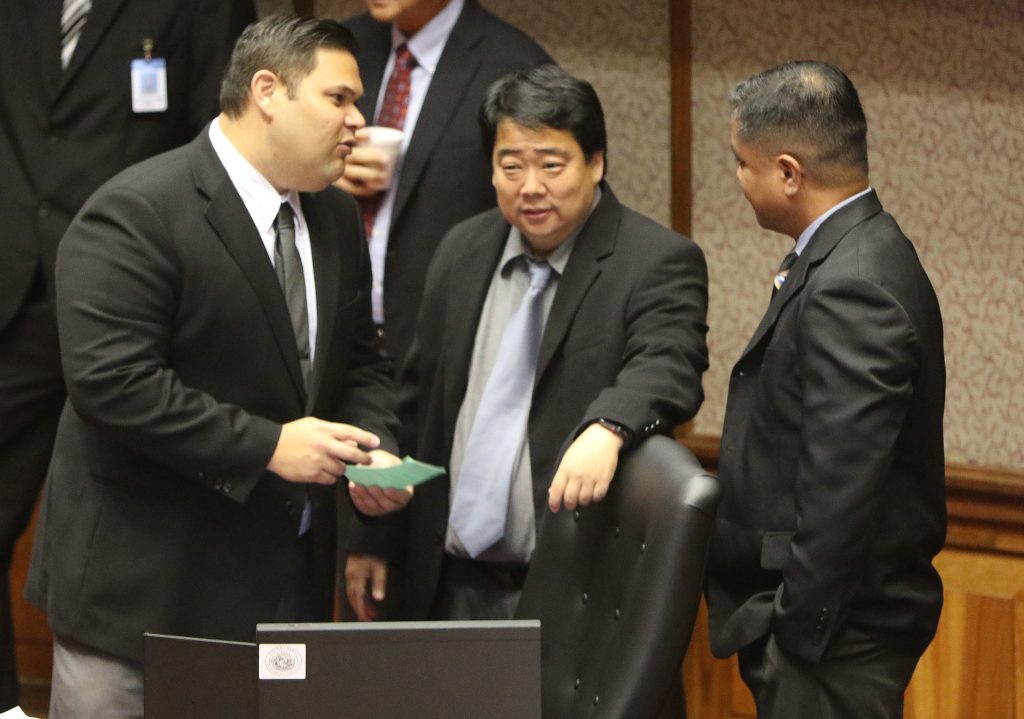
Liberty Dialysis opposed the bill, and recommended it either be killed or proceed without the section dealing with dialysis centers. It was during that session in mid-April that Solidum is accused of meeting with Yamane to give him money. At the time, Yamane was on the conference committee negotiating the bill with the Senate.
Lawmakers reached an agreement on the bill, but the House later “recommitted” it, a legislative maneuver to kill bills after they’ve already passed.
“As long as its dead we are ok,” Solidum texted Yamane, according to the indictment. “Thanks for all your efforts.”
During the 2022 session, Yamane’s last, he introduced an emergency appropriations measure that would fund the kidney center’s testing contracts and make Solidum millions of dollars. On Feb. 14, a day before his committee passed the bill, Yamane deposited $1,000 cash into his bank account.
Yamane landed in a bit of controversy over a bill to ban flavored vape products. He inserted amendments into a measure that year that advocates believed would lead to its demise.
Yamane had received $37,000 from the tobacco industry and lobbyists connected to it from 2007 to 2022.
Notably, in the last six months of 2021, Yamane received $4,750 in campaign donations from tobacco companies and local lobbyists who worked for them. On Nov. 9, 2021, his campaign deposited two checks, $2,000 from Juul labs and $1,000 from Altria.
During the session, he stuffed the vape-ban bill with testing requirements that advocates thought would be untenable and other measures that would make a ban difficult to enforce. The weakened bill passed the Legislature, only to be vetoed by Gov. David Ige.
The bill had veered from its original intent and would make enforcement by the state difficult, the governor wrote. More worrisome, the amendments inserted by Yamane and other lawmakers would actually benefit the tobacco industry and “would cede,” the governor wrote “without principled reason, the state’s authority to enact and enforce a flavor ban to protect Hawaiʻi’s youth from the scourge of vaping and nicotine addiction.”
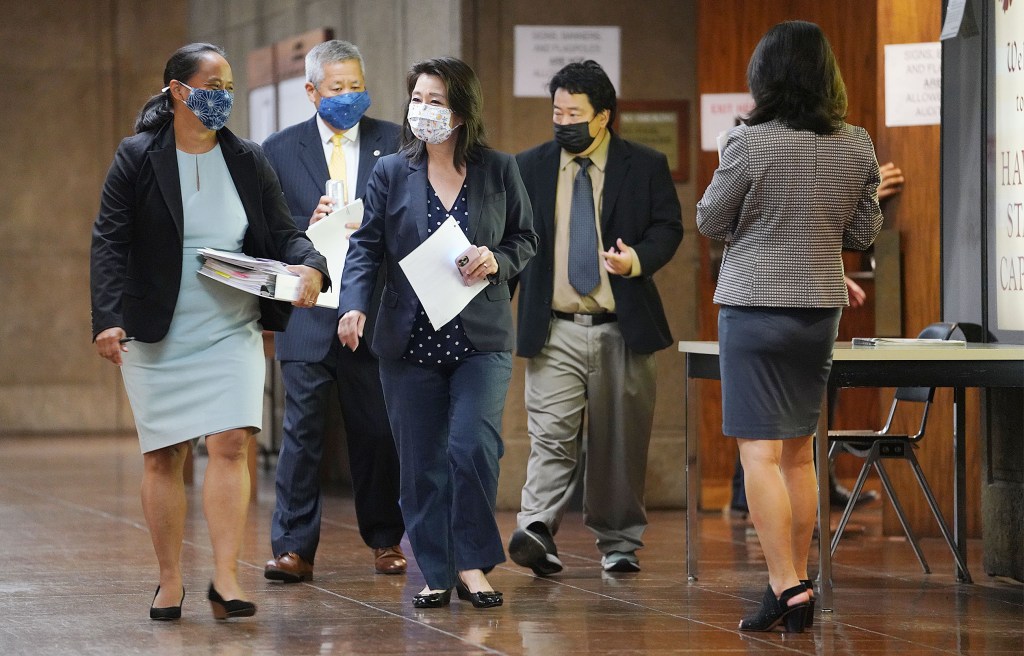
Yamane also had his hands on many other measures during the period described in the bribery indictment.
Between 2020 and 2022, 18 bills that he introduced became law, dealing with everything from healthcare funding and overhauls to the state health corporations system, to legalizing Native Hawaiian water-cremations.
Committees he chaired, first Water and Land and then the House Health and Human Services Committee that deals with homeless issues, also oversaw dozens of measures that became law.
In 2022 alone, the year prosecutors allege Yamane took action to benefit the kidney foundation, 43 measures that became law passed through his committee first. Those dealt with telehealth initiatives, residency programs at the University of Hawaiʻi’s medical school, state technology standards and funding for homeless programs.
One measure that passed through his committee that eventually became the law established the Office on Homelessness and Housing Solutions in the governor’s office. That office ran one of the governor’s signature projects – a tiny homes program Yamane would come to oversee as human services director. The kauhale project is now under intense scrutiny by the state auditor for potential fraud and abuse.
Reform Proposals Followed Last Bribery Case
So far, Nakamura’s measured response about what comes next in the Legislature contrasts with how her predecessor, Scott Saiki, responded when Cullen and former Sen. J. Kalani English were charged with bribery in 2022. The following day, Saiki started taking action.
The House and Senate went on to investigate their voting records for evidence of influence but found nothing remarkable. Saiki, however, convened a commission of good government advocates to come up with ideas to reform local politics and make government more transparent. That group came to be known as the Foley commission after the group’s chairman, retired Judge Dan Foley.
Foley said the recent indictments underscore the need for lawmakers to finally enact two of the group’s proposals from four years ago: eliminating money in politics by creating a fully-funded, publicly financed election system and banning campaign donations from government contractors. For more than 20 years, lawmakers have rejected bills to enact those changes.
“There’s a culture of corruption,” Foley said. “Having fundraisers – with the movers and shakers – everybody’s giving checks; going to dinners, putting checks on the table. If you take away all of that…then you change the culture.”
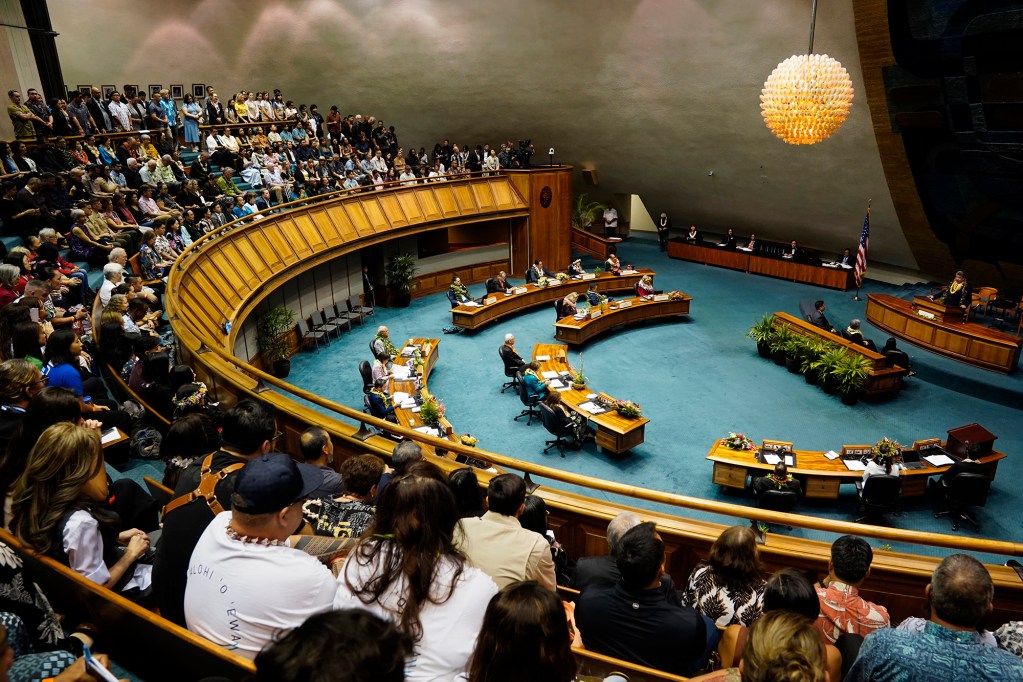
Banning such donations could have put an end to the transactions like those between Luke and Solidum, who along with his stepdaughter gave $10,000 in checks to the then-finance chair while discussing funding for a state contract over a dinner at Morton’s The Steakhouse in Ala Moana.
As it stands now, those meetings and donations appear to have been perfectly legal. Yet Foley said this case should push lawmakers to finally act and close the loophole on donations.
“Now is the time for them to really move,” Foley said. “If this won’t make them do it, you wonder if they ever will do it.”
Retired federal public defender Ali Silvert also hopes that this case will push lawmakers to finally act on reform measures that have been languishing for years.
He’s also skeptical that the charges against Luke will stick.
“The weakest part of the indictment is the allegations against Sylvia,” Silvert said. Taking a dinner with a donor who has a contract where funding is drying up “is what legislators do. If they see a problem, they meet with people to solve the problem.”
Five days after the dinner at Morton’s, Luke met with health officials to ask them about their ability to pay for the Covid testing program. But Silvert said it could still be hard to prove beyond a reasonable doubt that Luke was bribed with campaign donations or the promise of donations.
One point of weakness in the indictment, Silvert points out, comes when Luke is quoted at the dinner as saying “no thank you” when Solidum offers to come up with $70,000 for her bid to become lieutenant governor. How she said it matters, but on paper it reads as if she is declining his offer.
It’s unclear whether that money ever materialized or, if it did, whether it was done through bundling numerous smaller contributions, or other legal means.
On the other hand, the case against Yamane is much stronger because of the paper trail Yamane and Solidum left behind. Prosecutors allege that Solidum openly texted Yamane about going to the bank and dropping off cash and checks with other people and in other locations for Yamane to collect.
Read excerpts from the indictment below:
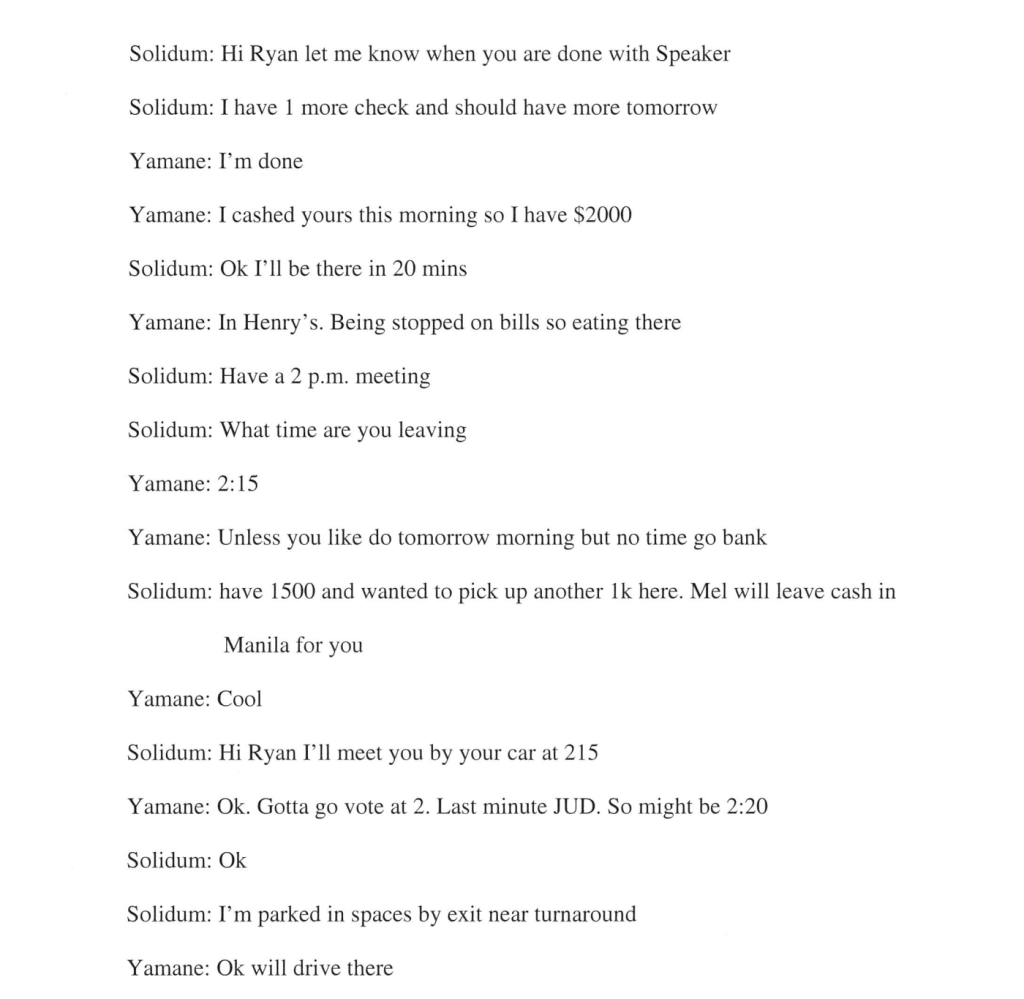
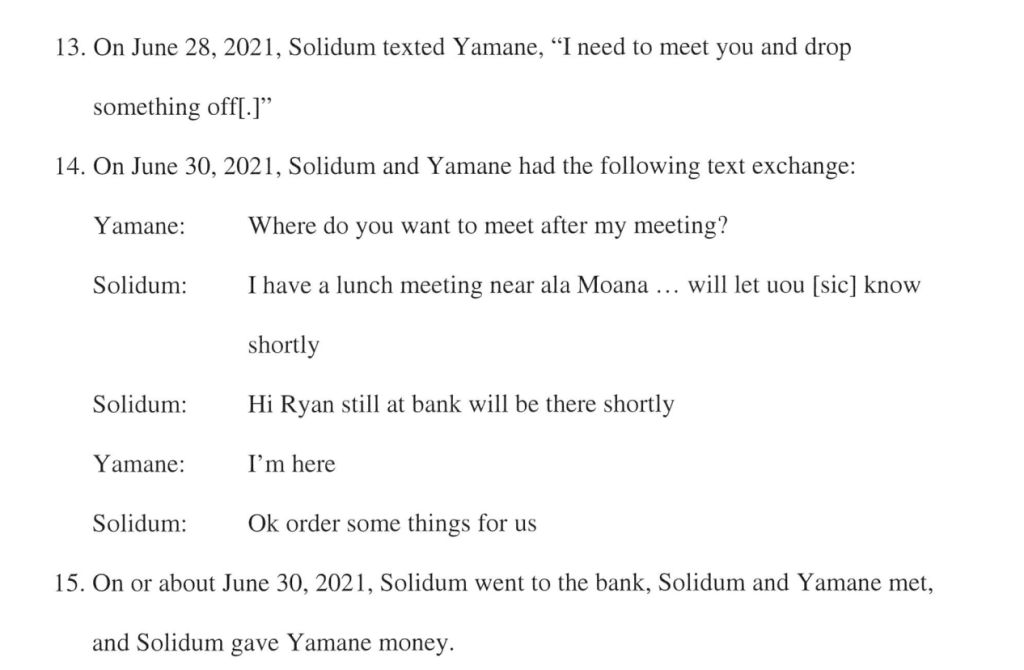
In 2020, Yamane and Solidum tried to arrange a meeting around lunch and hearings that Yamane had to attend. In other instances in 2021, they talk about meeting near Ala Moana, and several months later, Solidum discussed paying for an event that Yamane hosted.
The amounts allegedly given varied from $1,000 to $2,000. Those weren’t campaign donations; Solidum’s last reported donation to Yamane was back in 2015.
“These legislators are cheap,” Foley said. “It’s risking their livelihoods for a few thousand dollars that I find most incomprehensible.”
The indictment notes three cash deposits Yamane made totaling about $4,500, which allegedly came from Solidum. Cullen also admitted to taking a relatively low sum of $23,000 from Milton Choy over the years. Choy was central to a federal bribery investigation that led to the state charges against Luke, Yamane and others.
However, Cullen was still paying off loans, and mentioned as much to Choy, giving him a motive to take extra cash-for-favors.
“These legislators are cheap. It’s risking their livelihoods for a few thousand dollars that I find most incomprehensible.”
Dan Foley, retired judge
Yamane had no significant debts, according to his recent financial disclosures. During his final years as a lawmaker, he and his wife reported less than $10,000 in debt that has since been paid, according to his disclosure from this year. Property records show they paid off their mortgage in 2018.
In 2020, Yamane also recorded income from a property he jointly owned with others, which sold in 2019 for $998,000.
For his last three sessions in the Legislature, Yamane recorded no outside income or for-profit business interest except for in 2021, when he reported earning less than $1,000 from Hawaiʻi Pacific Health. He is currently the sole manager of R. Yamane LLC, his consulting company, which is not in good standing with the state and had a reported value of $0, according to his financial disclosure.
On Friday, Yamane, 56, turned himself in to state sheriffs just before 6 p.m. at a state Department of Law Enforcement facility in Kakaʻako. He wore a purple shirt and grey pants, according to an arrest report.
He was released after posting a $150,000 bail bond. He faces two bribery-related charges, each punishable by up to 10 years in prison.
The other suspects, including Luke, her former campaign treasurer Leo Asuncion and state airport administrator Ford Fuchigami also turned themselves in on Friday. Solidum’s whereabouts remain a mystery although he is thought to be in the Philippines.

