

Hawaiʻi Lawmakers Demand Special Session Following Bribery Indictments
The legislation would close a government contractor political contribution loophole.
Just hours after four defendants pleaded not guilty to bribery and other charges, a coalition of Hawaiʻi House of Representatives members and community groups are calling for the Legislature to act.
They want a special session to be held before the general election in November to immediately pass legislation that would prohibit government contractors from making campaign donations.
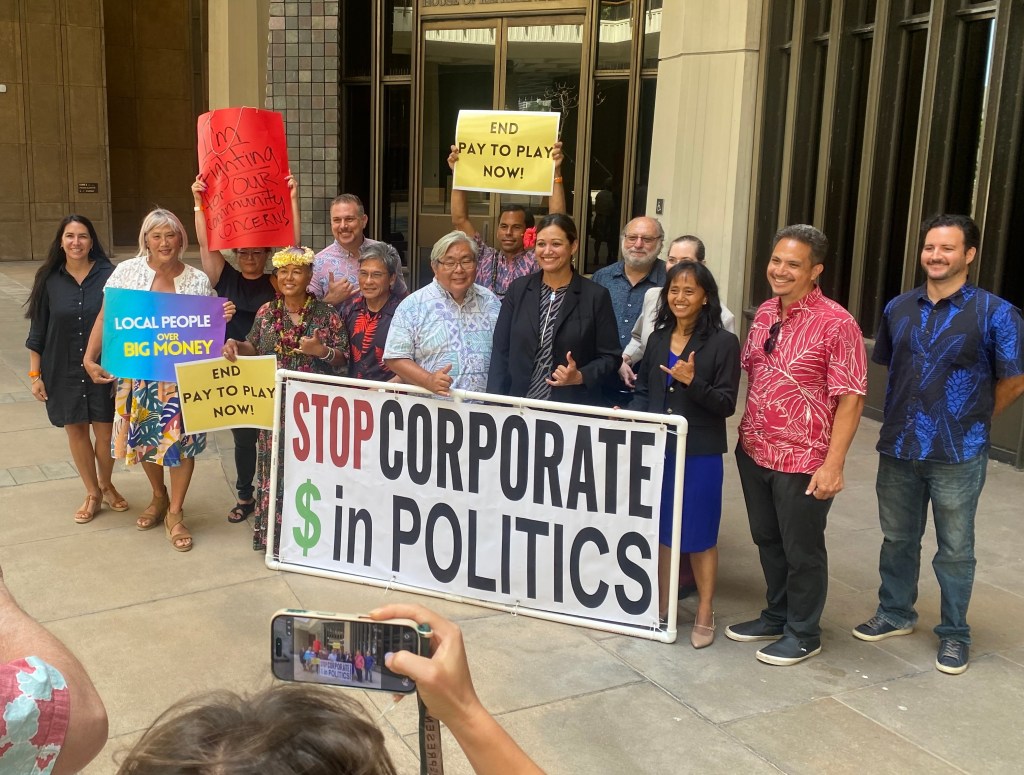
Rep. Kanani Souza, the co-convener of the Good Government Caucus, said at a press conference Thursday at the Capitol Rotunda that the bill would be “narrowly tailored.”
“We were close to having this passed this past legislative session, and we know that with a very short stint of a special session, we will be able to accomplish this task of passing this and closing that government contractor loophole, so that incidents such as what we’re currently seeing with the current indictments and those alleged facts, we can combat that before it gets worse.”
Souza was referring to a major corruption scandal that has ensnared the lieutenant governor, a former Cabinet member, another member of the Green administration and a former state agency chair. It involves a government contractor who allegedly bribed public officials in order to influence legislation.
“The community is calling on us to take action,” said Souza, a Republican. “They want to see leadership. They want to see people speaking up on this issue, and they want to know what can we do that’s tactile, that’s tangible, that we can complete in a very short duration, and that can be done now.”
It’s unclear what form the proposed legislation would take. This past session, House Bill 1519 and Senate Bill 2530 attempted to curb pay-to-play politics by banning campaign contributions from state contractors and nonprofits that get money from the state, including executives and family members of the companies and groups.
The House version would only have applied to the executive branch. The Senate version, which was backed by the Hawaiʻi Campaign Spending Commission, was gutted and replaced with language from the House bill. It did not get heard during conference committee at the end of session because the Senate did not appoint negotiators.
But Souza’s co-convener, Rep. Della Au Belatti, a Democrat, suggested that the Legislature could build off the existing legislation. She said session could last just a few days and it would be done with the current Legislature in either August, September or October.
Belatti, who is running for lieutenant governor in the Aug. 8 primary, said a bill had to be done now rather than waiting for the next session that begins in January.
“This is critically important because, as seasoned candidates, we know it’s the day after the general election when campaigning begins and fundraising begins for the next season,” she said, adding, “This is something that can be done. We just need the political will and the political leadership to call ourselves into special session.”
A special session can be called either by a two-thirds majority of lawmakers of both the House and Senate or by the governor. Senate and House leadership did not respond to questions about a possible special session on Thursday.
In a text message, Makana McClellan, the communications director for Gov. Josh Green, said, “At this time, no specific legislative proposal has been presented that would warrant a special session.”
Souza and Belatti were joined by Reps. Ikaika Hussey, Kim Coco Iwamoto, Terez Amato, Garner Shimizu, Joe Gedeon and Elle Cochran. Also on hand were retired federal public defender Alexander Silvert and a dozen other supporters.
It is rare for the Legislature to go into special session for a single purpose, but it has done so before, including to pass same-sex marriage legislation and to allow the now defunct Hawaiʻi Superferry to operate.
Aria Juliet Castillo, a member of the Hawaiʻi Alliance for Progressive Action and Clean Elections Coalition, said the principle behind passing a bill is simple.
“When you have business before the government decision makers, you shouldn’t be financing their elections,” she said.
Castillo said Hawaiʻi enacted landmark legislation 20 years ago prohibiting government contractors from making campaign contributions. But the lawmakers left a massive loophole.
“While contracting companies were prohibited to give to their owners, owners, executives, officers, and immediate family members remain free to contribute,” she said. “For the past two decades, that loophole has allowed pay-to-play politics to continue.”
“Today, campaign finance disclosures cannot tell us how much campaign money comes from government contractors and those affiliated with them,” she said. “Hawaiʻi’s reporting laws do not fully disclose these relationships, making it impossible to determine the true extent of this contract of affiliated political giving.”
Evan Weber of Our Hawaiʻi and the Clean Elections Coalition called the need for a special session urgent and timely. It won’t end money in politics nor fix the deeper culture of corruption, he said, but it would represent a major step forward in reforming local governance.
“What could be more important?” he said at the press conference. “What could be a better thing to do to regain the trust of the public to make us all know that this whole process that we go through every two years actually matters, actually means something, than to show them that you are responsive?”

