Lt. Gov.’s Books Were A Mess. Political Insiders Say It’s Not The Norm
It’s now up to the AG to decide whether to prosecute Sylvia Luke and some of her campaign staffers for alleged campaign finance violations.
A $6,000 donation from an alcoholic beverage wholesaler. A $4,500 payment to a local catering company. Tens of thousands paid to her own campaign staff.
These are just some examples of expenditures that, for years, went unmentioned in Lt. Gov. Sylvia Luke’s campaign finance disclosures.
After her campaign attracted scrutiny in connection with an FBI bribery investigation, the state’s campaign spending commission put a spotlight on those unreported donations and expenditures and other alleged violations.
Whether they were innocent errors or actions taken with criminal intent is now up to Attorney General Anne Lopez to decide.
The omissions and errors have stunned some political observers who, for years, watched Luke manage the state budget as House Finance chair and chastise those she felt were not on top of their agency’s finances. Her reputation as a state representative stands in contrast with what she’s accused of now: failing to report more than $50,000 in expenditures; reporting more than $30,000 in contributions late, sometimes years after they were received; and allowing unauthorized campaign staffers to sign off on checks. According to campaign finance law, only treasurers and deputy treasurers can sign checks.
In interviews with Civil Beat, several individuals who have worked on Hawaiʻi political campaigns said Luke’s alleged error rate was unacceptable.
“That’s a big, statewide race, and it just seems like there was some, for lack of a better word, sloppiness,” said Will Espero, a former state representative, who most recently represented parts of central Oʻahu the Senate until 2018.
“It’s balancing your checkbook, and if they weren’t doing it properly, or whatever the case may be, then of course, that’s why we have these government agencies overseeing the candidates and their campaigns, and making sure everything is done right.”
Others, though, say these kinds of errors can happen in campaigns.
Former state Rep. Sonny Ganaden, an attorney who represented Kalihi and surrounding areas between 2020 and 2024, said some of the allegations don’t sound serious to him. Having someone other than the designated treasurer sign checks could be understandable, especially when running a statewide campaign across islands.
The Campaign Spending Commission also noted Luke’s campaign filed 55 amended reports to fix omissions and discrepancies in previously-filed reports. The amendments were, in many cases, made four years after the original reports were filed.
But amending previous errors, Ganaden said, shows the campaign was trying to do the right thing.
“That should be applauded,” he said.
In the last decade, only four other political candidates have been prosecuted for campaign finance violations at the state level.
Ultimately, Ganaden said, the allegations are from years ago and the focus should be on the current race for lieutenant governor. Luke has been on unpaid leave since April when she acknowledged that she is the target of a bribery investigation by the AG’s Office. Eleven candidates are now running to replace her.
“You’re talking about Sylvia Luke, who I think was an excellent public servant for decades,” Ganaden said. “And continuing to interrogate her when there’s a race going on, I think, is a waste of time.”
Luke and her attorney, David Louie, did not respond to requests for comment for this story.
Toni Schwartz, spokeswoman for the Attorney General’s Office, said in a statement the AG’s Office had received the referral from the Campaign Spending Commission.
‘Not Minor Technical Errors’
After campaigns register with the Campaign Spending Commission, they must file an organizational report designating who the candidate is, selecting the bank the campaign will use and naming the chairperson, treasurers and deputies.
Campaigns must file reports that disclose a checklist of totals for each reporting period: how much cash the campaign had on hand at the beginning of the reporting period plus all contributions, loans, expenditures, contributions the candidates make to themselves, and assets purchased for the campaign, such as cellphones, laptops and printers.
Lengths of reporting periods vary depending on a number of factors, including when a candidate filed nomination papers. The commission lists all reporting deadlines for each race on its website.
The reports have to be detailed. For example, for contributions, reports must contain the amount and date of each deposit along with the name and address of any contributor who donated more than $100 during an election period. For contributors who donate $1,000 or more during an election period, the reports must also contain their occupation and employer.
Similar levels of detail are required for expenditures. Each expense must include the name and address of each payee as well as the amount, date and purpose of the expenditure.
In these endeavors, Luke’s campaign apparently left out a lot of information.
The complaint against Luke and her campaign, Friends of Sylvia Luke, which was filed with the Campaign Spending Commission in May, accuses her and her campaign of eight counts of filing false reports and four counts of unauthorized handling of campaign funds.
During the reporting period between July 1, 2021, and Dec. 31, 2022, the campaign failed to report more than $50,000 in expenditures. People who were not designated as treasurers for the campaign signed off on more than 230 checks. That includes Emmanuel Zibakalam, who paid himself $33,000 in 11 installments for “contract, employee & professional services.”
In the years since the reporting period closed, the campaign filed 55 amended reports noting more than $32,000 in late-reported contributions. In one amended report filed Feb. 7, 2026, the campaign noted a $6,000 previously-unreported contribution from a donor named Brant Tanaka. Another amended report filed in April 2026, included a previously-unreported $6,000 donation from Young’s Market Company.
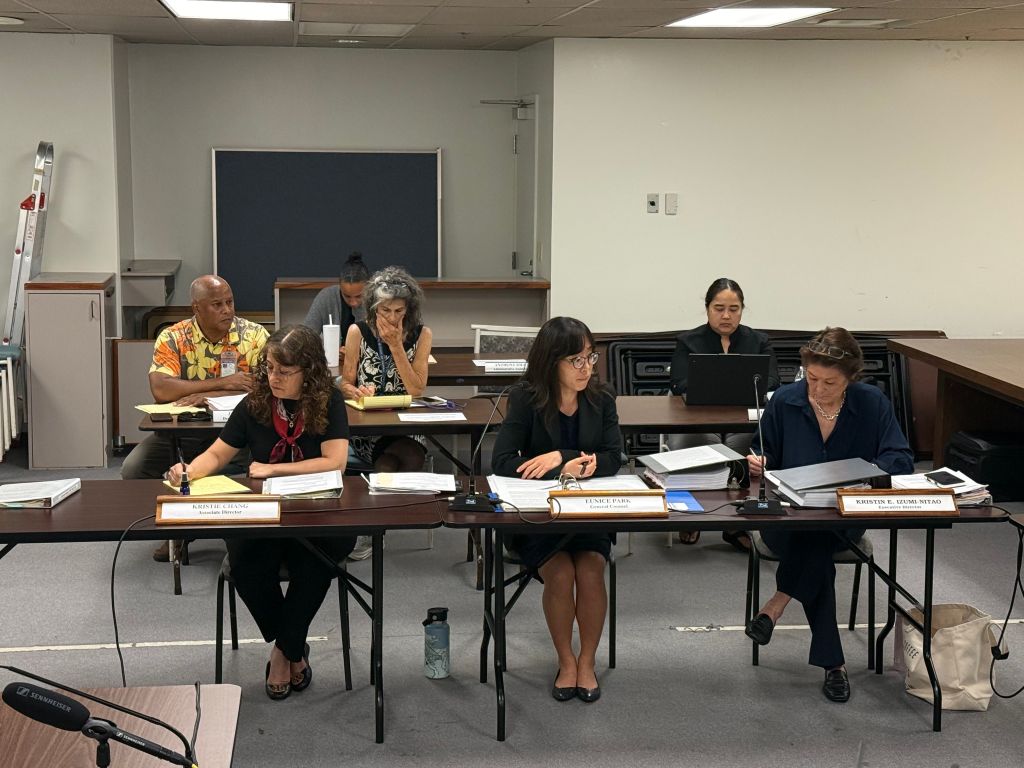
Eunice Park, general counsel for the Hawaiʻi Campaign Spending Commission, said during Wednesday’s meeting that when looked at as a whole, the alleged violations are serious.
“These are not minor technical errors,” she said during the meeting. “They occurred in a campaign for lieutenant governor run by a candidate who was then the House finance chair and who had more than 24 years of legislative and political campaign experience”
The Hawaiʻi Campaign Spending Commission last week voted to refer Luke’s campaign finance violations to the attorney general at a time when her campaign is already under intense scrutiny.
The AG’s Office is investigating Luke as part of its probe into an unidentified lawmaker accused of accepting $35,000 in a paper bag in 2022. The transaction, revealed by Civil Beat, was recorded by former state Rep. Ty Cullen, who at the time was working as an FBI informant. He later pleaded guilty to bribery and was sentenced to two years in federal prison.
Luke later revealed that she accepted two $5,000 checks from lobbyist and businessman Tobi Solidum and his stepdaughter during a dinner in January 2022 that was also attended by Cullen. She didn’t report receiving those checks until Civil Beat asked about them.
Luke has repeatedly denied ever accepting $35,000, which would be too large to be a legal campaign contribution or gift from an individual.
Down To The Smallest Donation
Diligently tracking a campaign’s finances is important in any race, even down to the smallest donation, said former Gov. Neil Abercrombie, who first ran for elected office in the 1970s to represent Mānoa and Maikiki in the state House.
He recalled one day driving a friend to the Honolulu airport in what was then his infamous yellow Checker taxi cab that had his name and picture emblazoned on the side. After his friend got out of the car, a pair of tourists from Alaska with backpacks and duffel bags came running up to the cab, hurriedly asking for a ride to the inter-island terminal. They were about to miss their flight to Molokaʻi, they said.

He tried to explain he wasn’t really a taxi driver. Anyway, he told them, the inter-island terminal was just a few minutes walk away. But they were desperate for a ride, he said, so he let them hop in and drove about 15 seconds before dropping them at their terminal.
After they exited the car, the man leaned back into the window of the cab to give Abercrombie a $10 bill. Abercrombie said he didn’t want to accept it, but the man left it on the passenger seat and walked away.
Abercrombie said he drove to his campaign’s makeshift headquarters in a toolshed in Mānoa where he was working with a team of university student volunteers. He handed the bill to his treasurer.
“I gave him the $10 bill and said, ‘Anonymous donation from Alaska,’” he said.
Abercrombie won that race in 1974 and went on to run in dozens more races, serving on the Honolulu City Council, in the U.S. House of Representatives and as governor from 2010 to 2014. Reporting requirements for campaigns have changed significantly over the decades, he said.
But through all the changes, Abercrombie said, he stayed on top of his campaign’s finances. As his races got bigger, he said he always had paid accountants to help handle bookkeeping.
“What has been common to all the campaign spending commissions over the last 50 years,” he said,“ is they had rules with regard to contributions and spending, which had to be obeyed, right? And all of which were crystal clear.”
Campaign Finance Violations Rarely Prosecuted
Since 2015, only four political candidates have been prosecuted for campaign finance violations at the state level.
Former Attorney General Doug Chin prosecuted three — former Reps. Richard Fale, Angus Mckelvey and Jimmy Tokioka.
Fale, who represented District 47, which encompasses parts of the North Shore from 2012 to 2014, was accused of failing to file a complete and accurate candidate committee report. He pleaded no contest in 2016 and was fined $1,000.
Tokioka, who represented parts of east Kauaʻi from 2006 to 2022, was charged for not reporting money raised during a fundraiser. He pleaded no contest in 2015 and paid a $1,000 fine.
McKelvey, who served as a representative for parts of Maui from 2006 to 2022, faced charges for not reporting all of his campaign contributions and allowing a relative who was not one of his campaign officers access to campaign funds. He currently serves as a senator for Maui’s District 6. He pleaded no contest to the charges in 2016 and paid a $2,000 fine.
All were misdemeanors.
The only other candidate to face charges after a referral from the campaign spending commission since 2015 was former Rep. Kaniela Ing, who represented South Maui from 2012 to 2018.
In 2022, the Campaign Spending Commission referred a complaint about Ing to the Honolulu prosecutor’s office, but Prosecuting Attorney Steve Alm declined to pursue most of the charges. He ultimately charged Ing with missing a deadline for filing a campaign spending report, a misdemeanor. Ing pleaded no contest in 2023.
Ing was also fined by the commission twice for dozens of violations. He paid $20,000 for misfiled reports and another $18,000 for failing to make records available to the commission and falsifying more than two dozen campaign finance reports.
Ing did not respond to calls and texts seeking comment.
Chin said that, having run for elected office himself, he understands the immense pressure candidates are under to fundraise. He ran for U.S. Congress in Hawaiʻi’s 1st Congressional District in 2018 and lost to Ed Case.
“I didn’t enjoy the experience because that pressure really permeates through a lot of what you’re doing, and all the good and sincere things you’re trying to do,” he said.
But because money is such a big part of political races, it’s important to ensure you’re following every aspect of campaign finance law, he said. Part of this, he said, is making sure you have strong campaign staff who know they’re going to be held to a high level of integrity.
“If you are upfront about the money that you’re raising and who you’re getting it from,” he said, “then that helps you avoid those even harder accusations or even more severe accusations down the road.”