Luke Campaign Violations Referred To AG For Possible Prosecution
The attorney general has already been investigating Lt. Gov. Sylvia Luke’s campaign donations.
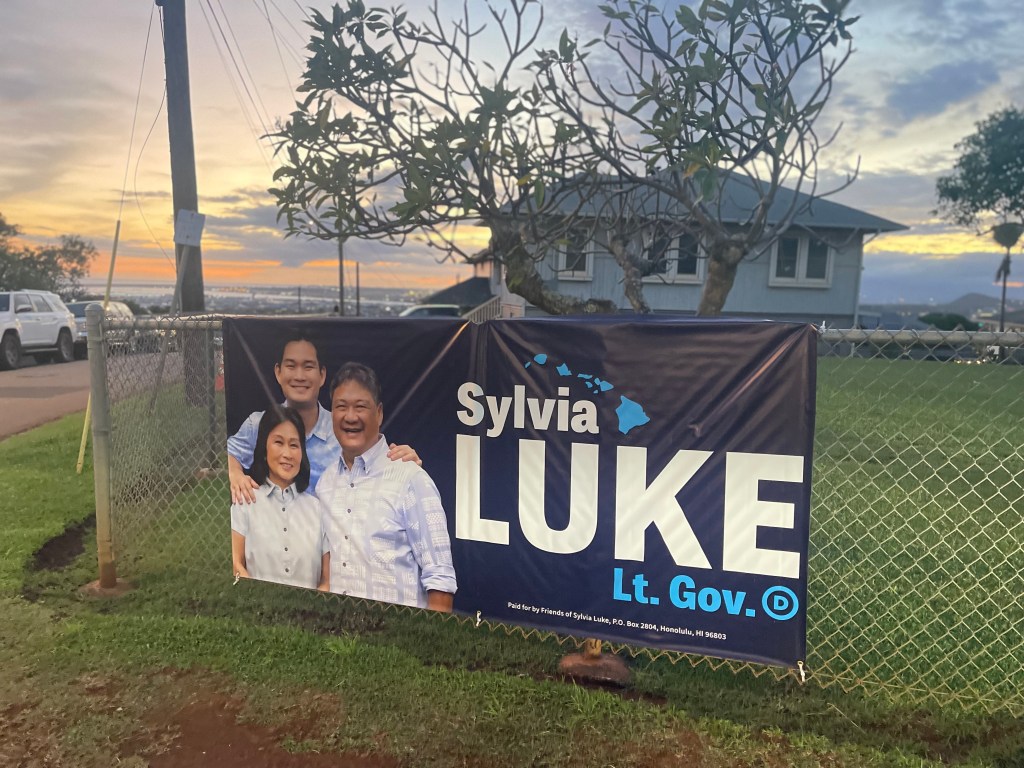
The Hawaiʻi Campaign Spending Commission on Wednesday voted to refer a set of alleged campaign finance violations by Lt. Gov. Sylvia Luke’s campaign to the Attorney General’s Office for possible prosecution.
The commission’s executive director, Kristin Izumi-Nitao, filed the complaint with the commission in May accusing the campaign, Friends of Sylvia Luke, of mishandling funds in 2021 and 2022. It alleges eight counts of filing false reports and four counts of unauthorized handling of campaign funds.
Luke has been on unpaid leave since April after becoming the target of a bribery investigation by the Attorney General’s Office. Also named in the complaint are Michael Luke, Emmanuel Zibakalam, Leo Asuncion, Kalowena Komeiji and Matt Sasaki, who were all identified as Luke campaign treasurers or deputy treasurers.
David Louie, a former Hawai‘i attorney general who is representing Luke and Friends of Sylvia Luke, told the commission he had no comment.
“At this time, I take no position, and I have no further comment,” he said.
Michael Luke is the lieutenant governor’s husband. Zibakalam is a lobbyist with Pacific Business Advocates and was previously Luke’s campaign manager. Komeiji has hosted fundraisers for Luke. Sasaki is listed online as an executive at a subsidiary of Hawaii Pacific Health. Asuncion is the former chair of the Hawai‘i Public Utilities Commission and received a target letter in the ongoing AG investigation.
Randall Hironaka, who is representing Michael Luke, Komeiji and Sasaki, asked for his clients to be dismissed because the complaint doesn’t allege any criminal conduct on their part. But the commission’s attorney, Eunice Park, said that it should be up to the AG’s office to determine who is individually liable.
Attorneys for Zibakalam and Asuncion did not respond to calls and emails seeking comment.
The commission met in executive session twice on Wednesday before voting unanimously in favor of referring the complaint to the AG’s office.
“This commission’s mission is to maintain the integrity and transparency of the campaign finance process, and to enforce campaign finance laws.”
Eunice Park, attorney for the Hawai‘i Campaign Spending Commission
Park said, when looked at as a whole, the violations alleged in the complaint could not be viewed as “minor, technical errors.” Luke, who was running for lieutenant governor at the time, was chair of the House Finance Committee and had more than two decades of legislative and political campaign experience.
“That candidate went on to win the race and had ample opportunity to correct these violations,” Park said. “This commission’s mission is to maintain the integrity and transparency of the campaign finance process, and to enforce campaign finance laws.”
As an alternative, the complaint also asked the commission to find probable cause that state campaign finance laws were violated and assess a fine of $28,300. But the commission declined to assess a fine.
AG Probe Ongoing
Attorney General Anne Lopez opened a probe in January into $35,000 that was given in a paper bag to an unidentified “influential state legislator” in 2022. The transaction, revealed by Civil Beat, was recorded by former state Rep. Ty Cullen, who at the time was working as an FBI informant. He later pleaded guilty to bribery and was sentenced to two years in federal prison.

Luke became embroiled in the scandal after she revealed in February that she accepted two $5,000 checks from lobbyist and businessman Tobi Solidum and his stepdaughter during a dinner in January 2022. The dinner was also attended by Cullen.
Luke issued refunds of the donations in March 2022 after Cullen was charged with bribery. But she did not report the contributions themselves until Civil Beat inquired about it this year. Luke said the $5,000 check she returned to Solidum’s stepdaughter, Kristen Pae, was never cashed, something she said her campaign noticed only after Civil Beat asked about it. In lieu of the refund, she said she issued a $5,000 check to the Hawaiʻi Campaign Spending Commission.
The Campaign Spending Commission launched a review of Luke’s books after the $10,000 omission came to light.
The lieutenant governor has repeatedly denied ever accepting $35,000 from anyone. The amount is too large to be a legal campaign contribution or gift from an individual. However, she has floated the possibility that federal investigators believed she was the influential lawmaker who supposedly took that money. She has declined multiple requests to explain why they would suspect her.
Evidence suggests Solidum may be the individual suspected of giving the $35,000. Civil Beat has been unable to reach him for comment, and he may now be living in the Philippines.
Intent Is In Question
Ali Silvert, a retired federal public defender who petitioned lawmakers earlier this year to investigate the $35,000 transaction, said the AG’s office is probably already investigating the underlying allegations in the complaint. But he said the referral from the Campaign Spending Commission adds weight.
“It’s something the AG’s office has to take seriously,” he said, “and fully consider.”

To refer the complaint for possible prosecution, commissioners had to determine there was probable cause that Luke and members of her campaign acted recklessly, knowingly or intentionally to violate campaign finance law.
Recklessly violating the law qualifies as a misdemeanor, while knowingly or intentionally violating the law can be a class C felony, according to state law.
The commission investigated Luke’s campaign spending over the course of the reporting period from July 1, 2021 to Dec. 31, 2022.
Her campaign has since filed 55 amended reports to disclose previously unreported expenditures.
The complaint alleges three counts of unauthorized handling of campaign funds, eight counts of false reporting and one count of unauthorized campaign expenditures.
According to the complaint, Luke signed off on 14 checks expending funds from her campaign account, even though she was never listed as a treasurer or deputy treasurer on the campaign. Under campaign finance law, only treasurers and deputy treasurers can authorize payments from a campaign account.
Zibakalam also signed off on 216 checks, including 11 payments of $3,000 to himself, between Nov. 6, 2021, and Nov. 9, 2022. He was not listed as treasurer or deputy treasurer during that time period.
Luke released an audit in March showing that her campaign failed to report more than $7,800 in donations between Jan. 1, 2021 to June 30, 2022. The audit did not include the two, $5,000 checks Luke received from Solidum and his stepdaughter and later returned.
Silvert said he thinks the sheer number of violations laid out in the complaint, as well as the time span they covered, led commissioners to see the actions as potentially criminal.
“The individual charges are not that significant,” he said. “It’s the overall time frame and the overall span and number of violations that makes it noteworthy.”
Whether or not there was criminal intent behind any of the violations is now up to the AG’s office to determine, he said. The purview of the Campaign Spending Commission is to enforce campaign finance regulations, Silvert said, and ensure that candidates are running their campaigns above board.
“While this complaint doesn’t specifically deal with corruption,” he said, “these rules and regulations that are in place are meant to prevent the issue of corruption coming into play in a campaign.”