

5 Takeaways From Our Investigation Of Methamphetamine In Hawaiʻi
A Civil Beat series starting today examines the people caught up in Hawaiʻi’s most severe drug problem, how it started and what’s being done about it.
Civil Beat spent nearly a year looking into Hawaiʻi’s persistent problem with methamphetamine, a drug that kills far more people than opioids on the islands. The number of meth overdoses has shot up dramatically in recent years, and the victims are often longtime users who suffer damage to their hearts and other organs.
What 100 Autopsies Reveal About Victims
Experts on the mainland say that polysubstance use — mixing meth with opioids, primarily fentanyl — has become far more common. That’s true among younger victims in Civil Beat’s review. But many older victims using meth showed no signs of fentanyl use at the time of their deaths.
About a quarter were homeless, but many held responsible jobs, owned property and even volunteered to help their communities. At least 30% suffered from a condition called dilated cardiomyopathy that can be caused by meth use and makes it hard for the heart to pump blood. One study found that Hawaiʻi had the highest rate of DCM among the states. It did not specify meth as the cause, and there can be other triggers, but considering the prevalence of meth in Hawaiʻi, the statistic is telling.
Many victims had told doctors they used meth but continued to smoke despite the peril, a testament to the drug’s addictive powers.
The Origins Of Ice In Hawaiʻi
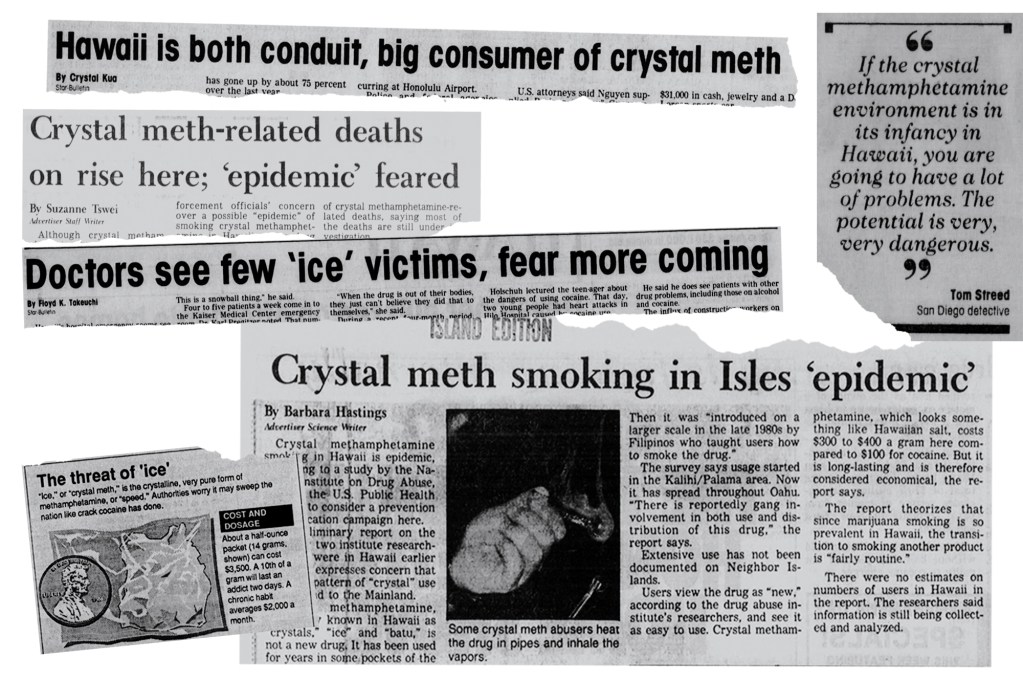
In the 1980s, Hawaiʻi was the first place in the U.S. to see widespread use of the smokable form of methamphetamine — ice. This was largely the result of the state’s cultural ties to the countries where ice was then being manufactured: Japan, South Korea, Taiwan, the Philippines and others. Experts feared the epidemic would spread to the mainland. And though the furor eventually died down, meth use did cross the Pacific, while also becoming part of the fabric of life in Hawaiʻi.
Hawaiʻi’s Drug Mix Is Unique
Hawaiʻi stands out among the states as the one place where methamphetamine deaths have far outpaced opioid overdoses for many years. That’s resulted in a mismatch between the priorities of the federal government, fixated on the opioid epidemic, and the reality on the ground in Hawaiʻi. In response to federal grants and a settlement with opioid manufacturers, Hawaiʻi has created a host of new initiatives targeting that drug. There is no comparable effort focused on meth.
Rehabs Filled With Meth Users
Another reflection of Hawaiʻi’s uniqueness is the number of people seeking treatment who list meth as their primary substance. As many as 6 in 10 whose treatment is paid for with public funds list meth as their drug of choice, a stark contrast to the U.S. as whole. This poses difficult challenges for Hawaiʻi rehabs because, unlike for opioids, there are no generally accepted medicines to treat meth use. Some drugs have shown promise, and experts say the most effective treatment so far is something called “contingency management,” which rewards users for negative drug tests with gift cards or other small cash inducements. Hawaiʻi is in the process of launching two contingency management initiatives, something Civil Beat will write about later this year as part of this ongoing series.
Those Left Behind

Hawai’i CARES 988 offers free, 24/7 support services for help with crisis, mental health and substance use, including meth. For Hawaii CARES SUD (substance use disorder), here are the numbers that anyone can call: (808) 832-3100 or toll free (800) 753-6879.
Those who die from meth toxicity leave behind loved ones who may struggle financially because of the lost income. Some survivors set up GoFundMe pages to raise money to bury them, or to pay for college for a child or assisted living for a spouse.
But the primary toll is emotional.
Rhonda Valera works most of the time these days, both to make up for lost income from her partner John Nobriga —who died from meth use in 2025 — and to avoid thinking about what happened.
“It’s very lonely,” Valera said.
Can’t see the form below? Answer here.

