Rural Maui Residents Still Isolated After Lala Washed Away Bridge
Emergency crews are flying in supplies to Nāhiku but a decades-long debate over who owns the bridge is complicating a long-term solution for this small community along the Road to Hāna.
Six Lower Nāhiku residents remain stranded more than a week after raging waters brought on by Hurricane Lala destroyed the only bridge connecting their remote East Maui community to the rest of the island, according to county officials.
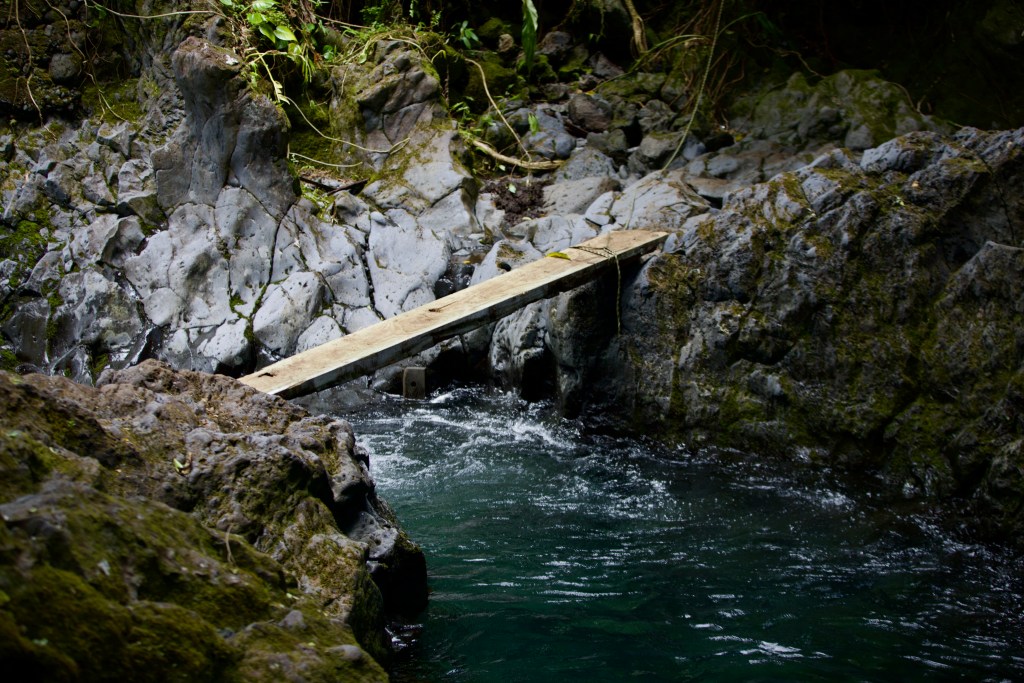
Now, the only way to access the neighborhood is by descending a muddy, densely vegetated hillside and maneuvering over a series of jagged rocks before walking along a plank of wood to the makai side of the Makapipi Stream.
The collapsed bridge is in a secluded community rarely seen by visitors, but it is one of dozens of East Maui bridges that have been identified in recent years as being in need of repairs, including many that have been labeled structurally deficient, according to the most recent publicly available federal safety inspections. Many are state-managed bridges on or along the iconic Hana Highway — also known as the Road to Hāna — which is driven by thousands of vehicles every day.
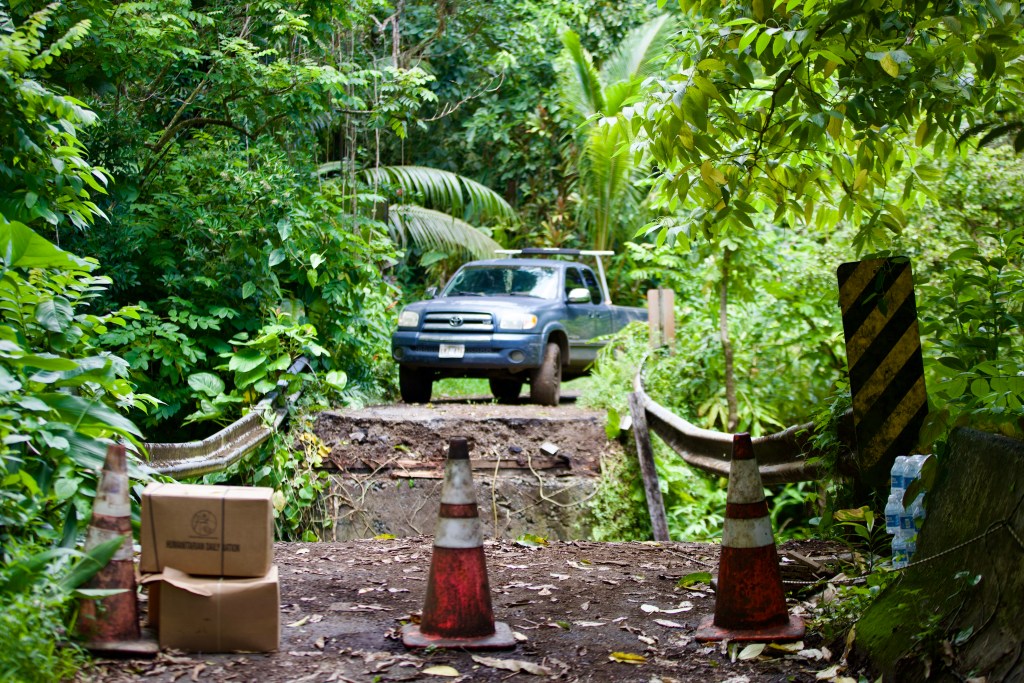
“It affects everyone,” said Lower Nāhiku resident Moke Bergau, explaining that the bridge’s collapse has also had consequences for residents on the mauka side of the bridge. “There is no other shoreline access point.” People in the community have long used the bridge to get to the beach, he added, including local fishermen who rely on their catch to feed their families.
Maui County officials have been in direct contact with the stranded residents, and they are committed to ensuring that they have access to essential resources, according to a statement provided by county spokeswoman Laksmi Abraham. After conducting an official site visit shortly after the storm, Maui Emergency Management Agency officials used the Maui Police Department’s helicopter to return to the affected Nāhiku neighborhood Thursday. They delivered a generator, fuel cans and approximately 40 gallons of fuel, according to Abraham.
Long-term efforts to reconnect the neighborhood with the rest of the island, however, are complicated by a decades-long debate over who owns the bridge and is responsible for maintaining it. County and state officials have said it is not government-owned and that liability has precluded the county or state in the past from being able to step in and work on it. Property records show the land around the bridge has long been owned by East Maui Landholdings, a subsidiary of Alexander & Baldwin. That’s not to be confused with East Maui Irrigation, which was also owned by A&B until the commercial real estate giant sold it to the farming company Mahi Pono last year.
“There has always been a question about who owns it,” said Bergau, who represents Nāhiku on the Aha Wai O Maui Hikina, the East Maui community board that is working to acquire public water rights in the region. “That bridge has gone through so many wars and controversies.”
Residents were raising safety concerns related to the Lower Nāhiku bridge for years before it was washed away during the storm. Jeffrey Paisner, who has owned property on the far side of the bridge for more than 50 years, has publicly called on the county to take responsibility for the bridge multiple times, including during an April 2016 Maui County Council meeting.
“The bridge is rotting now. It’s a very dangerous situation which is going to expose both the county and the state of Hawai’i to great liability,” Paisner said at the time. “I appeal to you to come up with the funds to at least temporarily repair the bridge until you come to a proper solution.”
Russell Stoner, who is from Lower Nāhiku and currently lives on Paisner’s property makai of the stream, said that when the government declined to take action, residents ultimately banded together about 10 years ago and raised the funds necessary to repair and reinforce the bridge themselves.
“It got to the point where it was just falling into the river,” Stoner said. “There were families walking across it — kūpuna, little kids — and it was getting to the point where someone was just going to get hurt and we were going to lose access to that side.”
In 2008, state lawmakers introduced legislation that said the condition of the bridge was so concerning that it put residents and first responders at risk. The resolutions would have requested that the Hawai’i Attorney General investigate who owned the bridge and surrounding road and requested that the state Department of Transportation estimate the cost of safety improvements. However, the legislation died in committee. Tiffany Chang, special assistant to the Attorney General, said in a statement that because so much time had passed, the agency was unable to respond by Monday afternoon to questions about whether an investigation occurred or its findings.
The Lower Nāhiku bridge was constructed on private property and does not carry a public road, according to Abraham. Given the loss of roadway access, county officials are working to determine what options may be available to address the situation while continuing to meet the immediate needs of the residents living on the makai side of the damaged bridge, she said.
Some residents have been able to cross the wooden plank that has been serving as a temporary footbridge, but not all have been able to do so safely, Abraham added. Stoner said he placed the board there, chiseling small grooves into the rocks for added stability, so that he and others could get to work and bring supplies across the stream.
In 2020, county officials informed East Maui Landholdings and A&B representatives that they had violated local laws by building the Lower Nāhiku Bridge without a special management area permit. A&B did not respond to messages seeking comment Monday. On Tuesday, a spokesperson for the company said in an emailed statement that A&B does not own the bridge.
Bergau said past efforts to work with the sugar company on a solution went nowhere.
Dawn Hirai, a spokeswoman for Mahi Pono, said in a statement Monday that Mahi Pono does not own the bridge or the land on either side of it.
The King’s Highway
Just minutes before the Lower Nāhiku bridge collapsed, Stoner had been prepared to drive over the bridge until a friend stopped him. He noticed the area where a large tree had gone down and taken out a critical weight-bearing column, he said. Stoner stood at the edge of the gulch and watched the torrents of dark brown water raging down below. He captured a video that shows the handrails shaking violently as heavy rain pelted the old wooden and concrete bridge, and support beams — almost completely detached — flailing around helplessly in the deluge.
“That is the biggest I’ve ever seen the river,” he said.
Stoner and his friend were walking away when the bridge suddenly cracked down the middle and sent the two halves careening upward, he said.
“It actually catapulted me like 5 or 6 feet in the air,” he recalled. “If I was like a step further back, it would have shot me into the river. Instead, I was right on the end, and it just kind of threw me in the air and I landed, and I was fine. But it was real close. It could have been really bad.”
On Saturday morning — exactly one week later — the stream had returned to it’s more typical icy blue color, and it had slowed down enough for some residents to go for a morning swim.
About a dozen cases of plastic water bottles and three cardboard boxes labeled “United States of America Humanitarian Daily Ration” sat on the ground in front of the space where the bridge previously allowed vehicles to cross the stream. While there was no bridge, a pair of sagging guardrails stretched across the expanse over the gulch.
A bridge was built in Lower Nāhiku over Makapipi Stream around 100 years ago, along the storied footpath known as the King’s Highway, according to Bergau and other local residents.
When Bergau was growing up, the area was even less developed and fewer people lived makai of the stream, he said. Residents also largely understood that no one person or entity owned the bridge, he added. “It was always understood that everyone is responsible for that bridge,” he said.
The issue of ownership began to crop up more around the 1990s, after more people moved to Lower Nāhiku and built homes makai of the bridge, he said. Those new residents included Beatles singer George Harrison, who bought 63 acres in Nāhiku in the 1980s. The guitarist owned property there until his death in the early 2000s.
Stoner and Paisner both noted that in previous decades, the county had made repairs to and replaced the bridge. They said they hoped local officials would agree to help rebuild a stronger bridge so that residents who are trapped on the other side, including some who are older and have been unable to drive to doctors appointments, would be able to come and go from their properties.
“If this was in Wailea or something, there would be no problem. Even if it was the exact same conditions and the same gray areas, they would figure out a way,” Stoner said. “It’s because we’re in such a rural area.”
Bergau said building a bridge that can carry cars is likely out of the question due to the cost, permitting and environmental impact, but some people in the community would be happy to see a footbridge that can be driven over by ATVs.
John Blumer Buell, who has lived in East Maui for more than 50 years, said he first remembered questions about the safety and ownership of the bridge coming up around 2005, when the historic Lower Nāhiku Grammar School burned down and Hawaiʻi legislators proposed setting aside the long state-managed property for the county to build a community center directly in front of the bridge.
Those plans stalled after the county filed a lawsuit against the contractor, and community members voiced concerns about the project’s environmental impact and potential to bring more tourists into the area. Buell said many Lower Nāhiku residents liked that their community rarely saw tourists, and they did not want to see more people crossing the bridge to access the beach at Nāhiku Landing.
Lower Nāhiku is a sparsely populated community that includes several multi-generational Native Hawaiian families. On the makai side of the bridge, residents grow taro, fish and spend time at Nāhiku Landing, a culturally significant spot that once served as a port, according to Buell and others.
“People were going across the bridge down to Nāhiku Landing, which is where the community hung out and people fished and did just local stuff,” he said, referring to the early and mid-2000s. “They were being bombarded with the tourists.”
There was still a faded “No tourists” sign on the street in front of the bridge on Saturday.
MEMA officials, led by East Maui liaison and Hāna native Akaneki Lind, will continue to maintain direct contact with the residents while a solution is sought, Abraham said. They are coordinating with county, state and federal partners to monitor conditions and provide additional support as needs arise, she said in the statement.
Correction: This story was updated on Aug. 28, 2026, to reflect that legislation related to an Attorney General’s investigation failed to pass.