This Form Of Japanese Buddhism In Hawaiʻi Could Disappear
Hongwanji temples were valued by early immigrants from Japan. But as congregations age, some say ties to Japan must be watered down for the sect to have a future in the islands.
Pieper Toyama grew up on a sugar plantation on the Big Island in a family and faith shaped by Japanese immigration and rooted in the values of warmth, welcome and fellowship. Today he preaches those values as co-president of Jikoen Hongwanji, a Japanese Shin Buddhist temple on Oʻahu.
Over the years though, Toyama, 79, and his wife Lois, who serves alongside him, have watched the temple empty. The elders and old friends who once filled it, many of them Japanese immigrants or their children, have died. The temple is now facing an existential question.
“How can we share it with non-Japanese now that they are gone?” Toyama said of the religion. “Nobody likes to talk about that, even though it’s the elephant in the room.”
“Our original close ties with Japanese culture,” he continued, “is making it very difficult for us to look outward.”
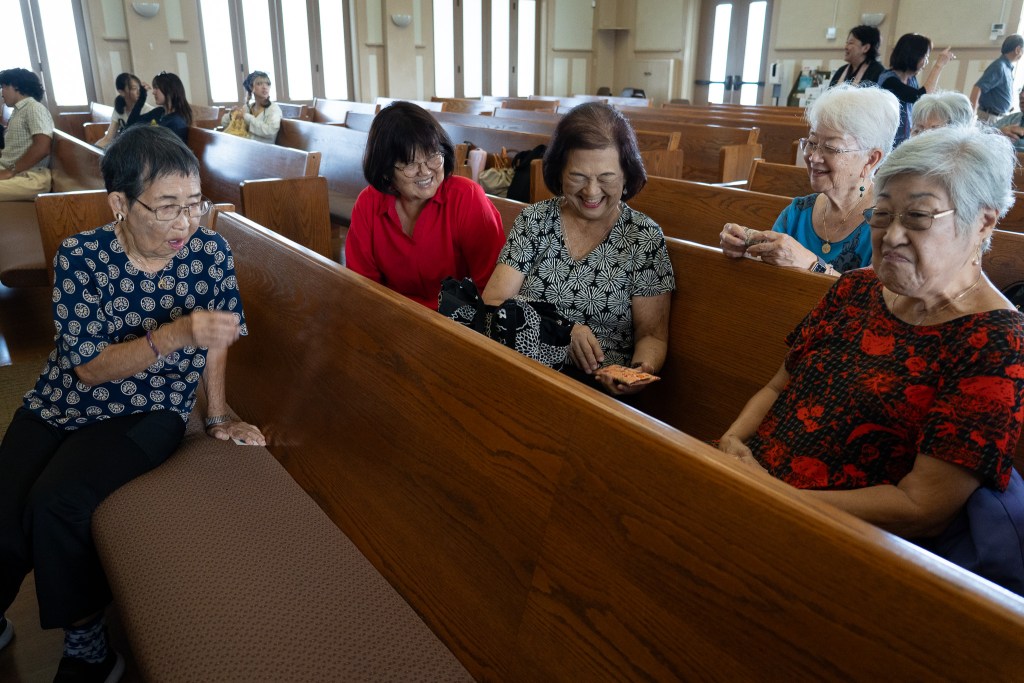
With an aging congregation, dwindling attendance, and thinning membership dues, some former centers of Hawaiʻi’s Japanese Buddhist communities are closing or consolidating as its members pass away. While the religious denomination historically bonded Hawaiʻi-based immigrants and their families to their homeland, some say ties to Japan must be watered down for there to be a future for Buddhism in the islands.
As it’s trending now, the decline in Hawaiʻi Hongwanji’s membership could mean the mission “disappears” by 2036, according to the Frederick P. Lenz Foundation for American Buddhism, a nonprofit organization with the mission of developing an “American Buddhism.”
“It’s not only the closing of the temple but to not have that Buddhist presence in those communities anymore,” said David Fujimoto, reverend at Mōʻiliʻili and ʻEwa Hongwanji, “It’s very unfortunate.”
There are efforts by the individual temples and young people to chart a path forward, but not enough are interested in maintaining the sangha, or congregation.
The lack of attendance has resulted in a gradual shrinking of properties. Last year, the Waiʻanae branch of Hongwanji closed its doors. The property is currently on the market for $2.9 million with no telling who the next buyer will be or what the property might become.
The Waialua branch will hold its last service in November, and according to several sources, the ʻEwa Beach location may not be far behind.
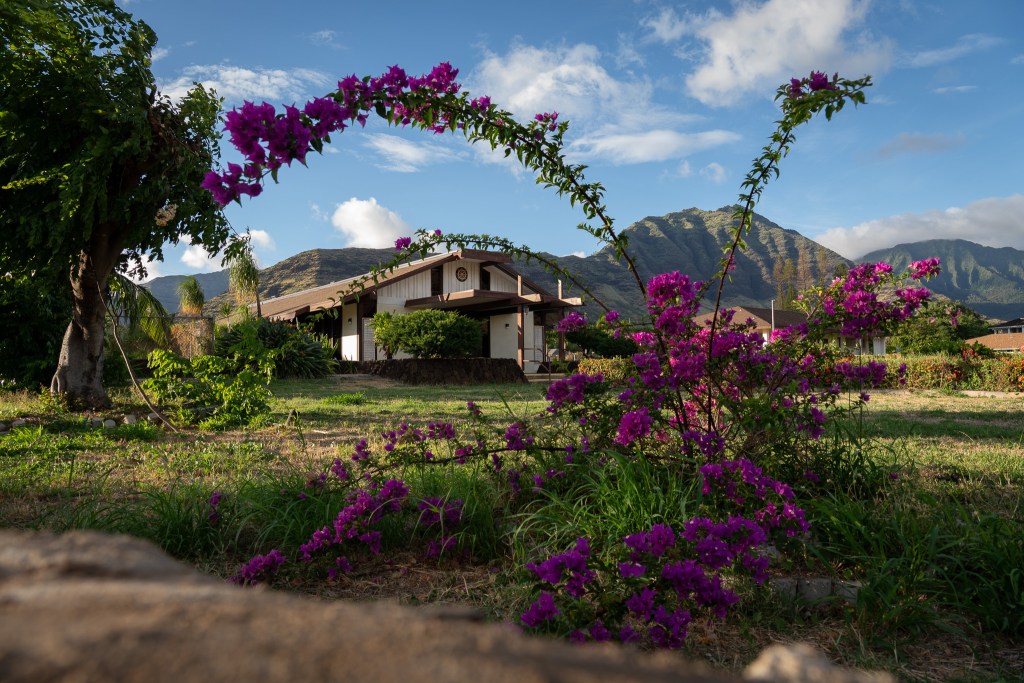
The downsizing has been happening for years.
In 2022 on Kauaʻi, the Hanapēpē and Waimea temples merged to become one, and on the Big Island, the Pāpaʻaloa and Honohina Hongwanji temples did the same. Before that, on Oʻahu, the Hongwanji temple in Kahuku shut down in 2013 and has since found a second life as a dance and tumbling studio.
Making the decision to close means that “they have been struggling for a really long time,” Emi Hashi, the children and youth activities specialist at Hongwanji, said. “It was actually more of a burden to those members to keep it open.”
In the 1970s, there were 10,000 members. Four years ago, there were 4,300. Today, 3,300 are left.
‘Buddhism Is Dying’
Roughly 5% of Hawaiʻi’s population identifies as Buddhist, according to a study by the Pew Research Center, down from 8% in 2014. It is still one of the highest concentrations of Buddhists in the nation.
There are many sects of Japanese Buddhism in Hawaiʻi, and even more that trace back to other Asian countries and traditions. Shin Buddhism, the largest sect across the Hawaiian Islands, is largely represented by the Honpa Hongwanji Mission of Hawaiʻi.
Brought over by Japanese plantation workers in the late 19th century, the Honpa Hongwanji Mission of Hawaiʻi grew rapidly as the Nishi Hongwanji temple in Kyoto began sending official ministers to serve Japanese immigrant communities.
Hawaiʻi is home to one of four major Honpa Hongwanji missions worldwide, alongside branches across the mainland, South America, and Canada. Beyond religious services, the mission has long served as a cultural and educational anchor for Hawaiʻi’s Japanese American community, while also absorbing the island’s particular mixture of cultures along the way, producing a version of Buddhism that is, in many ways, unique from Japan.
For instance, in the 1930s, Ernest and Dorothy Hunt, an English Buddhist Reverend and his wife who was an educator, created Buddhist hymns in English, with the heavy influence of Christianity. The songs are still sung in Hawaiʻi pews today. In Japan, hymns, or gathas, are not typically sung.
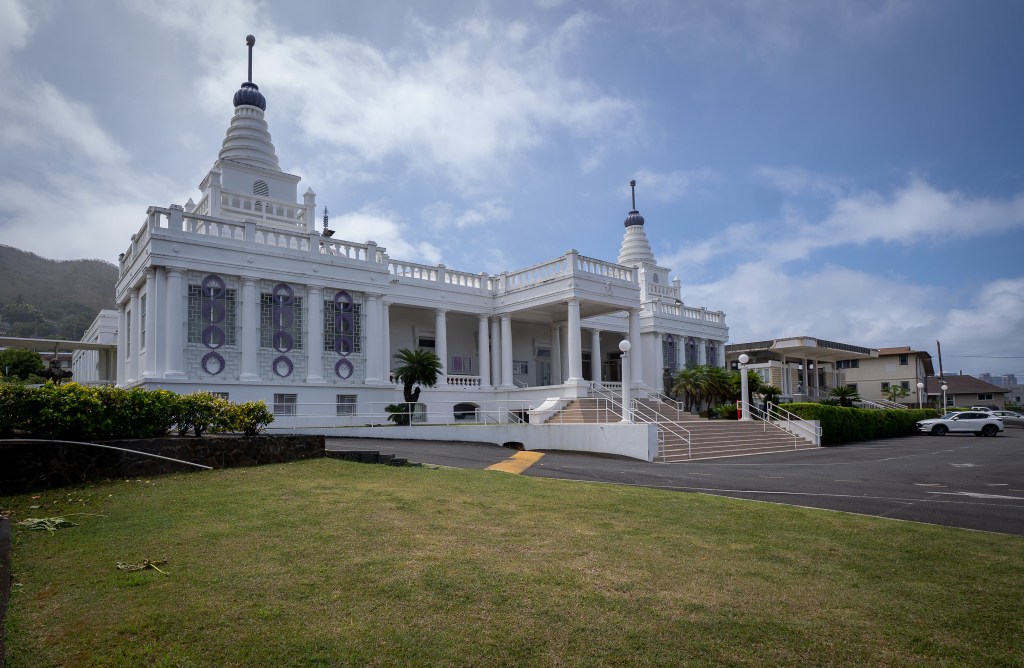
The headquarters located off the Pali Highway stands out. It has a bright white exterior with Indian stupas on top, classical Western columns holding up the structure and pews inside that are reminiscent of a Christian church. Only the altar is designed like that of a temple in Japan.
Construction of the temple took place during World War I, and the blend of cultural elements was meant to underscore that Japanese immigrants were loyal Americans.
The architecture was also meant to be “international,” as a reminder that Buddhism is not originally a Japanese religion, said George Tanabe, Professor Emeritus of Religion at the University of Hawaiʻi Mānoa and President of BDK Hawaiʻi, a non-sectarian Buddhist organization.
Bishop Yemyo Imamura, the mission’s second leader starting in 1900, understood that “you cannot practice Buddhism in Hawaiʻi like you do in Japan,” Tanabe said. “You cannot expect that people are going to take to a very traditional Japanese form of religion, when they’re not Japanese, culturally.”
Even so, Tanabe, who is sansei, or third-generation Japanese, and grew up going to the Waialua Hongwanji temple that is closing in November later this year, said that some members are still struggling to let go of Japan ties.
“Buddhism is dying because they’re still presenting and practicing Buddhism in ways that my first-generation grandfather did.”
Nostalgic For Japan
In a way, what is happening at the Hongwanji temples around Hawaiʻi is a very American story of immigrants adapting to the culture of their new country, while also trying to remain tied to their ancestral homelands.
“When I was younger, the ministers spoke nothing but Japanese,” said Fujimoto, the Mōʻiliʻili Reverend who was born and raised on Oʻahu.
Now, as a minister, he said, “if there are Japanese concepts, I try my best to translate them.”
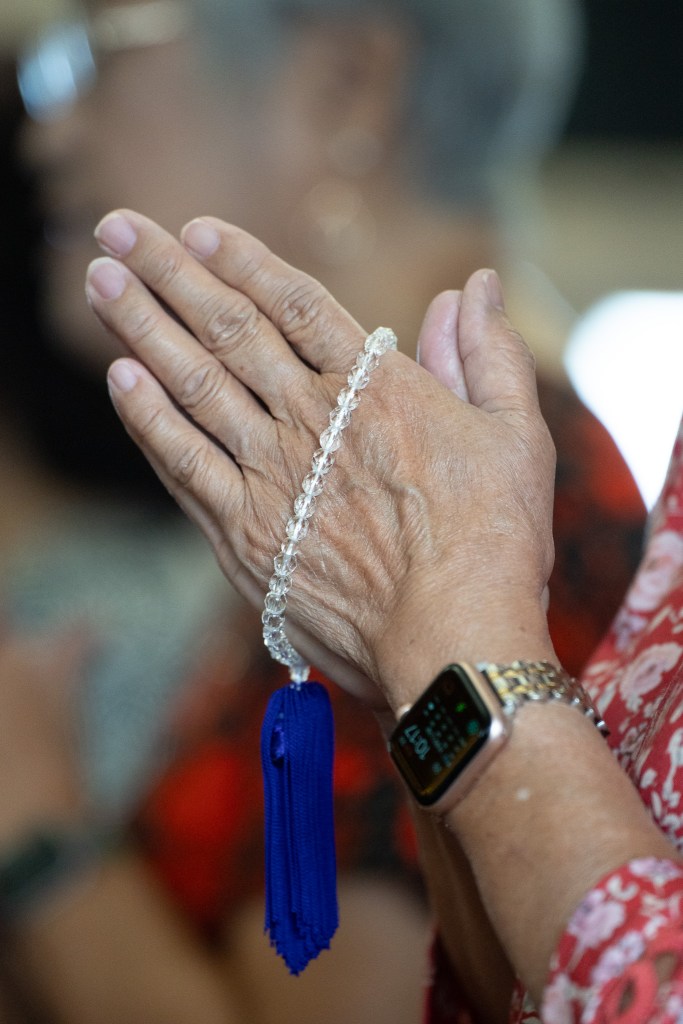
Hongwanji’s mother temple is headquartered in Kyoto, where even Hawaiʻi-born and raised ministers must go for the first level of ordination, tokudo.
Traditionally, all ministers at Hongwanji temples were sent to Hawaiʻi from Japan, but in recent years, there have been more homegrown Japanese American ministers. But there is still a shortage overall. Currently, there are 20 active ministers for the 30 temples statewide, meaning some go between temples for services.
Tanabe, the UH scholar, said that some of the Hawaiʻi-based ministers from Japan “can barely speak English,” which can be challenging for an American congregation.
“It’s hard to get people to accept something they don’t understand,” he said.
Although individual temples have moved to having services in English, there is a debate around which language to use.
“Sansei (the third generation), we basically just speak English so you think we would be pushing for Americanization,” Tanabe said. But “we became very nostalgic for Japanese culture, and we all want to be Japanese.”
The Japanese chants are done by reading Chinese characters pronounced in Japanese, rendering Sanskrit texts that the average Japanese speaker does not understand.
Maslyn Kaneshiro Takeuchi, a senior at Punahou School and the President of Hawaiʻi’s Junior Young Buddhist Association, said that she gave up on learning Japanese, but still enjoys the traditional chants.
“You can use Jinglish for us,” she said, referring to the mixing of Japanese and English language, “but a lot of us really struggle with Japanese.”
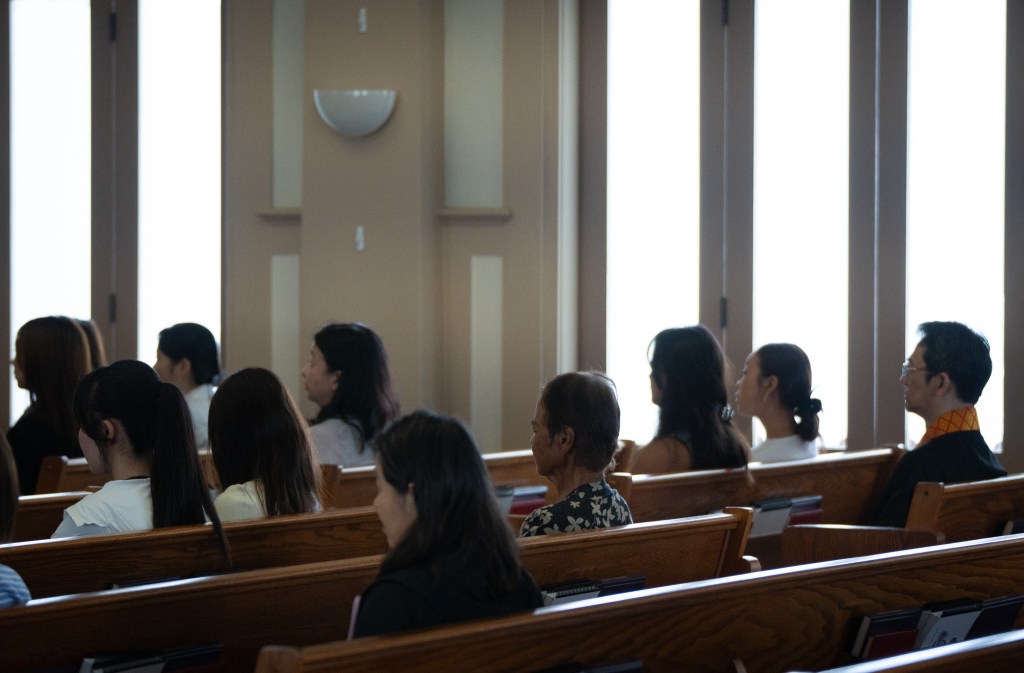
Toyama, co-president of Jikoen Hongwanji, a branch with deep ties to the Okinawan community in Kalihi, said that talking to people in a way that resonates with them, in a language they understand, is essential.
“The spread of any religion is the ability to talk to a group who doesn’t know anything about it in a way that they’re comfortable with,” he said, adding that there should also be more ethnic diversity in their ministerial staff.
In his home attached to the Waipahu temple, Jeffrey Soga, the longest-serving Hongwanji Minister in Hawaiʻi, originally from Kyoto, said that before its closing last year, the Waiʻanae temple was also no longer a Japanese hub.
Native Hawaiians and Filipinos were among the dwindling congregants, he said.
The Future of the Temple
Some in the sangha argue that survival depends on making the temples more welcoming to people who have no Japanese ancestry or familial connections to the temples at all.
“You can’t just rely on the same old families being recycled,” said Emi Hashi, the children and youth activities specialist at Hongwanji.
Mitch Hannon has been attending the Mililani Hongwanji for roughly a year and a half. As a 31-year-old, 6-foot-1 caucasian man, he towers over the rest of his Sunday choir as they practice singing Buddhist hymns in English.
Hannon grew up Catholic but dabbled in Buddhism while in college on the mainland and started attending service in Mililani after moving to Hawaiʻi with the Navy. He considered going to the Thai Buddhist temple, a different branch of Buddhism altogether in Pearl City, but settled at Mililani because it was closer to his home. He stayed for the community.
The teachings “weren’t very dense” like he had experienced previously, and Hongwanji attracted him because, he said, it felt “closer to the church experience that I had when I was younger.”
There is also an effort by individual temples to further widen who feels welcome inside them.
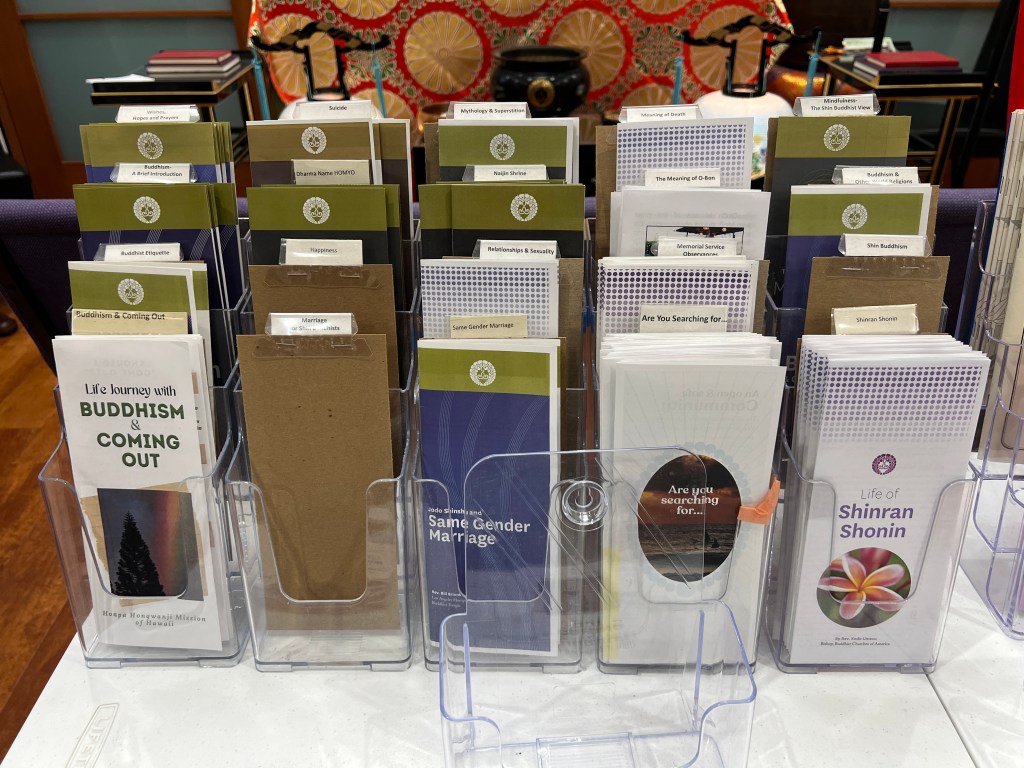
Debbie Kubota, the education chair at Hongwanji, heard about some youth members struggling with their sexual and gender identities. She spearheaded the creation of pamphlets on coming out and had them displayed prominently at a few Hongwanji temples and bon dances around Oʻahu.
She also organized a panel discussion where parents of queer children could speak to temple members, including the Toyamas.
“That definitely helped us open up to the public because I know some religions have conservative views,” said Chihiro Okawa, who also goes by Chad and identifies as a part of the LGBTQ+ community. Growing up in the ʻAiea temple, Okawa believes these initiatives can help attract more people.
“We say here, ‘Buddha accepts you as you are,’” Okawa said. “And I think that’s an important message for people to understand.”
Ty Wakahiro, a senior at California State Polytechnic University-Pomona, was born in San Francisco but moved to Oʻahu in 2016 with his parents who are from Hawaiʻi.
As a yonsei and gosei, or fourth- and fifth-generation Japanese American, the 21-year-old understands the need for some change.
“It’s important to say ‘Yes, we are Japanese, we are proud of that,’” he said, “but we also have to adapt so these temples continue.”
Wakahiro helps with the Mililani Hongwanji website, where they “use pidgin as much as possible,” he said. They emphasize “talk story” time and write that during bon dances, “rubber slippers OK.”
“What is unique about Hongwanji today is that classic aloha spirit and plantation-style community and values,” Wakahiro said.
At the Windward temple in Kailua one July evening, the bon dance was in full swing.
Traditional songs like Soranbushi, a fisherman’s work song and folk dance from Hokkaido, played alongside contemporary pop hits like “Soda Pop” from K-Pop Demon Hunters and “Shivers” an Ed Sheeran song – with the lyrics all in Japanese. Dance moves included making heart signs with fingers and the electric slide.
Obon season, observed every August, is traditionally a time to honor ancestors who have died, a period of remembrance rooted in Japanese Buddhist practice. In Japan, bon dance is seen as a secular community celebration.
Yet the bon dances that fill temple grounds across Hawaiʻi each summer weekend are a separate tradition altogether. In Hawaiʻi, religious observance and communal dance have become closely intertwined. And that is okay.
“No one wants to admit it, but the fear is that when you begin to adapt, you’re going to change the doctrine,” said Pieper Toyama, the Kailihi temple co-president.
“But I know deep in my heart that’s not true,” he said, adding, “you can evolve in a way that resonates with local people.”